Clean Beauty Face Oil: A Complete Guide to Choosing One
You're standing in front of the mirror, pressing a few drops of golden oil into damp skin and waiting for the promised glow to appear. The bottle says clean, but the word leaves you with a practical question: does it describe the formula, the farming, the packaging, or just the mood the brand wants to create?
A trustworthy clean beauty face oil should make that question easier, not harder. You should be able to understand what's inside, where the ingredients came from, how the oil was extracted, and which skin concern the formula is meant to address. The oil itself is only one part of the decision. Transparency and sourcing come first, then skincare performance.
What a Clean Beauty Face Oil Actually Means
“Clean beauty” doesn't have one universal legal definition. A brand can use the word to describe plant-based ingredients, a short ingredient list, recyclable packaging, or a broader philosophy about what it chooses to exclude. That flexibility can help thoughtful brands communicate their standards, but it also gives vague marketing plenty of room to sound more precise than it is.
A green bottle, earthy label, or botanical name doesn't prove much on its own. A face oil can look natural while containing undisclosed fragrance blends, inexpensive fillers, or highly processed carriers. The useful question isn't whether the product feels wholesome. It's whether the brand can show its work.
A practical definition
For this guide, a clean beauty face oil is a minimally processed plant oil whose sourcing, extraction, and ingredient list can be verified end to end. That definition rests on three checks:
- Traceability: The brand identifies the oil, its plant source, and meaningful details about where or how it was produced.
- A restrained formula: The ingredient list is short and readable, without filler oils, synthetic fragrance, or petrochemical diluents.
- Gentle processing: Cold-pressing or a comparable low-intervention method keeps the oil closer to its original plant composition.
That doesn't mean every refined ingredient is automatically unsafe, or that every natural ingredient suits every face. “Natural” and “clean” aren't synonyms for gentle. Essential oils, for example, may be plant-derived while still irritating reactive skin.
Ingredient disclosure has shaped these expectations for decades. In the United States, cosmetic ingredient labeling became a formal regulatory issue in the early 1970s, with guidelines published in mid-1972, proposed regulations in early 1973, and requirements becoming fully effective in early 1977 after final regulations and court proceedings. Canada's Cosmetic Ingredient Hotlist added another important framework by maintaining a regularly updated list of cosmetic substances that are restricted or prohibited.
So when you evaluate a bottle, look past the word clean. Read the INCI list, check the extraction language, and investigate the brand's sourcing page. Ella & Eden's guide to clean beauty stores can also help you think about retailer standards rather than relying on shelf appearance.
The Science Behind Why Single-Ingredient Oils Work
A single-ingredient oil is easier to understand because its texture, benefits, and potential drawbacks come from one principal material. That simplicity doesn't guarantee a perfect product, but it makes the formula more accountable. If your skin reacts, you have fewer ingredients to investigate. If the oil feels comfortable, you can identify the ingredient responsible.
The skin barrier contains lipids that help hold cells together and limit water loss. Plant oils don't rebuild every component of that barrier, but they can soften the surface and form a semi-occlusive film that slows water escaping from the outer skin. In vivo research on oil penetration found that vegetable oils generally remain in the upper layers of the stratum corneum while still reducing transepidermal water loss, or TEWL, the measure most directly associated with water escaping through the barrier.
Why extraction changes the result
“Cold-pressed” describes a mechanical extraction method designed to limit heat exposure. Expeller-pressed oil is also mechanically extracted, but the friction created by the press can generate more heat. Solvent extraction uses chemical solvents to pull oil from plant material, followed by processing to remove those solvents.
For a clean beauty routine, the important distinction isn't that one method makes an oil magically pure. It's that heat, oxygen, refining, and processing can affect fragile compounds such as vitamin E, carotenoids, and polyphenols. Unrefined oils may retain more of the plant's native color, aroma, and minor compounds, while refined oils are often more neutral and stable. Neither choice should be judged without considering the specific skin concern and the brand's testing.
A blend can still be well formulated. The issue is transparency. A product may combine a valuable oil with cheaper carriers, fragrance, and stabilizers, making it harder to know what your skin is receiving.
| Method | Heat Exposure | Nutrient Retention | Clean Beauty Fit |
|---|---|---|---|
| Cold-pressed | Limited heat from mechanical pressing | Often preserves more native plant compounds | Strong fit when sourcing and testing are disclosed |
| Expeller-pressed | Mechanical friction may create more heat | Depends on temperature control and handling | Suitable when the process is explained |
| Solvent extraction | Uses chemical solvents and later removal steps | Depends on subsequent refining | Requires closer review of processing details |
Formulator's rule: A short ingredient list is valuable because it makes a product easier to assess, not because fewer ingredients automatically make every formula better.
People who want a minimalist routine during pregnancy may also appreciate a separate guide to safe skincare ingredients during pregnancy. Pregnancy decisions should still be discussed with a qualified healthcare professional, particularly when a product contains essential oils, active treatments, or a complex blend.
Ingredients to Seek and Ingredients to Avoid
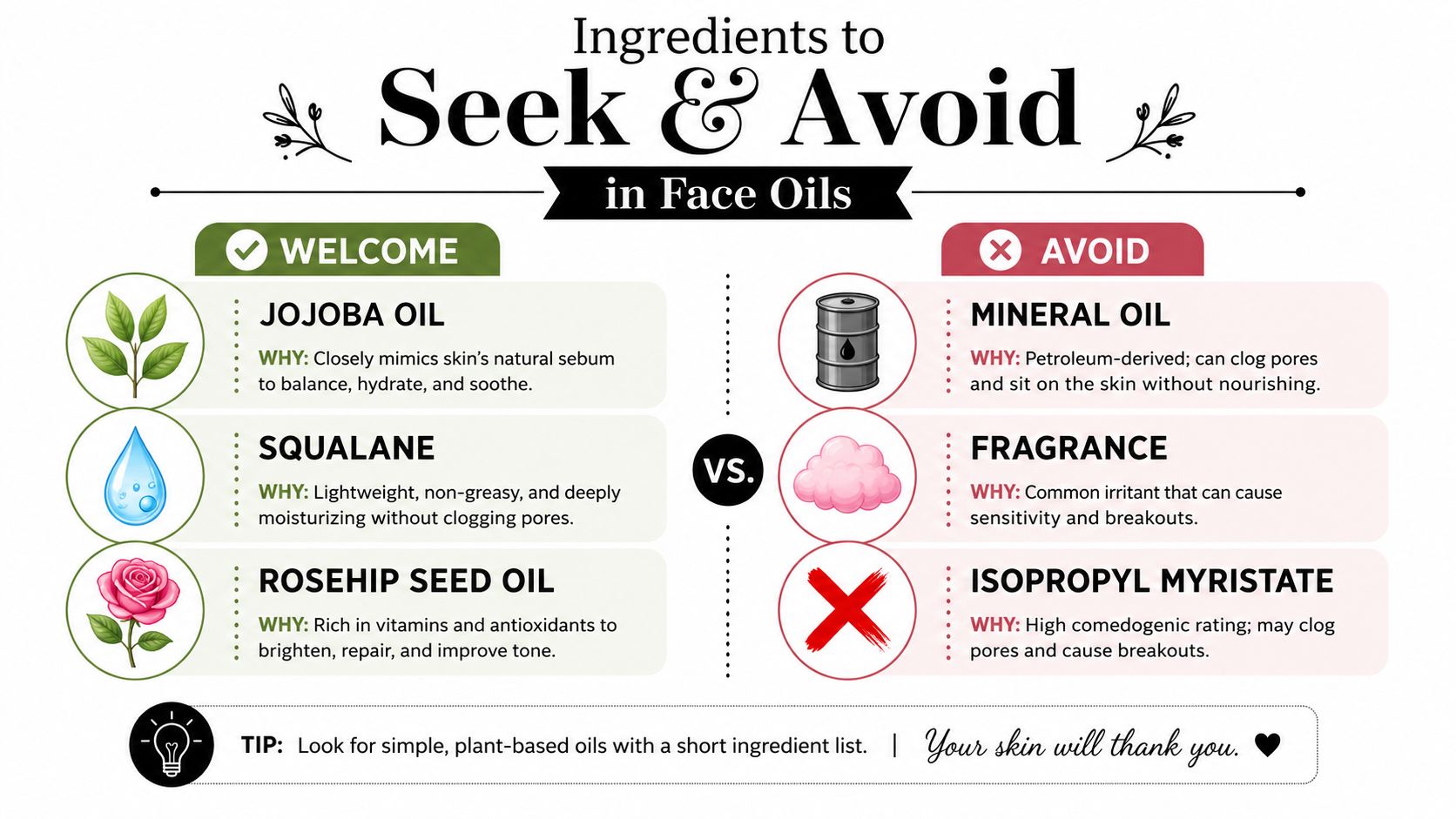
Read the ingredient list before you read the front label. A face oil's first ingredient is usually the main carrier, and the order gives you a useful sense of what the formula prioritizes. A short list can support transparency, but it doesn't replace checking the identity, quality, and intended use of each ingredient.
Ingredients to welcome
- Jojoba oil: Technically a wax ester rather than a conventional triglyceride oil, jojoba resembles some properties of human sebum. It's a practical choice for people who want lightweight conditioning and a less greasy finish.
- Rosehip seed oil: Its profile makes it appealing for dull-looking, uneven skin and routines focused on visible renewal. It isn't retinol, and it shouldn't be described as a retinol replacement.
- Plant-derived squalane: Squalane offers a smooth, lightweight layer of barrier support. It can suit people who dislike the richer feel of many unrefined botanical oils.
- Marula and baobab oils: These richer oils provide fatty-acid nourishment for skin that feels tight, rough, or persistently dry.
- Sea buckthorn oil: Its vivid color and concentrated botanical profile make it interesting for skin that feels stressed, though a formula may need careful dilution to remain comfortable and wearable.
- Prickly pear seed oil: Often selected for its antioxidant-focused positioning and elegant feel, particularly in routines aimed at maintaining a healthy-looking glow.
The right ingredient depends on the problem you're trying to solve. Jojoba makes more sense for shine management than a dense oil chosen only because it sounds luxurious. A richer oil may comfort dry cheeks but feel excessive across an oily forehead.
Ingredients to question
- Synthetic fragrance or parfum: These terms can represent numerous aromatic materials, and fragrance is a common reason a facial product feels irritating rather than soothing.
- Essential oils added for scent: Botanical origin doesn't remove irritation or sensitization concerns. If an essential oil has no clear skin function for your routine, its presence deserves scrutiny.
- Mineral oil and dimethicone: Both can reduce water loss and improve slip, but they don't provide the same plant-derived lipid story many clean beauty shoppers are seeking. Calling them harmful would be inaccurate, so judge them against your personal formulation standards.
- PEGs and harsh surfactants: These ingredients are more common in cleansers and emulsions than pure oils, but their presence can signal a more complex formula that may not suit a minimalist routine.
- Undisclosed natural fragrance blends: “Natural” doesn't tell you which aromatic compounds are present. Ask the brand for a complete ingredient disclosure if the label stays vague.
The goal isn't to fear every synthetic material. It's to distinguish a clear formulation from a formula that hides behind attractive language.
Choosing the Right Oil for Your Skin Type
Skin type is a starting point, not a permanent identity. Weather, cleansing habits, hormonal changes, medication, and irritation can all change how an oil feels. Start with the area that needs help rather than applying a rich formula everywhere by default.
| Skin Type | Recommended Oils | Why It Works |
|---|---|---|
| Dry | Marula, baobab, argan | Richer fatty-acid profiles can soften rough texture and help retain comfort |
| Mature | Rosehip seed, marula, prickly pear seed | Supports a nourishing routine focused on softness, suppleness, and visible radiance |
| Combination | Jojoba, plant-derived squalane | Offers lightweight conditioning without making every zone feel equally coated |
| Acne-prone | Jojoba, squalane | A lighter finish may be easier to tolerate than a heavy, heavily fragranced blend |
| Oily-sensitive | Jojoba, used selectively | Its sebum-like profile and simple formula make it a logical starting point for reactive, shiny skin |
The oily-sensitive exception
Oily-sensitive skin is both sebum-rich and easily provoked. That combination creates a problem most face-oil advice skips: adding moisture can feel necessary, yet too much product, fragrance, or rubbing can increase discomfort and congestion.
Jojoba is a particularly relevant option because its wax ester structure closely resembles aspects of human sebum. In a prospective pilot study involving a clay and jojoba facial mask for mild acne and lesioned skin, participants showed a 54% mean reduction in total lesion count after six weeks. That result doesn't prove that every jojoba face oil treats acne, but it supports jojoba as an ingredient worth considering in a carefully designed, lightweight routine.
A recent review describes oily-sensitive skin as increased sebum production combined with heightened sensitivity, particularly around areas such as the forehead and jaw. That makes zone-specific use more sensible than all-over application. Try a tiny amount on dry or tight areas, and leave the most congested zones alone until you know how your skin responds.
Two or three single oils can cover different needs without creating a crowded shelf. Patch testing still matters, even when the ingredient list looks exceptionally clean. Plant oils oxidize, vary by batch, and can trigger reactions in individuals who are sensitive to particular botanicals.
For more targeted guidance, compare this guide to the best oils for acne-prone skin before choosing an oil based only on its texture.
How to Use a Clean Beauty Face Oil in Your Routine
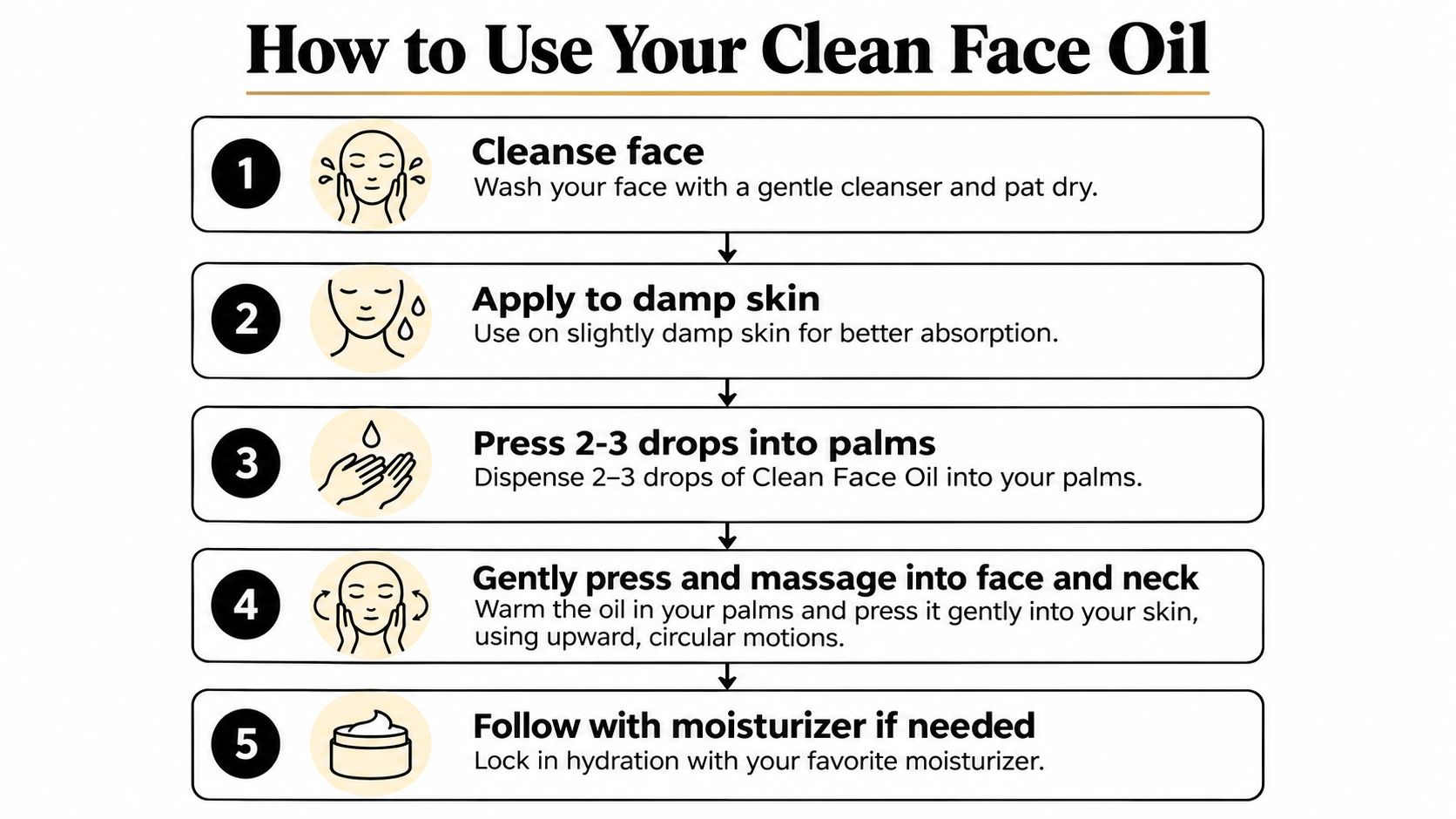
Face oil works best as a sealing and conditioning step, not as a replacement for every water-based product. Apply it after cleansing while the skin still has a little dampness. The oil won't add water to the skin, but it can help slow the escape of water already present on the surface.
Morning application
Use a water-based serum first, allow it to settle, then press a small amount of oil over the areas that need extra comfort. Finish with sunscreen. Oil can interfere with the even film formed by some sunscreens, so don't mix the two together or assume that face oil provides sun protection.
A few drops are usually enough for the entire face and neck. Warm them between your palms, then press rather than scrub. Pressing reduces unnecessary friction, especially around sensitive cheeks and the eye area.
Evening application
At night, apply the oil after water-based treatments and moisturizer, if you use one. It can sit on top of a retinoid routine as a final comfort layer, but don't use oil to dilute a treatment unless your dermatologist has advised that approach. Active ingredients still need to contact the skin according to the product's instructions.
Common mistakes
- Applying it to bone-dry skin: This can leave the oil sitting on the surface without the comfortable, conditioned finish many people want.
- Using too much: A heavy film can feel greasy and may be unpleasant for congested skin. Start with a few drops and add only if needed.
- Rubbing aggressively: Friction can aggravate reactive skin. Press and use gentle movements.
- Layering over an oil-based sunscreen: The extra oil may disturb the sunscreen's finish and coverage.
- Skipping a patch test: Test the product on a small area before committing to all-over use, especially if it contains aromatic botanicals.
Your face should feel supple, not slick. If you can feel the oil several hours later, reduce the amount or reserve it for dry zones and nighttime use.
Sourcing, Sustainability, and Quality Signals
Sustainability language becomes useful only when a brand connects it to something you can verify. “Pure,” “ethical,” “regenerative,” and “responsibly sourced” sound reassuring, but each term should lead you to a specific explanation on the bottle or brand website.
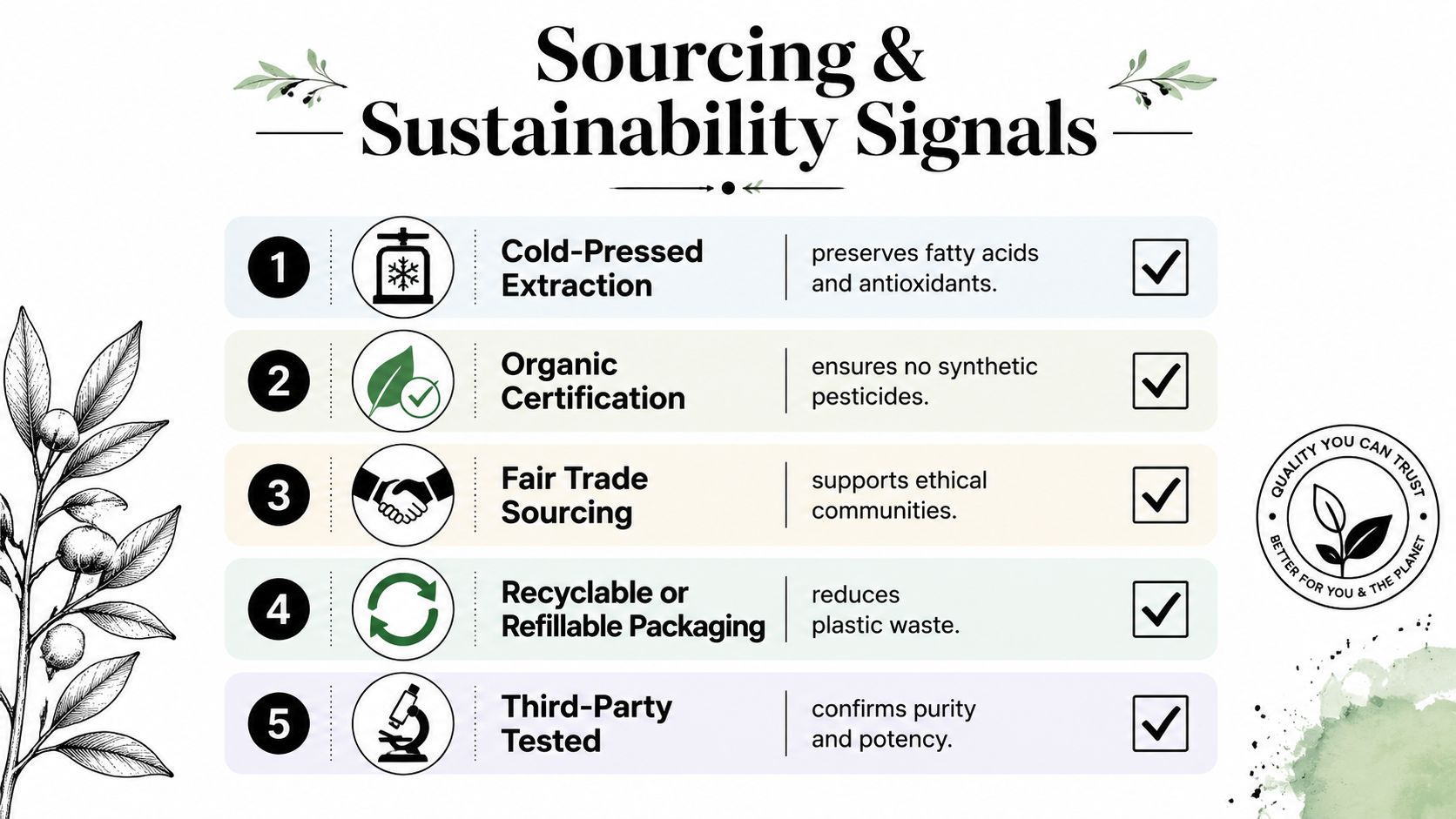
Cold-pressed extraction can be a meaningful signal because it indicates mechanical processing with limited deliberate heat. It doesn't guarantee freshness. The brand should also explain how the oil is filtered, stored, tested, and protected from oxygen and light.
Packaging and stability
Dark glass or opaque packaging matters because light can accelerate oxidation in vulnerable oils. A beautiful clear bottle may look attractive on a shelf while offering less protection than a darker container. Look for a secure cap, a clean dropper, and storage guidance that tells you to keep the product away from heat and direct sunlight.
Packaging sustainability requires the same skepticism. Refillable glass can reduce repeated packaging, while post-consumer recycled plastic can lower demand for virgin plastic. The better choice depends on the product's weight, shipping requirements, reuse system, and whether the brand supports refills.
Certifications and sourcing language
Certifications such as COSMOS, Ecocert, and USDA Organic can provide structured standards, but read what the certification covers. Fair-trade language should identify the ingredient or supply chain it applies to. “Single origin” is more informative when the brand names the region and explains the relationship with growers rather than saying “sourced globally.”
A shorter formula can also be a practical sustainability signal. Fewer ingredients may mean less processing and fewer manufacturing inputs, although shipping, farming, packaging, and testing still matter. Minimalism is useful when it reflects a transparent supply chain, not when it becomes an excuse to provide no information.
Use this quick bottle check:
- Read the complete INCI list. Confirm that the formula matches the front-label promise.
- Find the extraction method. Look for cold-pressed, expeller-pressed, or a clear explanation of refining.
- Check the container. Prefer packaging designed to limit light and air exposure.
- Look for meaningful certification details. Verify the standard rather than trusting a logo alone.
- Ask about testing. Purity, identity, oxidation, and contamination testing are more useful than broad claims of potency.
For a clearer explanation of what “cold-pressed” means in practice, consult this guide to cold-pressed oil.
Clean Beauty Face Oil Questions Answered
Can face oils clog pores or cause breakouts?
They can, depending on the oil, amount, formula, and your skin. “Non-comedogenic” isn't a universal guarantee, and a single ingredient can still feel congesting for a particular person. Oily or acne-prone skin may tolerate lightweight jojoba or plant-derived squalane better than a rich, fragranced blend. Patch test first, apply a very small amount, and use it only on dry zones if your T-zone is easily congested.
Can a face oil replace moisturizer?
Sometimes, but not for everyone. A face oil mainly supplies emollience and helps reduce water loss, while a moisturizer may also provide water, humectants, and barrier-supporting ingredients in an emulsion. If your skin feels comfortable with oil alone, that can be a reasonable minimalist routine. Apply it over damp skin, and add a moisturizer when tightness remains.
How long will results take?
You may notice a smoother feel and less surface dryness quickly, particularly when you apply the oil over damp skin. Longer-term changes depend on the ingredient, your baseline barrier condition, and consistent use. Don't judge an oil by glow alone. Track whether your skin feels comfortable, whether dry patches improve, and whether congestion or irritation appears. Stop if your skin worsens.
Are single-ingredient oils safe during pregnancy or for sensitive skin?
A simple ingredient list makes a product easier to evaluate, but it doesn't make every oil universally appropriate. Sensitive skin generally benefits from fragrance-free formulas and cautious patch testing. During pregnancy, review the full ingredient list with your healthcare professional, especially if the oil contains essential oils or sits within a broader active-treatment routine. Start with one clearly labeled product and change only one variable at a time.
Ella & Eden offers single-ingredient, cold-pressed oils such as jojoba and argan for simple skin and self-care routines, with sourcing and ingredient details suited to shoppers who want a clearer clean beauty standard. Visit Ella & Eden to compare the available oils and choose one based on your skin concern, tolerance, and preferred routine.