Argan Oil for Color Treated Hair: A Practical Guide
You've just left the salon with a rich brunette, glossy copper, or bright blonde that catches the light beautifully. After a few washes, though, the color looks flatter, the ends feel rough, and your hair seems to absorb every product except moisture. That's where argan oil for color-treated hair can help, but its role is more specific than many beauty claims suggest.
Argan oil can soften a compromised surface, improve shine, reduce friction, and support the hair fiber during chemical stress. The more difficult question is whether it preserves artificial pigment over time. The answer is encouraging but limited: some formulations have shown better color retention, while argan oil alone isn't a guaranteed barrier against washing, sunlight, heat, or oxidation.
The Color Fade Problem
Maya notices the change while standing beneath her bathroom light. Her newly colored hair looked dimensional at the salon, but after several washes, the copper seems less vivid and the ends feel slightly coarse. She hasn't done anything obviously wrong. The color is responding to the condition of the hair beneath it.
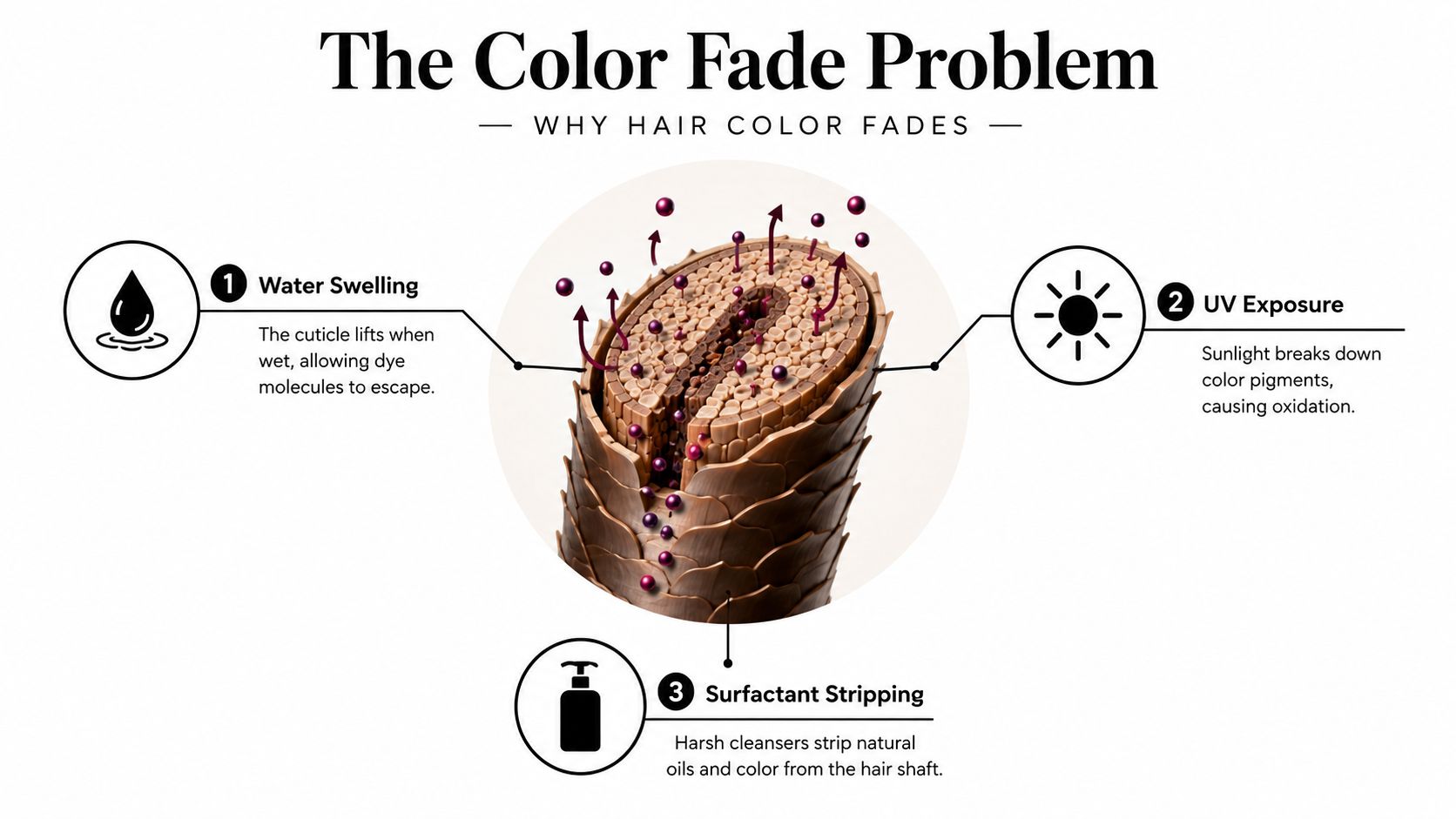
Bleaching and permanent dye can lift or disrupt the cuticle, the outer layer that helps regulate moisture and protects the inner fiber. A more porous strand loses moisture readily and has a rougher surface, so it reflects light less evenly. That can make color look dull even before a large amount of pigment has disappeared.
Several routine factors add pressure:
- Water swelling: Hair expands when wet, and the cuticle can lift, giving dye and water more opportunity to move through the strand.
- Ultraviolet exposure: Sunlight can contribute to oxidation and visual fading.
- Cleansing: Strong or frequent surfactant cleansing can remove surface lipids and encourage color leaching.
- Heat styling: Blow-dryers, flat irons, and curling tools can increase dryness and surface roughness.
- Mechanical stress: Brushing, towel rubbing, and detangling can roughen an already fragile cuticle.
Argan oil belongs in this picture as surface support, not as a universal fade stopper. It can make hair feel smoother and look glossier, which may restore some of the visual richness people associate with fresh color. Whether it meaningfully slows pigment loss depends on the formula, the color process, the hair's porosity, and the way the oil is used.
Practical rule: Use argan oil to improve the condition and appearance of colored hair, while relying on a complete color-care routine to manage fade.
The rest of the guide separates cosmetic effects, structural support, and direct color-preservation evidence so you can choose a routine without expecting a miracle.
What Argan Oil Actually Is
Argan oil is a plant-derived lipid pressed from the kernels of the argan tree, which is native to Morocco. In a hair formula, it behaves less like a watery moisturizer and more like a conditioning oil that spreads across the fiber, fills some surface irregularities, and reduces friction.
A simple way to understand its chemistry is to divide it into three groups.
Fatty acids for surface conditioning
Argan oil contains fatty acids, including oleic and linoleic acids. These lipids help soften the outer hair layer and make raised, dry cuticles feel more flexible. They don't rebuild a missing cuticle or reverse chemical processing, but they can improve slip and reduce the abrasive feel that makes damaged hair difficult to comb.
Tocopherols for antioxidant support
Tocopherols, commonly associated with vitamin E, contribute antioxidant activity. Colored hair encounters oxidative stress from chemical services and environmental exposure. Antioxidants can support the formula's protective behavior, but they shouldn't be described as a complete UV shield for the finished hairstyle.
Minor plant compounds
Argan oil also contains smaller amounts of compounds such as polyphenols, squalene, and ferulic acid. Their contribution is part of the oil's overall protective profile, although the presence of a compound on an ingredient label doesn't prove that a particular product will preserve every dye system.
| Component | Approximate Share | Function for Color-Treated Hair |
|---|---|---|
| Fatty acids | Not specified in the provided evidence | Smooth and condition the surface, improving softness and combability |
| Tocopherols | Not specified in the provided evidence | Provide antioxidant support within the oil or formula |
| Minor bioactives | Not specified in the provided evidence | Contribute to the oil's broader protective and conditioning profile |
Unrefined oil usually retains more of its natural character, while refined oil has undergone additional processing that can change its scent, color, and minor components. Cosmetic-grade products may be pure oils or blends designed for a specific sensory result. Cold pressing, careful storage, and opaque packaging matter because light, heat, and air can degrade oils over time.
The useful takeaway is simple: fatty acids address feel, tocopherols support antioxidant behavior, and the finished formula determines how those properties reach your colored hair.
What Argan Oil Does for Color Treated Hair
Argan oil's most dependable value is better surface condition. That improvement can make freshly colored hair look healthier, but each benefit has a different mechanism and a different level of evidence.
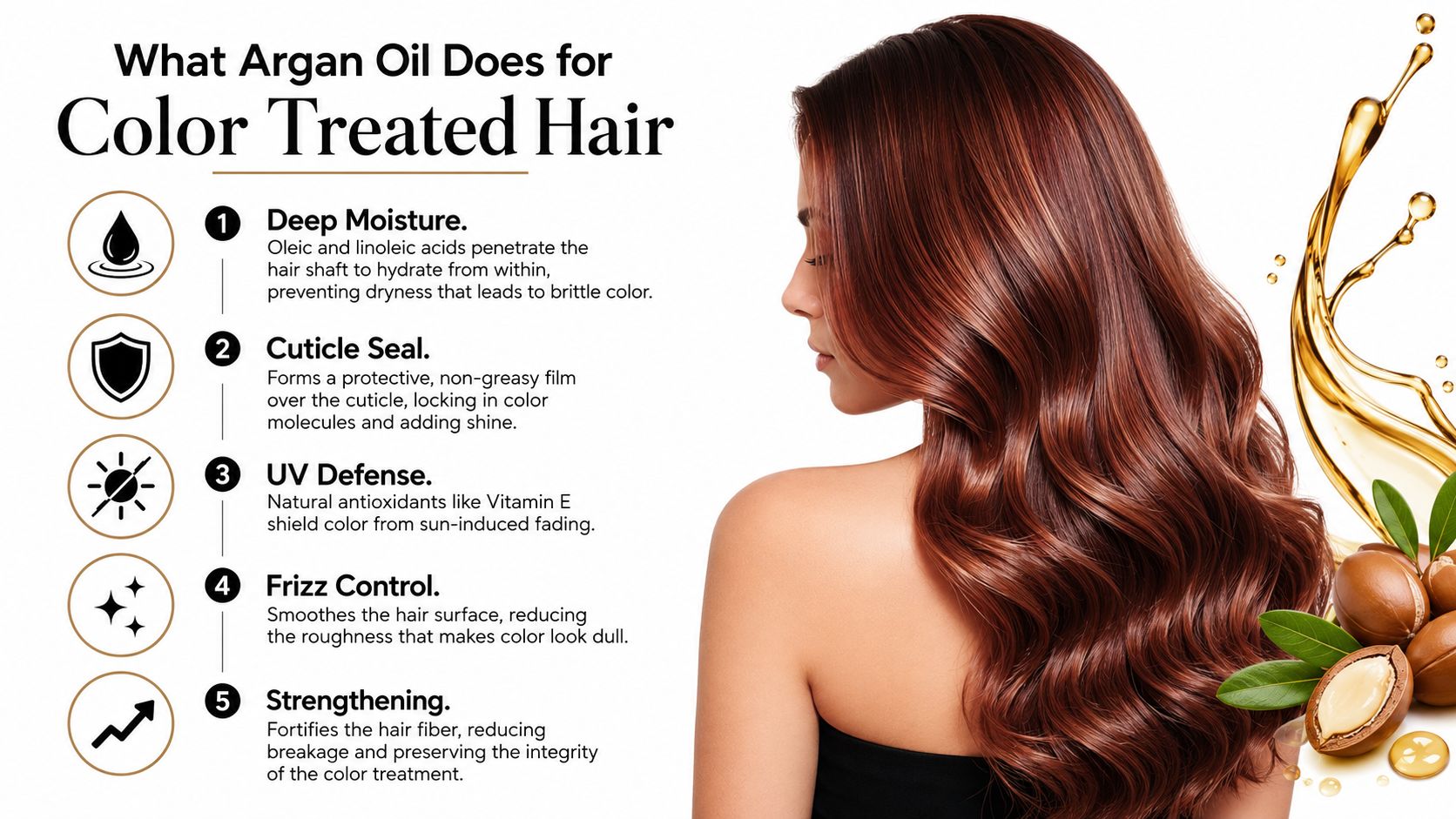
Moisture and softness
Chemically treated strands often feel dry because their surface no longer regulates water as effectively. Argan oil's fatty acids create a lubricating layer that improves flexibility and reduces the straw-like sensation associated with rough cuticles.
This is conditioning, not hydration in the same sense as water-based ingredients. A leave-in containing humectants, conditioners, and argan oil may offer a broader result than a bottle of oil used alone.
Shine without adding pigment
A rough cuticle scatters light. When argan oil smooths the surface, light reflects more evenly, so brown, red, blonde, or fantasy color can appear richer and more luminous. The oil hasn't necessarily increased the amount of dye in the hair. It has improved the optical finish.
That distinction prevents a common misunderstanding. A gloss after oil application can signal better surface alignment, not proof that the product has locked pigment inside the cortex.
Frizz and friction control
Lifted cuticle edges catch on neighboring strands and increase friction during brushing. A thin oil film can improve slip, tame flyaways, and reduce the puffiness that appears when humid air reaches a porous surface.
Curly and coily hair may show this benefit especially clearly because uneven moisture movement can exaggerate frizz. The oil won't change the curl pattern, but it can make the surface feel less rough.
Heat support, with limits
Argan oil can reduce friction during blow-drying and styling, but it isn't automatically a complete thermal protectant. A dedicated heat-protection formula may contain film-forming ingredients tested for styling conditions that a single oil hasn't been tested for.
Apply oil sparingly before styling, and follow the directions on your heat protectant. For more context on the difference between cosmetic benefits and broader hair claims, see this guide to argan oil and hair growth.
Surface preservation
Repeated conditioning can help the cuticle remain easier to comb and less vulnerable to friction-related breakage. That indirectly supports the appearance of color because fewer broken, frayed ends means a more uniform reflective surface.
A 2021 controlled study found that a conditioner containing argan oil improved bleached-hair color retention and tensile strength more than a camellia-oil control, with slightly better protection against protein loss in the published study. The result supports argan oil in a properly designed rinse-off or post-treatment formula, not every argan product on the market.
How to Use Argan Oil on Color Treated Hair
The right application depends on what your hair can absorb without looking coated. Fine, straight hair often needs a rinse-out approach, while dry, curly, or high-porosity hair may benefit from a small leave-in layer on the mid-lengths and ends.
Leave-in use
Apply a very small amount to damp, towel-dried hair. Work it between your palms first, then smooth it over the ends and any visibly porous sections. Keep it away from the roots unless your scalp and hair tolerate oils well.
Damp hair helps distribute the oil more evenly, but it doesn't mean the oil is replacing water-based conditioning. Use it after a leave-in conditioner if your hair needs detangling, or use it as the final smoothing layer when your hair already feels conditioned.
Rinse-out use
Mix a small amount into a conditioner or mask, rather than pouring oil directly over the entire head. Leave the treatment on according to the product directions, then rinse thoroughly. This approach gives dry hair conditioning without leaving as much residue behind.
Fine hair can dilute the oil by blending a drop into a lightweight conditioner. If your hair looks flat, stringy, or greasy after drying, reduce the amount before changing the whole routine.
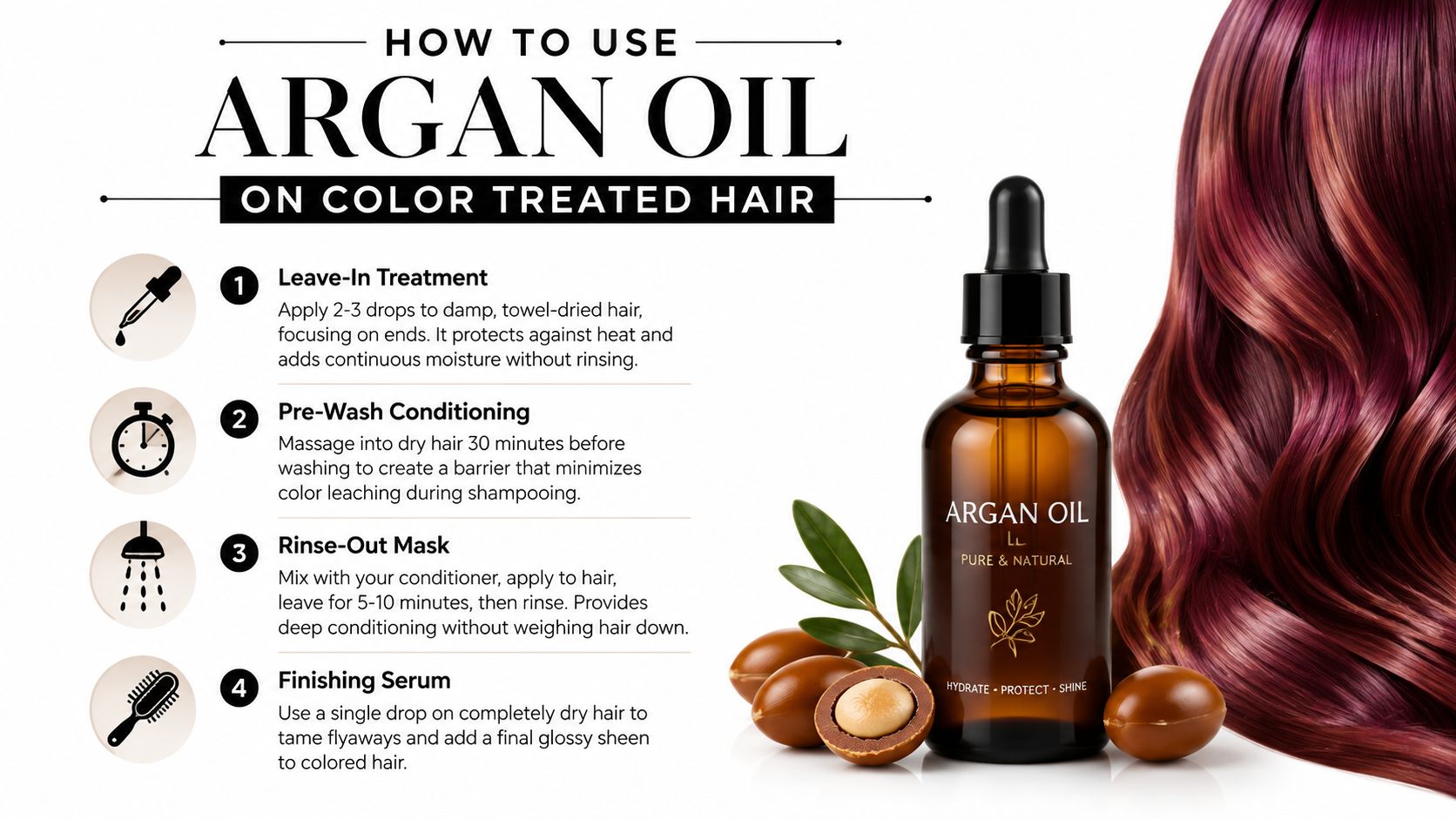
Pre-wash conditioning
A useful option for chemically damaged hair is applying argan oil before shampooing. A human hair-fiber study reported that argan-oil pre-treatment reduced oxidant-induced protein loss, and ATR spectroscopy showed that oil deposition remained on the hair after washing in the study record. That supports a barrier and film-forming role during oxidative processing, but it doesn't establish a universal color-preservation result.
An overnight mask may suit very dry, coarse hair, but it's unnecessary for everyone. Start with a short pre-wash application and observe how your hair feels after cleansing.
Application check: If your hair feels coated rather than supple, the issue is usually quantity, layering, or formula weight, not a need for more oil.
For more practical placement ideas, this guide to using argan oil can help you compare pre-wash, leave-in, and finishing applications. Use a dedicated heat protectant whenever you use significant heat, and don't treat argan oil as a replacement for that product.
Compatibility With Different Color Processes and Hair Types
Argan oil can complement many color services, but it can't undo lifted cuticles, reverse bleaching, or repair a strand that has already fractured. Its most consistent role is improving softness, slip, and surface appearance after the chemical service.
| Hair Type or Color Process | Application Approach | Primary Benefit |
|---|---|---|
| Permanent color | Use a lightweight leave-in or conditioner blend on dry lengths | Softer feel and smoother reflection |
| Semi-permanent color or gloss | Apply sparingly after washing | Shine and reduced surface friction |
| Balayage | Concentrate oil on lighter, drier pieces | Better manageability and less roughness |
| Fully bleached hair | Consider pre-wash conditioning and a richer mask | Support against oxidative protein loss and dryness |
| Fine, straight hair | Use a tiny amount only on the ends | Finish without excessive weight |
| Wavy or curly hair | Smooth through damp mid-lengths and ends | Frizz control and improved slip |
| Coily hair | Layer over a water-based leave-in | Sealing and softness |
| High-porosity hair | Use oil after conditioning, adjusting by feel | Surface sealing and reduced moisture loss |
The evidence isn't equally strong for every category. A controlled study on bleached hair supports improved retention with an argan-oil conditioner, while other compatibility advice comes from formulation logic and professional experience rather than controlled color-fastness testing.
A 2013 study on dye-treated Caucasian hair reported reduced damage when argan oil was added to conditioner formulations in the published research. That finding is useful, but hair texture, porosity, dye chemistry, and styling habits can change the result.
Choose the lightest application that gives you the desired slip. Fine hair may need only the ends treated, whereas a porous curl pattern may need oil layered over conditioner to reduce roughness.
Does Argan Oil Really Help Preserve Hair Color
The phrase “locks in color” sounds clear, but it combines several different outcomes. An oil can make colored hair feel smoother, reduce friction, and create more shine without preventing pigment from leaving during washing or breaking down through oxidation.
The strongest relevant evidence is formulation-specific. The 2021 study discussed earlier found better bleached-hair color retention with an argan-oil conditioner than with a camellia-oil control over 21 days of shampooing. That result suggests argan oil may contribute to color retention when included in the right conditioner system.
It doesn't prove that pure argan oil alone will preserve every shade or dye type. A rinse-off conditioner contains other ingredients that affect deposition, lubrication, detangling, and cuticle behavior. The study also involved a defined hair model and process, so you shouldn't assume identical results for curly, coily, fine, repeatedly bleached, or differently colored hair.
What the evidence supports
Argan oil may help colored hair look vibrant for longer by improving the surface that reflects light. It may also support structural integrity when used around oxidative treatments, especially as a pre-treatment or part of a conditioner.
What it doesn't establish
There's no strong basis for saying argan oil alone prevents all fade caused by water, cleansing, UV exposure, or heat. A systematic review found no strong evidence that argan oil improves hair growth, hair quality, or infestation outcomes across the broader claims often made about the ingredient in its review.
The balanced verdict is supportive, not definitive. Pair argan oil with gentle color-safe cleansing, thorough conditioning, cooler rinses, reduced friction, and a product that offers UV support when needed. That routine addresses more pathways than oil alone.
How to Choose a High Quality Argan Oil
Read the ingredient list before the front label. If you want a single-ingredient oil, look for Argania Spinosa Kernel Oil as the only ingredient. Claims such as “100% pure,” “cold-pressed,” and “unrefined” can help identify minimally processed options, although transparent sourcing still matters.
A dark glass bottle is preferable to clear packaging because light can accelerate oil degradation. Store it away from heat and close the cap promptly after use. A mild natural scent and a light golden appearance can be normal, but scent and color vary with processing, harvest, and refinement.
Green flags
- Simple INCI: The bottle lists only Argania Spinosa Kernel Oil when a pure oil is your goal.
- Traceable sourcing: The brand explains where the argan kernels come from and how the oil is processed.
- Protective packaging: Amber or other dark glass helps limit light exposure.
- Clear storage guidance: The label tells you how to protect the oil after opening.
- Routine flexibility: You can use the oil before shampooing, in conditioner, or on dry ends.
Red flags
- Undisclosed blends: “Argan blend” doesn't tell you how much argan oil the product contains.
- Added fragrance: Fragrance may be undesirable for sensitive scalps or freshly processed hair.
- Silicones or mineral oil: These aren't unsafe, but they change the product's behavior and don't suit shoppers seeking a single-ingredient formula.
- Poor packaging: Light plastic can offer less protection than dark glass.
- No sourcing information: A lack of transparency makes quality harder to assess.
A stylist's guide to extension care offers useful context on choosing lightweight, controlled products for hair that needs careful handling. You can also compare ingredient-focused considerations in this guide to choosing argan oil.
Label habit: Choose the simplest formula that matches your purpose. A pure oil is flexible, while a finished serum may offer easier spreadability and additional heat or detangling support.
Frequent Questions and Final Takeaways
How often should you apply argan oil? Start with a small amount a few times across the week, focusing on the ends rather than the scalp. Very dry or porous hair may tolerate more frequent conditioning, while fine hair may need it only after washing.
Can argan oil cause buildup? It can if you layer too many rich products or keep adding oil without cleansing effectively. Watch for limpness, a coated feel, reduced curl definition, or hair that looks dull instead of glossy. Clarifying may help, but use it thoughtfully because aggressive cleansing can make processed hair feel drier.
Can you mix it into conditioner or a mask? Yes. Blending a small amount into a rinse-out conditioner or treatment is a practical way to control distribution. Don't assume that more oil creates more repair, especially if the hair is fine or easily weighed down.
Can argan oil replace heat protectant? No. It can improve lubrication and reduce friction, but a dedicated heat-protection product is the safer choice for regular hot-tool use.
When might it not be the right choice? Very fine or oil-prone hair may respond better to a lighter serum or conditioner. Severely bleached hair may also need protein-rich and bond-supportive treatments alongside oils, because oil mainly improves surface feel and manageability.
The simplest routine is to combine a high-quality, fragrance-free argan oil with color-safe cleansing, consistent conditioning, gentle drying, cooler rinses, and UV-aware styling. That approach uses argan oil for what it does well, while avoiding the promise that it can single-handedly preserve every shade.
Ella & Eden offers simple, single-ingredient oils, including Pure Argan Oil, for routines focused on smoothing, shine, and easier hair care. Visit Ella & Eden to explore clean, fragrance-free options and build a color-care ritual that fits your hair's texture and damage level.