How to Dilute Rosemary Oil for Hair: A Complete Guide
You've bought a bottle of rosemary essential oil, placed it beside your shampoo, and now you're staring at the tiny opening wondering whether “a few drops” means three or thirty. That uncertainty matters. Rosemary oil can fit into a thoughtful scalp routine, but the wrong concentration can leave you with stinging, dryness, itching, or dermatitis instead of a ritual you'll maintain.
The practical answer is simple: start with your scalp's tolerance, not your hair-growth ambition. For most adults, a low dilution of 0.5% to 1% is a sensible starting range, while stronger blends should be reserved for tolerant scalps and short, pre-wash use. This guide shows you how to dilute rosemary oil for hair with measurable ratios, a suitable carrier, and a routine that doesn't oversell what topical oil can do.
Why Diluting Rosemary Oil Matters Before Anything Else
Your scalp should set the starting point, not your hair-growth ambition. Rosemary essential oil is highly concentrated, and applying it directly makes the amount reaching your skin unpredictable. Undiluted use can cause stinging, dryness, itching, or dermatitis. Mixing it with a carrier oil helps distribute the essential oil evenly and gives you control over the formula.
That control matters for three practical reasons:
- It reduces irritation risk. A lower concentration gives reactive skin a better chance of tolerating the blend. Burning or itching is irritation, not proof that the formula is working.
- It improves coverage. Carrier oil helps rosemary spread across the scalp instead of sitting in one concentrated spot.
- It supports consistency. A comfortable blend is easier to use repeatedly than one that leaves your scalp sore, tight, or greasy.
Practical rule: If the blend stings, feels hot, or makes your scalp itch, wash it out. Do not treat discomfort as a reason to continue.
Let scalp tolerance choose the concentration
A blend can be too weak to provide much noticeable sensory benefit, but a strong blend can disrupt the scalp barrier and make regular use unpleasant. The useful target is the highest concentration your scalp tolerates without redness, itching, warmth, or lingering tightness.
Start at the lower end if your scalp is sensitive, reactive, or color-treated. A tolerant scalp may handle a stronger cosmetic blend, but higher concentration is not automatically better. The full measurement breakdown belongs in the ratio section, where you can choose a level and measure it accurately. General guidance commonly places adult scalp blends in the 0.5% to 1% range, with specific drop measurements depending on the amount of carrier oil.
Dilution cannot promise hair growth
Rosemary oil belongs in a scalp-care routine, not a promise of new density. A 2025 review described positive findings from a human study comparing rosemary oil with coconut oil, while a broader 2025 review noted small sample sizes, inconsistent formulations, and limited long-term safety data. Your experience also depends on the carrier, contact time, application method, and consistency.
Begin gently, observe your scalp, and adjust only while the formula remains comfortable.
Choosing a Carrier Oil That Matches Your Hair
Your scalp sets the starting point. If it is sensitive, reactive, oily, or color-treated, choose a light, simple base before chasing richer texture or ambitious results. The carrier oil controls how the blend spreads, feels at the roots, and washes out. Scent comes last. A pleasant aroma does not justify greasy roots or a congested scalp.
For a clear explanation of a carrier oil's role in a formula, read Ella & Eden's guide to what a carrier oil is.
Match the base to your scalp
Jojoba oil is my first choice for fine hair, oily roots, first-time users, and easily irritated scalps. Its light, fluid feel spreads easily and usually leaves less coating at the roots. Start here when you are unsure how your scalp will respond.
Argan oil fits dry, color-treated, frizzy, or heat-stressed hair. It adds slip and softness without the dense feel of heavier oils. Keep the blend close to the scalp if that is your goal, then use only enough on the lengths to address dryness. Too much can flatten fine roots.
Coconut oil works better as a selective pre-wash option. Coarse, curly, low-porosity, or very dry hair may benefit from its richer, more coating texture. Fine hair and acne-prone scalps may find it heavy, greasy, or uncomfortable, so do not make it your default.
| Carrier Oil | Best For | Texture | Watch Out For |
|---|---|---|---|
| Jojoba | Oily roots, fine hair, sensitive scalps | Light and fluid | May feel too light for very dry lengths |
| Argan | Dry, color-treated, or heat-stressed hair | Smooth and mid-weight | Can flatten fine roots if overapplied |
| Coconut | Coarse, curly, low-porosity, or very dry hair | Rich and coating | Can feel heavy or congested on fine or acne-prone scalps |
Let your scalp make the decision
Choose jojoba when oiliness or sensitivity is the main concern. Choose argan when your strands need softness but your scalp does not tolerate dense oils. Use coconut as a pre-wash base only if your scalp already handles it comfortably.
You can combine carrier oils, but measure their total volume first. Add rosemary essential oil only after the combined carrier amount is set. Do not calculate separate rosemary additions for each oil. Your total carrier volume determines the dilution level.
Safe Dilution Ratios You Can Actually Measure
Your scalp's tolerance sets the starting point. Ambition comes second. For adult scalp use, a practical range is 0.5% to 3%. Start at the lower end if your scalp is sensitive, reactive, dry, or color-treated. Treat the upper end as short-contact care, not an everyday leave-on default.
For a 0.5% to 1% blend, use about 3 to 6 drops in 30 mL of carrier oil. A 1% blend suits many beginners, while 2% is a stronger option for a scalp that already tolerates rosemary oil. A 3% blend reaches the upper practical limit for short-contact use. These recommendations align with essential oil dilution ratios and practical rosemary dilution guidance.
The table uses the common approximation of 20 drops per milliliter. Drop size changes with the bottle and the oil's thickness, so measured volume is more precise. For small home batches, these figures remain practical.
| Dilution % | Drops per 30 mL | Drops per 50 mL | Best For |
|---|---|---|---|
| 0.5% | About 3 | About 5 | Very reactive or first-time scalps |
| 1% | About 6 | About 10 | Everyday adult starting blend |
| 2% | About 12 | About 20 | Tolerant scalps using pre-wash care |
| 3% | About 18 | About 30 | Experienced users, short-contact masks only |
My recommendation for each level
Choose 0.5% when fragrance causes discomfort, your scalp feels dry, or it has recently been stressed. Choose 1% as the default starting point if you are new to rosemary oil and have no known sensitivity. Increase to 2% only after repeated comfortable use, and keep it as a pre-wash treatment.
Skip 3% as a starting formula, and do not use it as a leave-on blend. Higher concentrations increase the chance of irritation, particularly on reactive skin.
For a small 15 mL batch, use about 1 to 2 drops for a gentle blend and 3 drops for a standard blend. Measure the carrier oil with a dropper or syringe. Kitchen teaspoons are too inconsistent for repeatable small-batch formulation.
If your scalp is color-treated or easily irritated, stay at 0.5% to 1% until tolerance is clear. A stronger formula cannot compensate for an uncomfortable scalp. Consistent, tolerable use is the better target.
Mixing Your Blend Step by Step
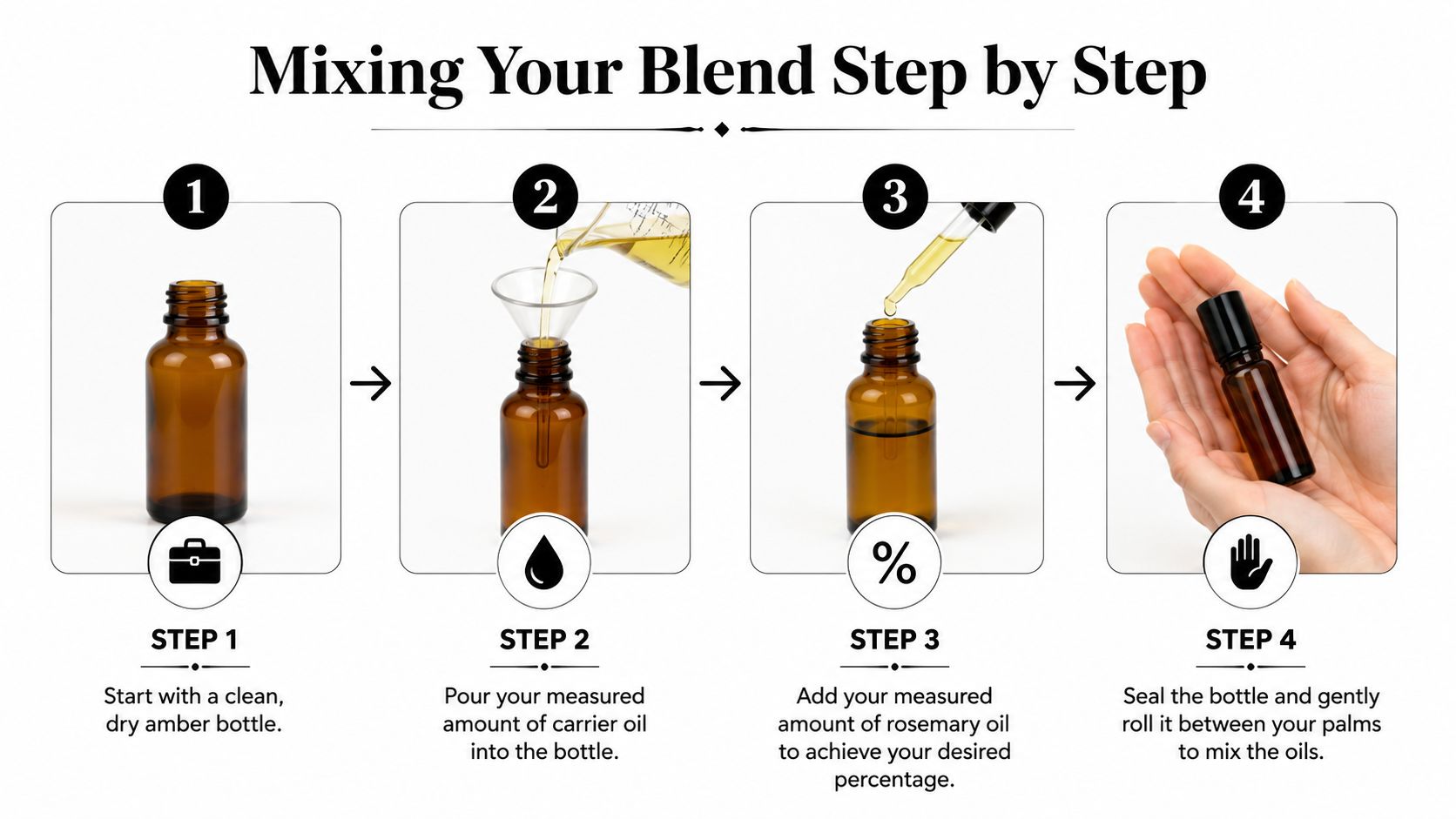
Start with scalp tolerance, then choose the batch size. For a sensitive, reactive, or color-treated scalp, make a small amount so you can stop without wasting a full bottle. Use a clean, dry amber glass bottle. Amber or cobalt glass reduces light exposure, while a dry container keeps water out of an oil-only blend.
A controlled mixing workflow
- Measure the carrier oil first. Use a small funnel, syringe, or cosmetic measuring tool, and measure the exact volume you plan to make.
- Add the rosemary drops upright. Hold the essential-oil bottle vertically so each drop falls cleanly rather than coating the bottle's side.
- Cap and roll the bottle. Roll it gently between your palms for about 30 seconds. This distributes the rosemary without aggressively whipping air into the blend.
- Label the bottle. Record the dilution percentage, carrier oil, and mixing date.
Store it like a cosmetic formula
Keep the bottle away from direct sun, bathroom steam, and repeated heat. Make a modest batch instead of filling a large bottle that may sit open for months.
Check the blend before every use. Cloudiness or an off scent means it should be discarded and replaced. For scalp care, mixing only what you need for each session keeps the concentration predictable and limits air exposure. A small, clearly labeled batch is the better home setup, especially while you are learning how your scalp responds.
Sensitive Scalps, Patch Tests, and When to Go Lower
More rosemary does not mean better results. For a reactive scalp, tolerance is the ceiling. If your skin already feels irritated, a stronger blend can increase discomfort and make the routine harder to maintain.
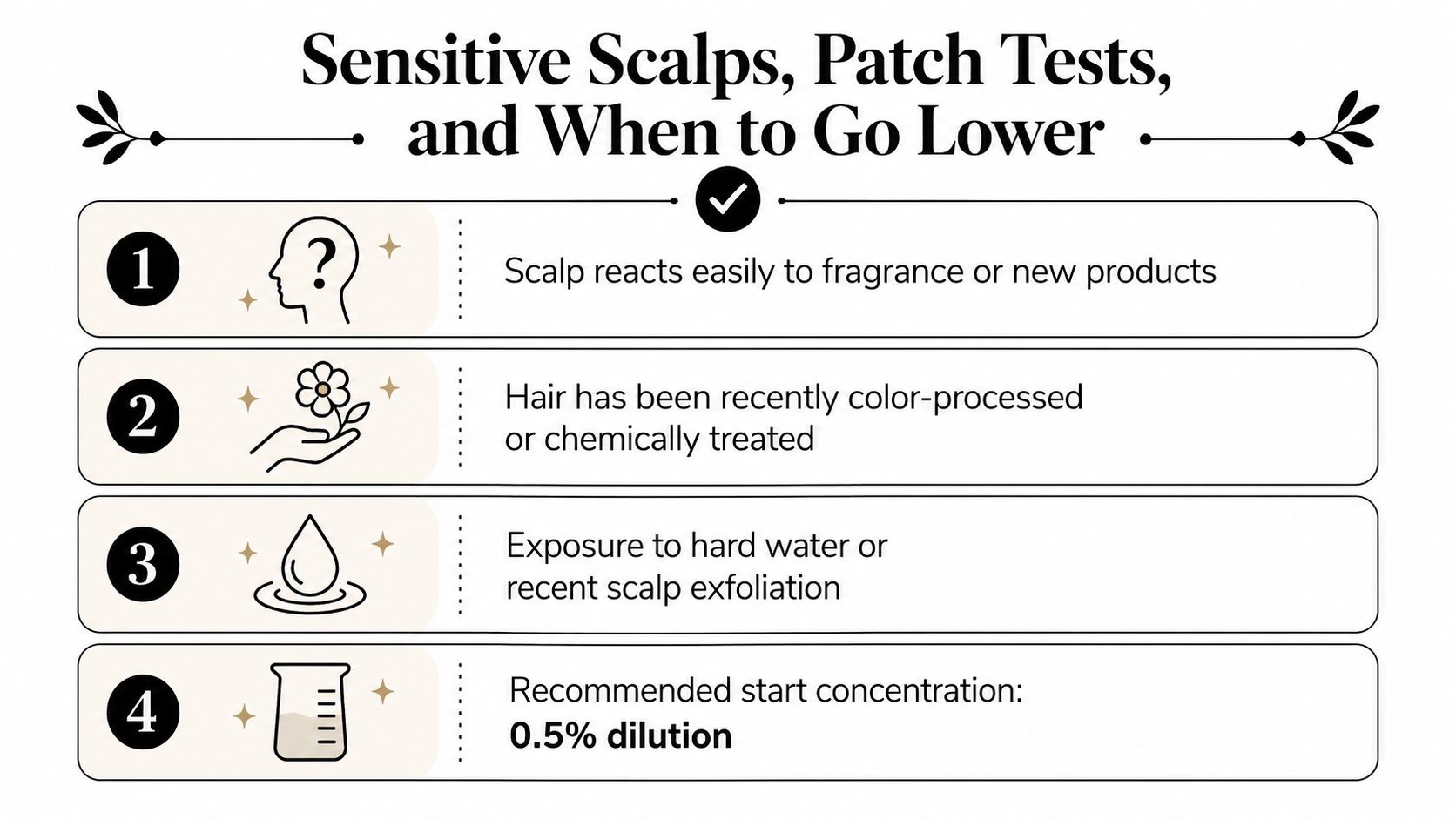
Start cautiously when your scalp flares easily, reacts to fragrance, or feels compromised after color processing, hard-water exposure, or exfoliation. Guidance for sensitive scalps recommends a conservative starting point and a 24-hour patch test. Use the lowest strength that lets your scalp stay comfortable rather than chasing a more ambitious formula.
Patch test before the first full application
Apply a small amount of the finished blend behind the ear or along the inner wrist. Leave it undisturbed and observe the area for 24 hours before applying it to your scalp. Follow this skincare patch-test guide for a careful testing approach.
Look for:
- Redness or warmth
- Itching or persistent tingling
- Swelling or visible irritation
- Dryness that continues after cleansing
Color-treated hair needs a calmer approach
Color-treated hair does not automatically rule out rosemary oil, but chemical processing can leave the scalp more reactive. Skip a new essential-oil blend while the skin feels tender, tight, or freshly stressed. Wait until it feels normal, then patch test before proceeding.
A reaction means wash the blend off and stop using it. Do not push through discomfort or add more rosemary to “build tolerance.” If you try again later, choose a milder blend or a different carrier and test it first. A comfortable formula you can use consistently is more useful than a strong one that repeatedly forces you to stop.
Application Methods and How Often to Use It
Choose the method your scalp can tolerate and repeat. The goal is even scalp contact, not coating every strand. Using too much oil only makes cleansing harder and gives you less control over the formula.
Scalp massage
Warm a small amount of the diluted blend between your fingertips. Apply it to the crown, temples, and other targeted areas with slow circular movements for about 2 minutes. Use light pressure. Comfortable coverage matters more than vigorous friction, especially when your scalp is reactive or your hair is color-treated.
Pre-wash treatment
A pre-wash application suits anyone who dislikes leaving oil on the scalp. Apply a small amount of carrier oil to the lengths if they need softness, then place the rosemary blend at the roots. Leave it for roughly 15 to 60 minutes, shampoo thoroughly, and adjust the contact time if your scalp feels dry or uncomfortable. This approach gives you a defined window of exposure and simpler cleanup.
Root mist
A water-based mist requires a properly formulated solubilizer or emulsifier. Rosemary essential oil will not stay evenly distributed in plain water, so each spray may deliver a different concentration. For home use, an oil-only blend is easier to measure, apply, and control. For more background on how to use essential oils for hair, review the guide before experimenting with a spray.
| Method | Dilution | Contact Time | Best For |
|---|---|---|---|
| Scalp massage | 0.5% to 1% | Short massage, then wash or leave according to tolerance | Beginners and targeted application |
| Pre-wash treatment | Up to 2% for a tolerant scalp | Roughly 20 to 30 minutes, or within a short pre-wash window | Users who prefer controlled exposure |
| Leave-on use | 0.5% to 1% | Leave on only if fully tolerated | Experienced users with a comfortable scalp |
Start with 2 to 3 sessions per week. Do not increase frequency because the blend feels pleasant at first. After several weeks of steady use, assess comfort, cleansing, and whether the routine still fits your hair-care schedule. Rosemary oil research remains limited and inconsistent, so judge the formula by tolerance and consistency, not dramatic promises. A milder routine you can maintain is the better choice.
Troubleshooting, Results, and Staying Consistent
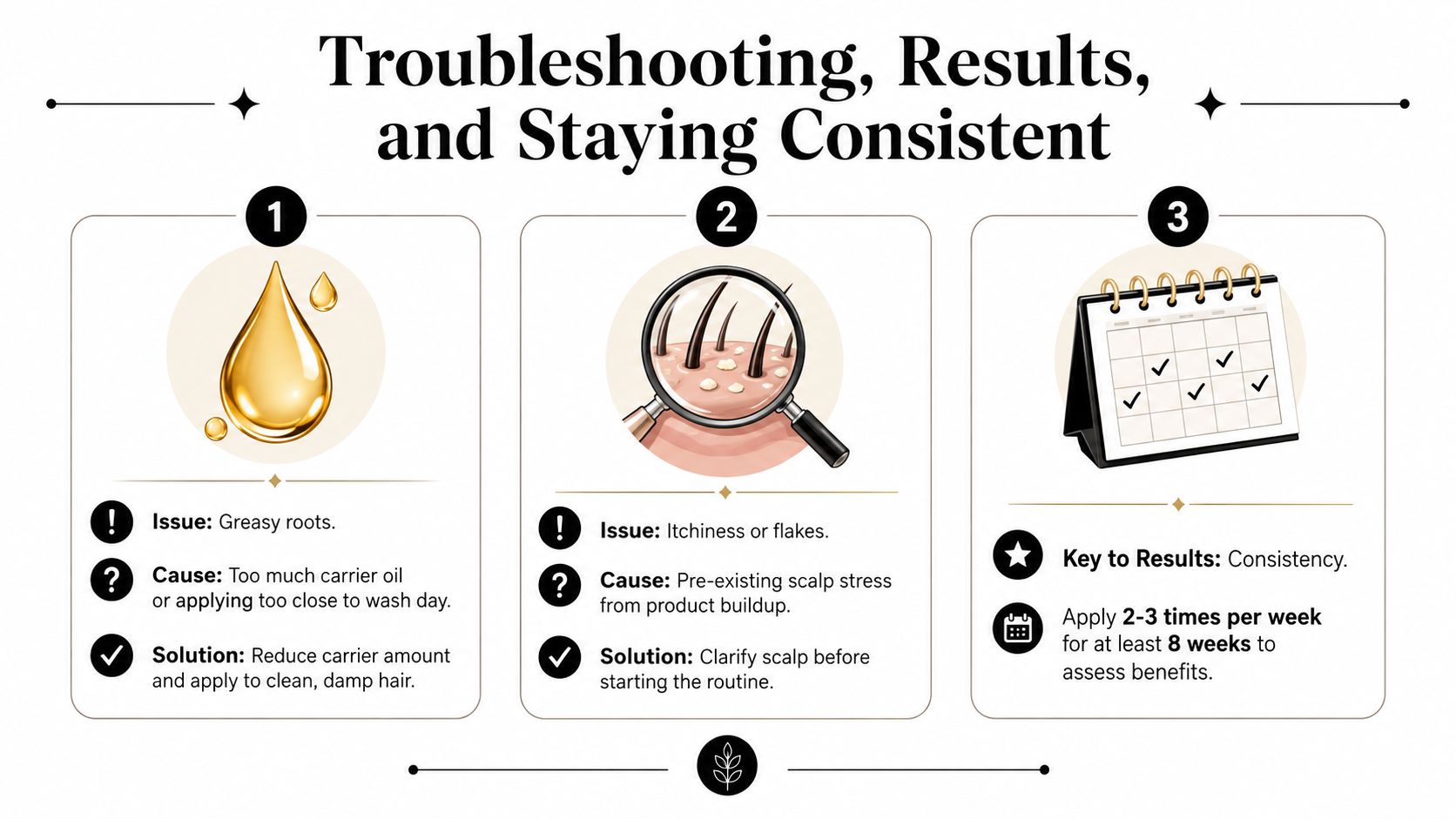
A rosemary routine often goes wrong because the base overwhelms the hair, the scalp is already reactive, or the process is too complicated to repeat. Start with tolerance, then adjust your ambition. Sensitive, color-treated, or easily irritated scalps should stay with the gentlest workable blend.
Greasy roots usually point to too much carrier oil or poor timing before wash day. Apply less to the scalp, keep the blend close to the roots, and spread it evenly instead of saturating one area. If your hair is fine or color-treated, reduce the amount before lowering the dilution further.
Itchiness or flakes can signal buildup or irritation rather than a need for more rosemary. Stop using the blend, cleanse gently, and give your scalp time to settle. Persistent symptoms call for professional medical advice, not more essential oil.
Set expectations you can live with
Softer hair, easier detangling, or a more comfortable massage may appear before any noticeable change in density. Early shine does not prove new growth, and a few extra hairs in the brush do not settle the question.
The evidence remains fragmented, and home recipes vary in dilution, carrier, and application. A 2025 review described positive findings in a human study when rosemary oil was compared with coconut oil. Keep your formula and routine stable so you can judge comfort and results without changing several variables together.
Consistency beats intensity. A comfortable blend used regularly is more useful than a stronger formula that irritates your scalp.
Miss a session? Resume at the next planned opportunity. Do not compensate with extra drops or longer contact time. Ella & Eden offers carrier oils and rosemary-focused clean-beauty options for a measured scalp routine. Visit Ella & Eden to explore oils for a calmer, consistent hair-care ritual.