Jojoba Oil Hair Mask Guide: How to Make and Use One
You've washed your hair, reached for a comb, and immediately hit resistance. The mid-lengths feel rough, the ends look frizzy, and a few strands snap before you've worked through the first knot. Maybe your scalp feels tight too, or maybe your roots already look oily while the lengths still feel thirsty.
A jojoba oil hair mask can make that routine easier, but it works best when you treat it as a targeted conditioning step, not a miracle growth treatment. Jojoba is a lightweight wax ester that can coat the hair fiber, improve slip, and support a more comfortable scalp. The practical results to watch for are softer texture, easier detangling, smoother ends, and less breakage.
The right formula depends on your hair. Fine strands need less product and shorter contact time, while thick, curly, or chemically processed hair may benefit from a richer blend and longer application. The guide below gives you specific ratios, timing, application order, and realistic expectations.
Why a Jojoba Oil Hair Mask Might Be Your Hair's New Best Friend
Jojoba is commonly called an oil, but chemically it's a liquid wax ester, not a typical triglyceride plant oil. That difference helps explain its light, smooth feel. A review published in PubMed Central describes jojoba as a wax ester and discusses its use as a conditioning ingredient that can coat hair without the heavy sensation associated with some plant oils.
For a beginner, the benefit is easy to understand. Jojoba can create more slip between your fingers, comb, and hair shaft. That makes it useful when your main complaint is roughness, frizz, or tangling rather than a need for dramatic transformation.
What you may notice first
A mask won't rebuild a split end or change the biology of a follicle. It can, however, make the existing fiber feel more flexible and manageable. The same review reports that jojoba added to thioglycolate-based straightening emulsions reduced protein loss and improved resistance to breakage, which is relevant to conditioning routines involving dry or processed hair.
Use these early signs as your scorecard:
- Smoother ends: Your fingers move across the length with less snagging.
- Faster detangling: A wide-tooth comb needs fewer passes after washing.
- Less brush breakage: Fewer short snapped strands appear during handling.
- More comfortable scalp: A dry or tight feeling may ease when you use a small amount at the roots.
Jojoba is best treated sparingly near the scalp. Dermatology guidance from the Cleveland Clinic advises avoiding heavy root application because oil can coat the follicle and hair shaft. The safest starting point is a small amount through the mid-lengths and ends, followed by a thorough wash.
What Makes Jojoba Oil Different From Other Oils
Your hair can feel coated after one oil mask but still rough after washing. Jojoba behaves differently. Its structure is closer to a lightweight conditioning wax than to a dense cooking oil, so it can soften the hair surface without automatically leaving the same heavy finish as coconut, olive, argan, or castor oil.
For formulation purposes, jojoba is primarily a surface-conditioning and sebum-like ingredient. Other oils may be chosen for deeper fiber interaction, shine, or a heavier protective coating. “Natural” describes an ingredient's origin, not its suitability for every hair texture or scalp.
The 2021 review in PubMed Central connects jojoba with reduced protein loss and improved resistance to breakage in a treatment formulation. That supports a protection-and-conditioning role for dry, chemically processed, frequently brushed, or roughly handled hair. It does not support a promise of new growth.
| Oil | Main Chemistry | Absorption Behavior | Best Mask Role |
|---|---|---|---|
| Jojoba | Liquid wax ester | Lightweight coating and conditioning | Softness, slip, scalp comfort |
| Coconut | Triglyceride-rich plant oil | Often selected for deeper fiber interaction | Rich pre-shampoo care for thick hair |
| Argan | Plant oil rich in fatty acids | Smooth, lighter-feeling surface finish | Shine and frizz control |
| Castor | Dense plant oil | Heavier surface coating | Fuller-feeling, protected lengths |
Jojoba's long use in cosmetics also explains its place in mask formulas. The referenced assessment recorded jojoba seed oil in 188 cosmetic products in 1989, at concentrations up to 25%, and in 1,123 products in 2007, with concentrations reaching 100% in the referenced assessment. The figures show broader documented cosmetic use over that period, not proof that higher concentration produces better hair results.
Ella & Eden offers a practical guide to jojoba oil benefits and simple rituals.
Single-Ingredient Versus Blended Masks
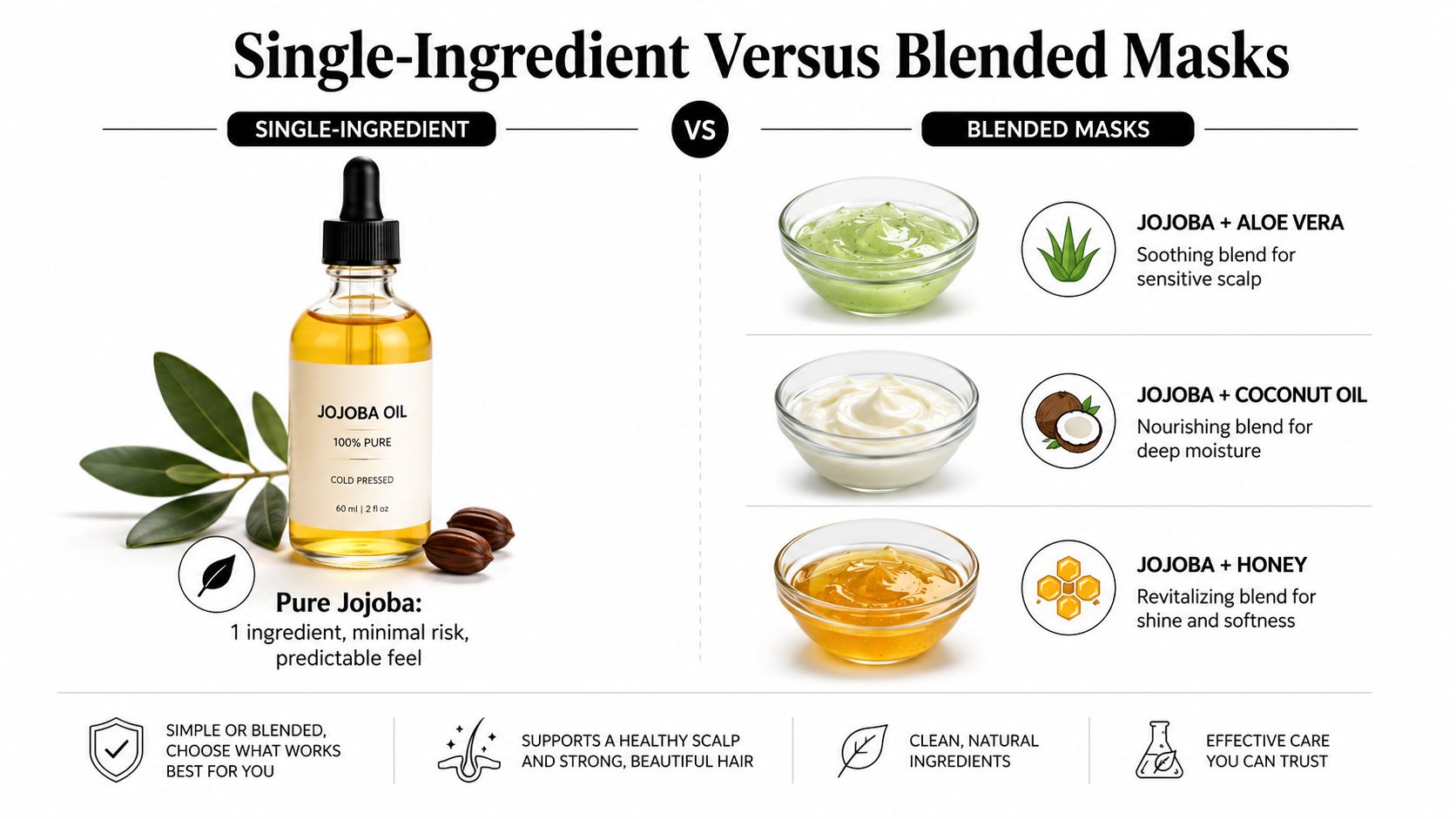
A pure jojoba mask is the most controlled place to begin. You know exactly what caused a benefit or irritation, and you can adjust the amount without trying to diagnose a reaction to several ingredients at once. This makes it a practical choice for fine hair, oily roots, sensitive routines, or anyone using a mask for the first time.
Blends can be useful when you have a specific reason to add another ingredient. The key is to keep jojoba as the main base and introduce only one partner at a time.
Choose the partner by the problem
- For thick or coarse curls: Combine 2 parts jojoba with 1 part coconut oil. The jojoba keeps the blend easier to spread, while coconut gives the treatment a richer feel.
- For shine and frizz: Use 1 part jojoba with 1 part argan oil. Apply the mixture from the ears downward, especially if your roots become oily quickly.
- For short, fragile lengths: Mix 3 parts jojoba with 1 part castor oil. Castor is dense, so the smaller proportion helps prevent a sticky finish.
- For a scalp-focused treatment: If you tolerate essential oils, use only 1 to 2 drops per tablespoon of carrier oil. Rosemary or peppermint may create a tingling sensation, but tingling isn't proof that hair growth is occurring.
- For a simple first test: Use jojoba alone. This gives you the clearest baseline for softness, detangling, and residue.
Essential oils require more caution than carrier oils. They can irritate sensitive skin, and peppermint's cooling sensation can make a product feel active without proving a follicle-related effect. Always dilute them, keep them away from the eyes, and stop if your scalp burns or develops a rash.
Formulator's rule: Start with one ingredient for two weeks, then add one partner only if you can name the next result you want.
For more context on choosing carrier oils by texture and use, explore this guide to the best carrier oils for hair. A single formula is usually easier to troubleshoot than a crowded kitchen mixture.
How to Mix and Apply Your Mask Step by Step
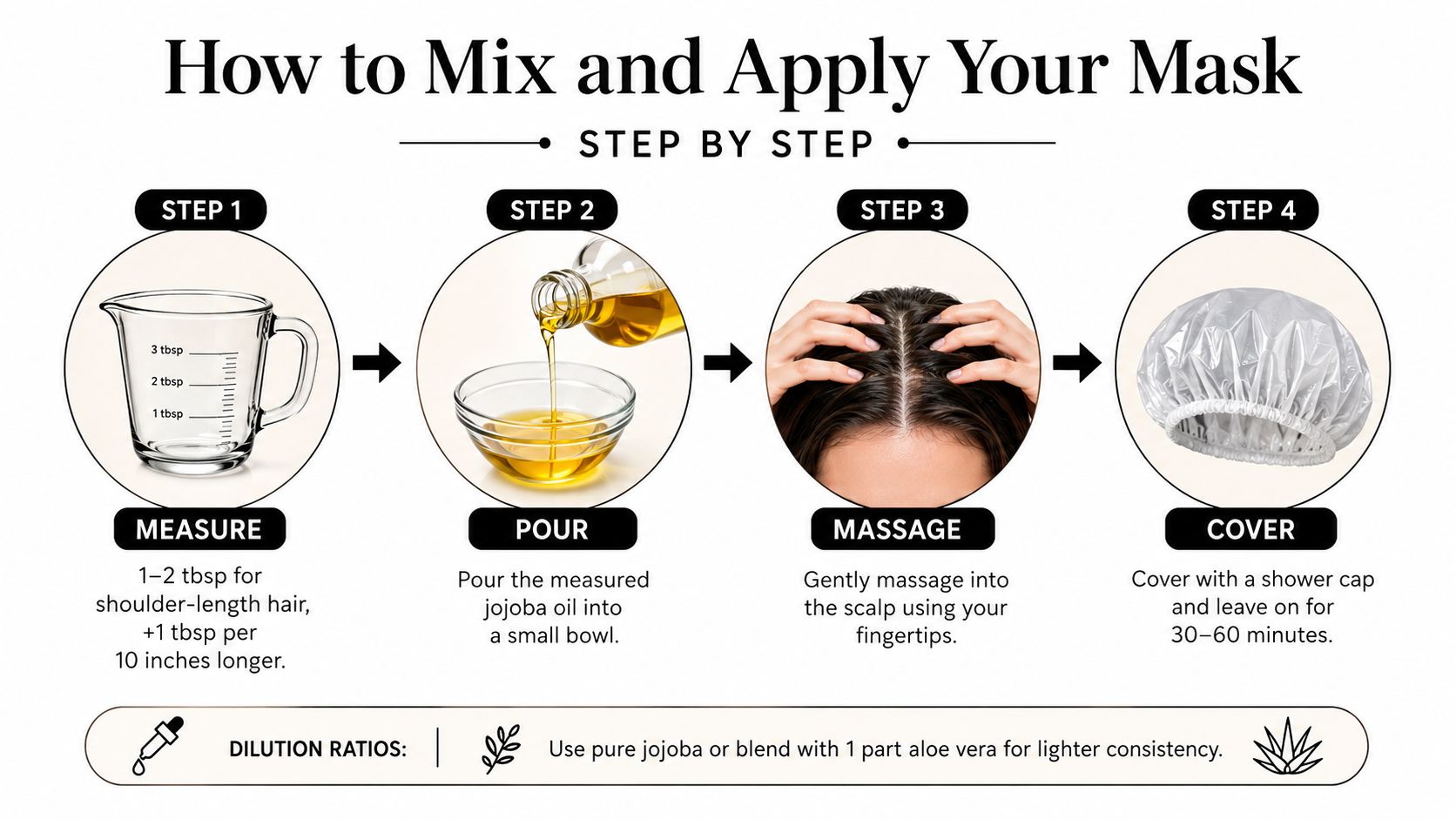
Start with clean tools, dry hands, and a small bowl. For shoulder-length hair, measure 1 to 2 tablespoons of jojoba. Add 1 tablespoon for every additional 10 inches of length, but adjust downward if your hair is fine or sparse.
If you're blending oils, use jojoba as the dominant ingredient. A practical formula is 70% jojoba, 20% secondary oil, and 10% scalp-active ingredient, although essential oils should be counted as drops within the total mixture rather than poured freely. For a lighter option, use pure jojoba or combine it with a small amount of aloe-based product, remembering that any water-containing formula needs different storage handling.
Application order matters
- Detangle before applying. Use your fingers or a wide-tooth comb on dry or slightly damp hair. Removing large knots first prevents you from tugging through oil-coated tangles.
- Divide into four sections. Clip the front, back, and sides separately so you don't overload one area.
- Warm a coin-sized amount between your palms. Body heat spreads the oil into a thin film.
- Press into the mid-lengths and ends first. These areas usually need the most conditioning and tolerate more product than the roots.
- Touch the scalp last, if needed. Use only a light residue on the fingertips for a dry scalp. Skip the roots if you're oily or prone to buildup.
- Cover the hair. A shower cap keeps the treatment contained and reduces transfer to clothing or bedding.
Fine hair usually needs 15 to 20 minutes before rinsing. Thick, curly, or coily textures can stay covered for 30 to 45 minutes, while very dry ends may tolerate an overnight treatment under a protective cap. Dermatology guidance from the Cleveland Clinic also describes mask-style use for about 30 minutes or overnight, with careful root application.
Wash with a gentle cleanser, then repeat if the hair still feels coated. A sulfate-free shampoo can remove excess oil without making the lengths feel stripped. Finish with a cool-water rinse and condition only where you need additional slip. For another pre-shampoo approach, see this guide to a DIY hot oil treatment for hair.
Matching Your Mask to Your Hair Type and Concern
The same tablespoon can feel nourishing on dense curls and excessive on fine, straight hair. Hair density, porosity, scalp oiliness, and chemical history matter more than a universal recipe.
| Hair Type / Concern | Best Formula | Timing | Frequency |
|---|---|---|---|
| Dry, curly, or coily hair | Pure jojoba, or 80% jojoba and 20% castor oil | 45 minutes, focused on ends | Weekly |
| Fine or oily hair | 50% jojoba and 50% argan oil, mid-lengths to ends | 15 minutes | Start weekly |
| Color-treated hair | Jojoba base, with a cautious amount of lavender or chamomile essential oil if tolerated | Short rinse-out treatment | Weekly |
| Itchy or flaky scalp | Jojoba with tea tree, using 10 drops per tablespoon | 20 minutes before shampooing | Use cautiously |
| Breakage-prone lengths | Jojoba, egg, and honey mask | Monthly treatment | Monthly |
Dry curls and coils usually benefit from sectioning and saturation at the ends rather than heavy scalp massage. Work the mixture over the outer layer, then gently squeeze it into the interior of each section. A loose twist or braid under the cap can keep the hair organized while the mask sits.
Fine or oily hair needs restraint. Keep the product below the roots, use the shortest timing range, and shampoo thoroughly. If your hair looks flat after rinsing, reduce the amount before changing the formula.
Color-treated hair requires a low-friction routine. Apply with your palms instead of aggressively rubbing, and avoid very hot water. Essential oils aren't necessary, and fragrance-free jojoba alone is the more cautious choice for a reactive scalp.
For flakes or itch, first consider whether the problem is irritation, product buildup, or a scalp condition. A diluted pre-shampoo application may feel comforting, but persistent flaking, redness, pain, or sores deserves professional evaluation.
Adjustment rule: If your hair feels coated after washing, reduce the quantity or contact time before adding another cleanser.
What Jojoba Will and Will Not Do for Hair Growth
Jojoba can support hair retention, but that isn't the same as stimulating new growth. By improving slip and reducing rough handling, it may help you keep more of the length you already have. The 2021 review linked jojoba treatment with reduced protein loss and better breakage resistance in a formulation context, which supports a fiber-care benefit rather than proof of follicle stimulation.
Dermatology guidance from the Cleveland Clinic states that strong clinical evidence doesn't show jojoba stimulates hair growth or increases density. The same guidance discusses evidence in which jojoba was less effective for growth than minoxidil and peppermint oil. That comparison shouldn't turn peppermint into a guaranteed solution, but it does show why jojoba shouldn't be marketed as a regrowth treatment.
A more honest success measure
Use a mask to assess:
- Fewer snapped strands during brushing.
- Less resistance when combing after shampoo.
- Softer, more flexible ends over repeated washes.
- A calmer-feeling scalp when dryness is the issue.
Sudden shedding, clearly defined patches, scalp pain, or noticeable thinning can have causes that an oil mask won't address. A dermatologist can assess those changes and discuss appropriate treatment, especially when hair loss seems hormonal, inflammatory, or progressive.
Storing Your Mask and Building a Simple Weekly Ritual
Pure jojoba is easier to store than a kitchen mask containing water, aloe, egg, or fresh ingredients. Keep an unopened bottle in a cool, dark cupboard, away from direct heat and sunlight. Amber glass can offer better protection from light exposure than clear plastic, which helps preserve the formula during regular use.
Water-containing blends need more caution because they can support microbial growth. Refrigerate them and make small batches rather than keeping a large jar in the bathroom. Egg masks should also be treated as fresh preparations, not long-term products.
Always perform a patch test behind the ear before your first full application. Wait 24 hours before proceeding, particularly if you're adding rosemary, peppermint, tea tree, lavender, or chamomile essential oil. Wash the area and stop using the formula if you notice burning, swelling, rash, or persistent itching.
A starter routine you can actually maintain
- Mask day: Apply your chosen formula, leave it on for the timing suited to your hair, then shampoo thoroughly.
- The next wash or styling day: Smooth a very small amount over damp ends if they still feel rough.
- Mid-week: If your scalp is oily, skip another full mask and treat only the dry ends. If your scalp feels tight, use a minimal pre-shampoo application instead.
- Tracking: Record softness, detangling time, visible breakage, and scalp comfort in your notes app.
Consistency makes the changes easier to judge. If your hair feels better but greasy, use less. If it feels unchanged, check application order, timing, and whether the cleanser is leaving residue.
Ella & Eden offers single-ingredient oils, including jojoba, for simple hair and scalp rituals without unnecessary fillers. Visit Ella & Eden to explore the jojoba oil option and build a focused routine around the results you can feel.