Simple Natural Skincare Routine for Healthy, Glowing Skin
You're standing at the sink with a half-empty cleanser, a serum you forgot to use, and an oil that promises everything except a clear plan. The shelf looks expensive. Your skin still feels reactive, dry, or congested in the same places, and the routine has started to feel like work.
A simple natural skincare routine works better when it behaves like a system, not a shopping list. The point isn't to own fewer bottles for the sake of minimalism. The point is to give your skin the same three jobs, every day, in a way you can repeat.
Why Fewer Products Done Consistently Wins
The people looking for a simpler routine usually aren't beginners. They're tired of opening the cabinet and feeling like every bottle needs a separate decision. That friction is where good habits die, and it's why a routine with fewer moving parts tends to survive real life better than a complicated one.
The market data backs up the behavior. One recent consumer survey found that 74% of respondents already keep both a morning and evening skincare routine, and women spend an average of 22.4 minutes per day on skincare. Another UK survey found that 39% of adults use only a 1-3 step routine, while just 3% use many steps, which tells you minimalist behavior is already mainstream in major markets, not a niche preference. For a friend who wants calm, repeatable skin care, that's the starting point.
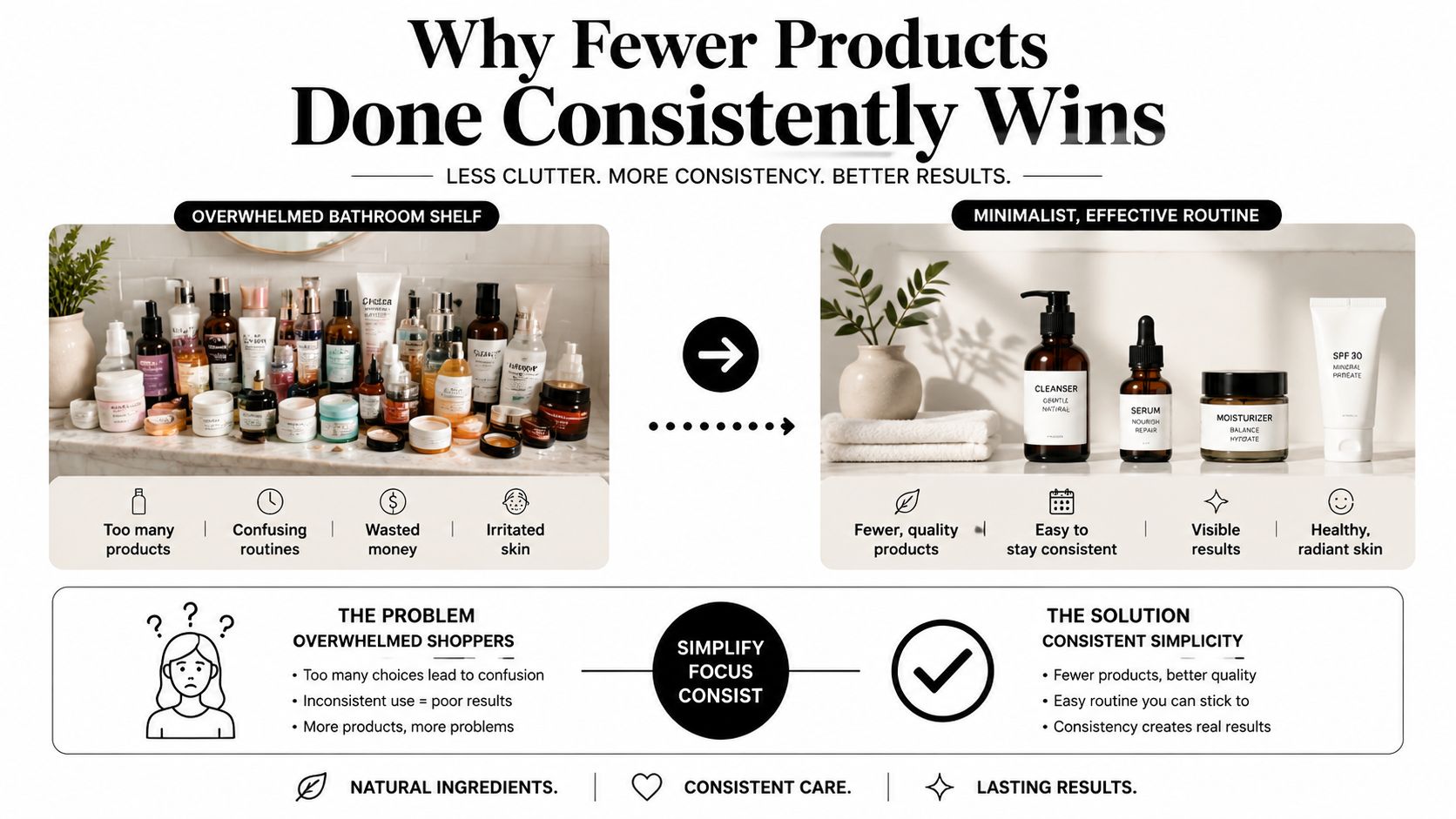
A shelf full of half-used products usually means each bottle is trying to do too much on its own, or it's replacing the discipline of consistency. A simple natural skincare routine works when every bottle earns its spot by doing a clear job, and when the skin sees that same order enough times to respond.
Practical rule: if a step doesn't have a purpose you can name in one sentence, it probably belongs in the back of the cabinet, not on the counter.
The Three Roles Every Natural Routine Must Fill
A useful minimalist routine isn't built around product count. It's built around three roles, cleanse, treat or moisturize, and protect. Once you think in those terms, the routine becomes easier to adjust without adding clutter.
Cleanse, treat, protect
Cleansing removes sunscreen, oil, sweat, and the day's buildup. Treating or moisturizing supports comfort and barrier feel, often with a carrier oil or a gentle hydrating step. Protecting means sunscreen in the morning, because oils can soften skin but they don't replace UV protection.
| Role | Best Single-Ingredient Option | Why It Works |
|---|---|---|
| Cleanse | Jojoba oil | It can help dissolve sebum-like buildup while staying light on the skin. |
| Treat or moisturize | Argan oil | It gives drier skin a more cushioning feel without turning the routine into a cream-heavy mix. |
| Protect | Mineral SPF | It covers the morning step no oil can replace. |
Rosewater fits neatly into the middle of the routine as a toner-like step because it adds a fresh, hydrating feel without making the routine feel heavier. For oily or combination skin, jojoba oil often plays a dual role, since it's described as closely mimicking sebum in the practical guidance used for minimalist routines. For dry skin, argan oil usually feels more substantial, especially when applied to damp skin so it doesn't just sit on top.
A clean beauty bottle should do one job well. A great simple routine usually combines one cleanser, one treatment or moisturizer, and one protection step, then stops there.
Your Morning and Evening Routine in Practice
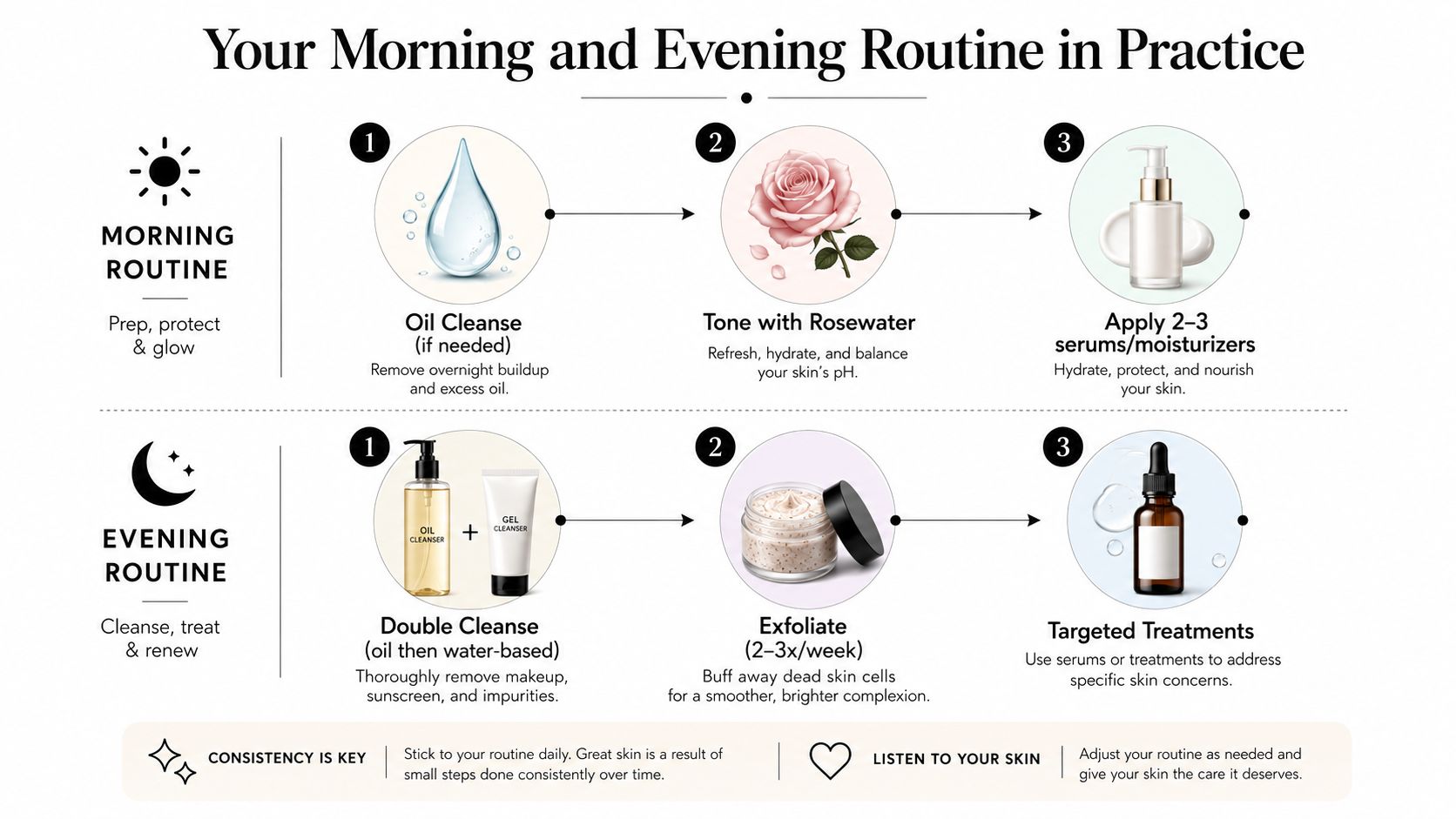
The easiest routine is the one that fits into the time you already have. Morning can be a two-minute reset before coffee, and evening can be the part of the day that helps your skin settle down after makeup, sweat, or city air. The trick is to keep the sequence short enough that you don't negotiate with yourself.
Morning that doesn't feel fussy
If your face feels clean already, you don't need to force a heavy cleanse. A light oil cleanse only if needed, then a rosewater mist, then 2 to 3 drops of jojoba or argan oil on damp skin is enough for many people. Damp skin means the face is still slightly dewy from water or toner, not dripping, and that tiny bit of moisture helps the oil spread more evenly.
Wait a moment between layers if the skin feels slick, but don't turn it into a long ritual. After the oil has settled, finish with broad-spectrum mineral SPF. That last step matters even when the rest of the routine is stripped back.
Evening without the overcorrection
At night, use an oil cleanse if you wore sunscreen or makeup, then follow with a gentle water-based cleanse if your skin likes a cleaner finish. Rosewater can go in again here if your face tends to feel tight after washing. After that, one treatment oil is usually enough, and in minimalist routines that means choosing what the skin needs most instead of stacking every option.
For blemish-prone areas, rosemary oil is best treated as a targeted ingredient, not a full-face pour. If the skin feels dry, seal with argan. If it feels balanced but easily overloaded, jojoba usually stays out of the way better than heavier oils.
The best routine is the one you can repeat on a rushed morning and still recognize on a tired evening.
Adapting the Routine to Your Skin Type
The same bottle can behave very differently depending on how your skin is acting that week. That's why minimalism works better as a ratio system than as a one-size-fits-all script. You don't need a new lineup for every skin type, you need to change how you use the same core oils.

Sensitive, dry, oily, and acne-prone skin
Sensitive skin usually does better when you move slowly. Start with a fragrance-free jojoba and patch test on the inner arm before facial use, which is why this patch testing guide belongs in your process before anything touches the face. If a skin barrier is reactive, keep the formula simple and avoid mixing too many potentially active natural ingredients at once.
Dry skin usually wants more slip and a bit more seal. Argan over damp skin tends to feel more protective, especially after cleansing, and it can be used a little more generously at night than during the day. Oily or combination skin often doesn't need much more than jojoba, because a lighter oil can give comfort without making the face feel coated.
If your skin feels tight after washing, your oil is probably doing part of the cleansing job too. That's not a flaw, it's a clue that the skin wants less stripping and more balance. For acne-prone skin, less really can be more, especially when you avoid piling on multiple rich layers at once.
My working rule: change the ratio before you change the product line.
Ingredient Dos and Don'ts for Clean Beauty Oils
Reading a label matters more than reading a marketing page. The words cold-pressed, unrefined, certified organic, and single-ingredient tell you a lot more about a bottle's usefulness than a green label or a wellness slogan ever will. Those terms don't guarantee perfection, but they do make the bottle easier to trust.
What to look for, and what to skip
A simple face oil should usually be transparent about how it was made. I'd rather see one clear ingredient than a long list that hides fillers, synthetic fragrance, or a vague “fragrance” label. Hexane extraction is another red flag if your goal is a clean, low-noise routine, because it tells you the oil may have been processed in a way that doesn't fit the idea of a stripped-back formula.
Some ingredients need a carrier, not direct skin dumping. Rosemary essential oil belongs diluted in a carrier oil, not used as if it were the star of the routine, and that's where many people overcomplicate things by making a simple routine irritating. Argan and jojoba usually pair well because they stay in the same simple lane, while a heavier or more reactive ingredient should stay targeted.
A common myth is that “natural” automatically means face-safe. It doesn't. Coconut oil can be too heavy for some faces, and “natural” doesn't tell you whether a product suits your pores, your barrier, or your tolerance.
Ella & Eden's what is a carrier oil guide is useful if you want a plain-language explanation of why some oils should carry others instead of competing with them.
Quick label test
- Single ingredient first: If the front says one oil but the back says a bundle of extras, trust the back.
- No vague fragrance: Skip bottles that hide scent under a blanket term.
- Use essential oils carefully: They belong diluted, especially on sensitive skin.
- Don't chase more actives: In a minimalist routine, clarity beats complexity.
The SPF Question Most Minimalist Routines Get Wrong
A simple routine can be gentle, elegant, and still wrong if it skips sun protection. Oils can support comfort, but they don't replace a daily mineral SPF with zinc oxide and at least SPF 30, even in a pared-down routine. That's the line where minimalist stops being smart and starts becoming incomplete.
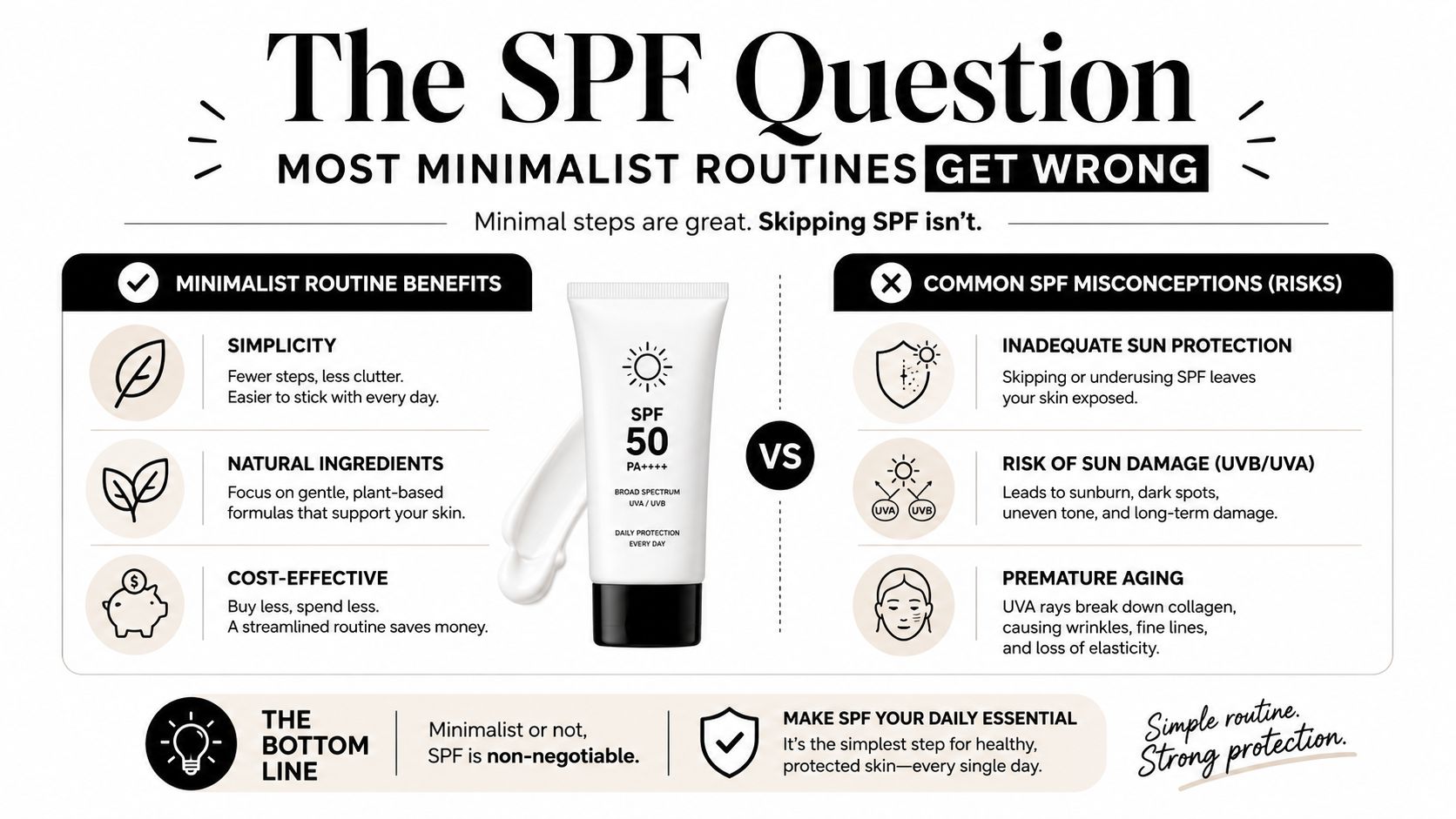
Many people under-apply sunscreen, which means the face gets less coverage than the label implies. That matters even more when the rest of the routine is oil-based, because a freshly moisturized face can make people think they're already covered or protected enough. To clarify, mineral sunscreen goes on last in the morning, and it's the protection step no oil can replace.
Where oil fits, and where it doesn't
Oil can absolutely stand in for moisturizer when the weather is cool, the air is humid, or you're staying indoors most of the day. It can also make sense after an evening cleanse when you want comfort without a cream. It cannot stand in for sunscreen during extended sun exposure, post-procedure skin, or any routine where your skin is already more vulnerable.
If sunscreen pills over oil, use less oil and give it a minute to settle before applying SPF. The goal is a thin, even film of protection, not a shiny face that has to be rescued by more product. Simple doesn't mean cut corners, it means using the right step in the right place.
Bottom line: if your routine is minimalist, the SPF step needs to be even more disciplined, not less.
Your First 30 Days and What to Watch For
The cleanest way to start is to treat the first month like a reset, not a makeover. Week one can be cleanser, toner, and SPF only, so the skin settles and you can see what its baseline feels like. Week two is when you add one treatment oil, then week three is for a second carrier if your skin needs it.
For the first 4–6 weeks, judge the routine by how the skin feels in daily life, not by one dramatic mirror check. The useful signs are softer texture, fewer reactive flare-ups, and a calmer morning feel. Tightness right after cleansing can be a sign that you're stripping too much, not that the routine is failing.
What to change if the skin pushes back
- If your skin is dry: lean into argan and use it on damp skin.
- If your skin is reactive: drop the extra actives and stay with jojoba only.
- If your skin is oily: you're probably using too much, not too little.
- If you're unsure: pause the additions and stay consistent with the basics.
A barrier that's irritated can't tell you which new product is the problem if you add three at once. That's why how to repair skin barrier is worth reading before you decide a product “doesn't work.” The first month is about learning your skin's language, not forcing it to tolerate a larger routine.
Ella & Eden builds simple, multi-purpose oils for people who want fewer decisions and cleaner labels, and the brand's ingredient guides are designed for exactly that kind of routine. If you want to keep your skincare calm, practical, and easy to repeat, visit Ella & Eden and start with the oils and guides that fit your skin type and your mornings.