Facial Oil and Serum: How to Choose, Layer, and Use Both
You know the moment. You're standing at the bathroom shelf, holding two bottles that both promise glow, hydration, and better skin, and you're not sure whether you need one, both, or neither. That's where facial oil and serum get confusing, because they can look similar in a routine while doing very different jobs on the skin.
The cleanest way to sort them out is to stop thinking about marketing and start thinking about formulation. A facial serum is usually the lighter, treatment-focused step, while a facial oil is the lipid step that helps soften skin and lock in moisture. Once you understand that split, choosing, layering, and skipping becomes much easier.
The category data shows why this question matters now. The facial serum market was estimated at USD 6.20 billion in 2025 and is projected to reach USD 10.66 billion by 2033, with a 7.1% CAGR from 2026 to 2033, while the face oil market is also growing from a smaller base, with estimates around USD 1.84 billion in 2025 and an 8.1% CAGR in one forecast, or USD 3.11 billion in 2026 and USD 5.68 billion by 2033 in another projection. That tells you both formats are mainstream now, not niche extras, and they're being pulled by real consumer interest in targeted skin goals rather than generic “more moisture” messaging.
| Criteria | Facial Serum | Facial Oil |
|---|---|---|
| Core role | Targets concerns with actives | Softens and seals in moisture |
| Typical base | Usually water-based | Oil-based |
| Texture | Light, fast-moving | Richer, more cushiony |
| Best for | Fine lines, discoloration, texture | Dryness, barrier support, comfort |
| Routine position | Earlier | Later |
What a Facial Oil and Serum Actually Are
A shelf can make these products look interchangeable, especially when both bottles promise radiance or hydration. They're not interchangeable in the formula sense. A facial serum is usually built around a lighter base, often water-based, so the skin can take in concentrated active ingredients more efficiently. A facial oil is built around lipids, so it sits in a different lane, softening the skin and helping hold moisture in place.
The simplest way to tell them apart
If you open the ingredient list of a serum, you'll often see a formulation designed to carry water-soluble actives. That's why serums are commonly chosen for fine lines, discoloration, and texture, and why they're treated as the “problem-solving” step in many routines. A facial oil, by contrast, is centered on oils and other lipids, so its job is less about delivering water to the skin and more about supporting comfort and reducing the feeling of dryness.
That difference matters in clean beauty because simple oils are easy to understand. A single-ingredient bottle of jojoba, argan, or rosehip doesn't ask you to decode a long active stack. You know what it is, and you know roughly what it's trying to do, which is why many minimalist routines start there.
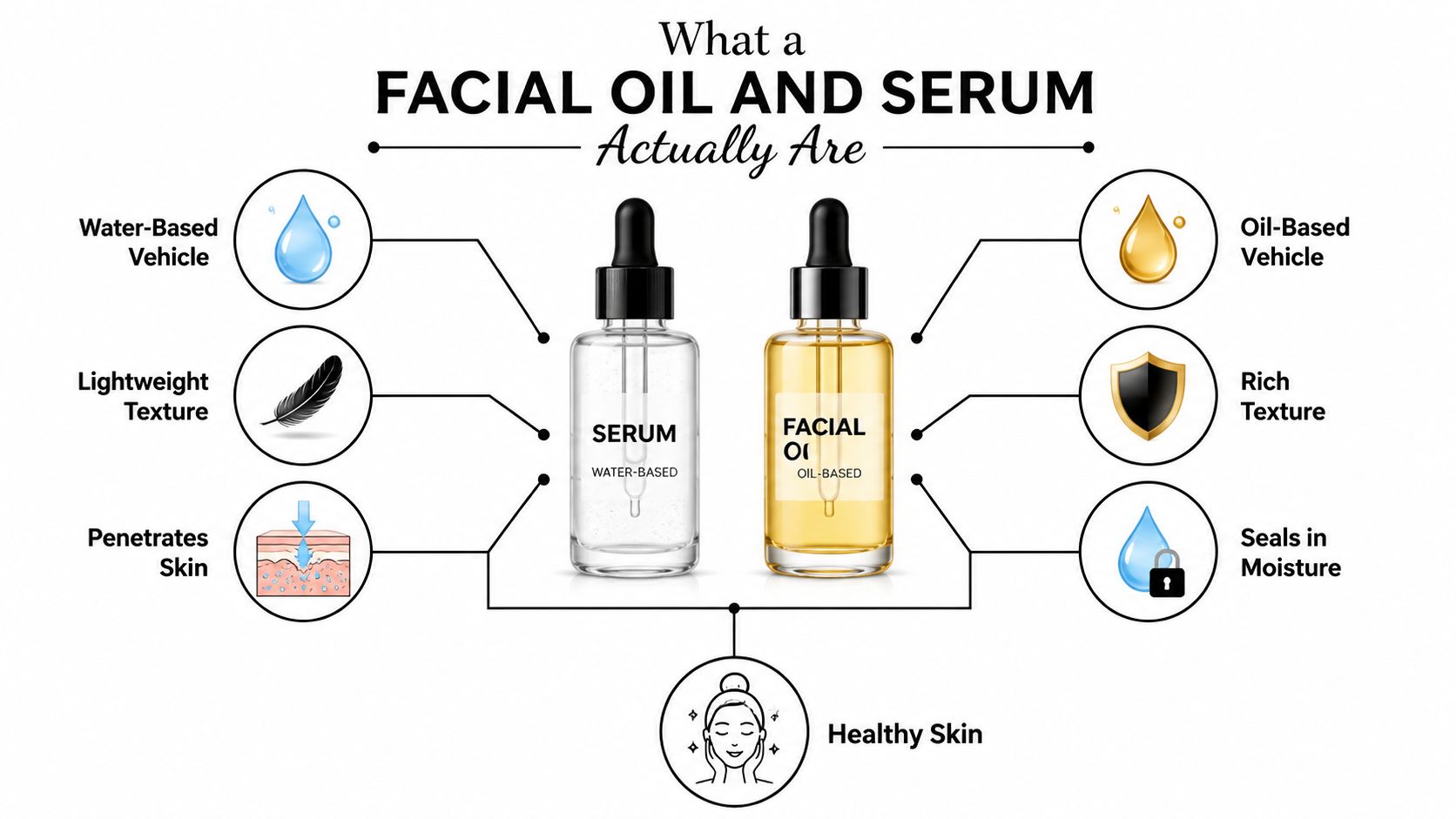
Practical rule: if the bottle is designed to deliver actives quickly, you're looking at a serum. If it's designed to soften skin and trap moisture, you're looking at an oil.
The market data backs up that these are established categories, not fringe steps. Serums are now a major global segment, and facial oils are growing steadily as well. That lines up with how people use them, as targeted treatments on one side and comfort-focused sealants on the other.
How Each One Works on Your Skin
Serums and oils behave differently because skin is layered, and the formulas are built for different jobs. A serum is usually the more efficient vehicle for water-soluble actives such as hyaluronic acid, niacinamide, and vitamin C derivatives. Those ingredients are chosen because they're meant to reach the skin in a lighter format and address concerns more directly.
Why serums feel “active”
A serum tends to feel thinner because it's meant to absorb quickly and disappear into the routine without leaving much residue. That's useful when you want to focus on a concern like dullness, uneven tone, or early lines. The point is not to coat the skin. The point is to deliver a concentrated treatment layer that can sit close to the skin and do its work.
A facial oil works differently. It doesn't add water to skin. It helps seal in hydration and reinforce the surface barrier, which is why dry or sensitized skin often feels more comfortable after oil than after another active product. Think of it less as a treatment syringe and more as a protective finish that slows moisture loss.
A serum brings actives. An oil protects what's already there.
That distinction is why an oil can feel wonderfully cushioning without replacing every serum. A skin barrier that's stressed, tight, or flaky may need more support than more actives. In those cases, a straightforward oil can be the more sensible choice because its formula is easier to predict and less likely to feel busy on the skin.
If you want a clean-botanical example of how that simplicity is presented, natural facial serums often sit in the same conversation as oils because readers are trying to decide whether they want a treatment step or a softer, sealing step. The answer depends on the skin's condition, not the trend.
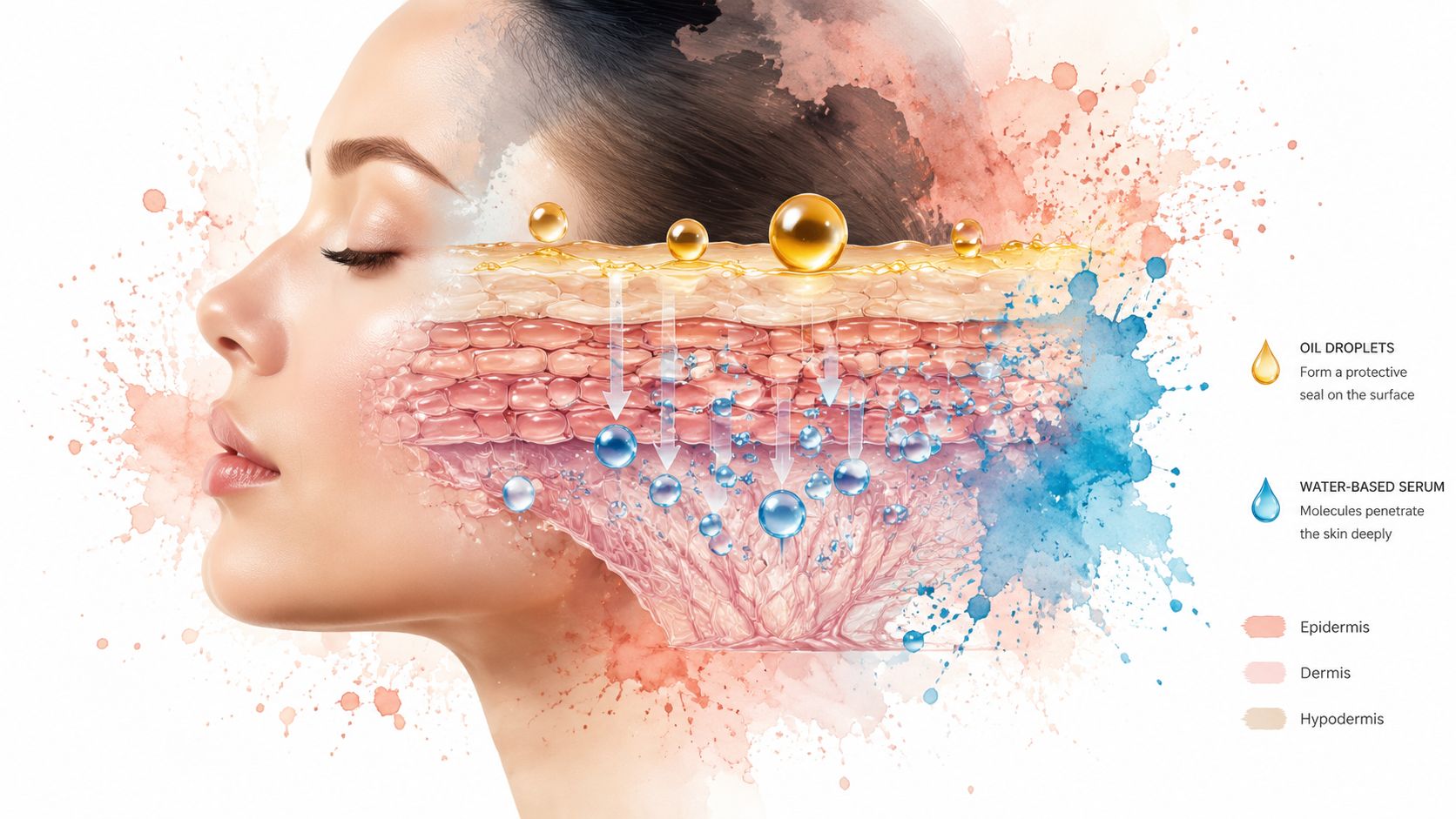
The clean beauty advantage is that oils can be easier to read at a glance. A single oil has a transparent composition, while many serums combine several actives that work well for one concern but can feel too much for another. That's why the formula, not the label, should guide the choice. The difference between face serums and oils is really a difference in how each one interacts with water, lipids, and the skin's surface.
Side by Side on Texture, Ingredients, and Feel
The fastest way to compare facial oil and serum is to put them next to each other and ask what they feel like on the skin, not what the label promises. That's where the decision usually happens. A product can sound ideal in theory and still feel wrong in a humid morning, a winter night, or on skin that's already irritated.
| Criteria | Facial Serum | Facial Oil |
|---|---|---|
| Texture | Light, fluid, often gel-like or watery | More plush, more emollient |
| Common ingredient pattern | Water-based actives and humectants | Lipids, plant oils, and barrier-supportive fatty compounds |
| Absorption | Sinks in quickly | Rests longer and creates a soft finish |
| Skin feel | Fresh, thin, treatment-like | Cushioned, smooth, sealing |
| Best climate or condition | When you want actives without heaviness | When skin feels dry, tight, or exposed |
Modern oils aren't all heavy or greasy. Well-chosen oils like jojoba and argan can absorb quickly and leave a soft finish, which is why they fit clean routines so well. The point isn't to make skin glossy for the sake of it. The point is to make skin feel protected without smothering it.
What the finish tells you
A serum usually disappears more completely, which is why people reach for it when they want a treatment step under moisturizer or SPF. A facial oil usually leaves a more noticeable after-feel because its job is to stay at the surface and help keep water from escaping. That's also why many people prefer oil at night. It can feel like the final, quiet layer that keeps the rest of the routine from evaporating away.
The most useful shortcut is this, serums penetrate, oils protect.
If you're comparing ingredient types, that difference is the tell. Serums are often built to carry active ingredients that address specific goals. Oils are usually chosen for their lipid profile, sensory comfort, and ability to reduce the feeling of dryness. For a reader who wants a transparent bottle, that makes a single oil easier to evaluate than a serum with several actives stacked together.
For a clean, ingredient-first approach, best organic facial oils is the kind of resource that helps people think in terms of function rather than hype. That mindset matters because the best product isn't the richest one, it's the one that fits the skin state you're in right now.
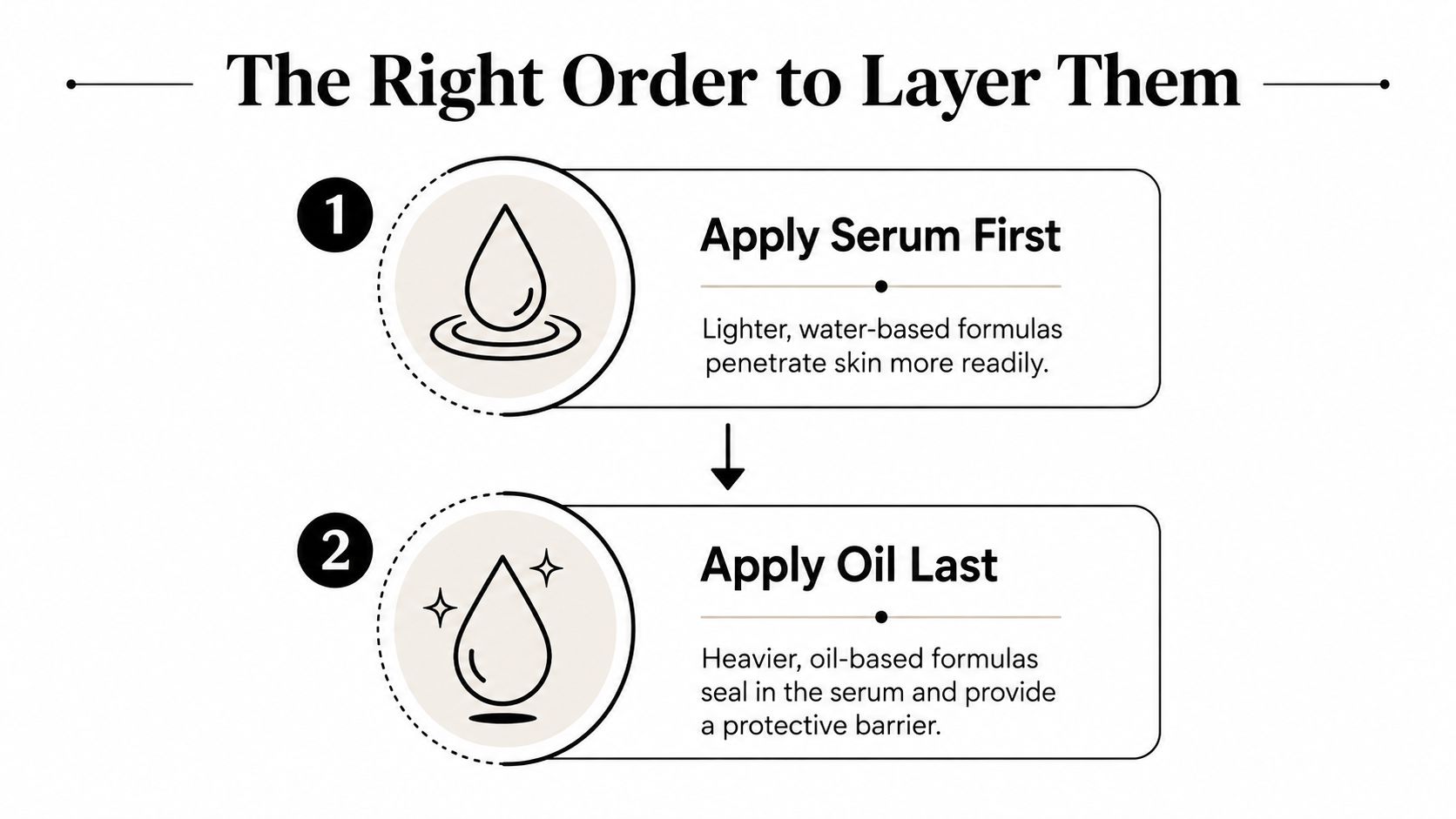
The Right Order to Layer Them
The classic rule is still the right starting point, serum first, oil last. The reason is simple. Serums are lighter and absorb more readily, so they belong closer to clean skin. Oils are more sealing, so they work best as the final layer that helps lock in the serum and the moisture underneath it.
How to make the order work in real life
Apply serum to slightly damp skin if you want more slip and a less draggy feel. Then warm 2 to 3 drops of oil between your palms and press it in rather than rubbing hard. That tiny shift in technique makes the oil feel more even and can help it sit nicely over the treatment layer instead of pill.
Morning and evening can look different. In the morning, a serum can sit under moisturizer and SPF if your skin likes it, while oil often works better as the last step at night. If your skin is sensitized or over-treated, simplify first. A calm routine with fewer steps is usually smarter than trying to push through with more actives.
If you want both, apply the water-based step first and use oil as the seal.
Mixing oil and serum in the palm can be fine for comfort, but the order still matters if you want the serum to have first contact with skin. Think of the palm mix as a convenience option, not a rule replacer. The more targeted the serum, the more useful the correct layering order becomes.
Matching Each Format to Your Skin Type and Concern
Skin type changes the answer more than habit does. A product that feels perfect on dry skin can feel too rich on oily skin, and a serum that helps texture can sting on barrier-impaired skin. That's why the better question isn't “Which one is better?” It's “Which one matches what my skin is doing right now?”
Dry, sensitive, oily, and combination skin
Dry skin usually benefits from both steps, but the oil often earns its place as the comfort layer. Sensitive or barrier-impaired skin can also do better with a single-ingredient oil because the formula is simpler and less likely to feel busy. Oily skin isn't automatically a serum-only category, either, because a well-chosen oil can feel balancing instead of stripping.
Combination skin often needs a split approach. Use serum on the zones where you want a targeted active, then oil only where the skin feels tight or exposed. That's less glamorous than one-bottle promises, but it's usually more accurate.
If you want a deeper resource on acne-prone routines, best oils for acne prone skin is useful because it keeps the conversation focused on compatibility rather than fear.
When the goal matters more than the skin type
For glow and short-term softness, facial oil often wins because it changes the skin feel quickly. For hydration, either can help, but they help in different ways, serum by adding water-binding ingredients, oil by holding the moisture in place. For anti-aging or hyperpigmentation, a treatment serum is usually the smarter anchor because those concerns need active ingredients, not just a comforting finish.
For calming a skin state that feels raw, tight, or stripped, a single oil can be the more rational choice. That's the trap in assuming oil is always the safer route. If the goal is breakouts, discoloration, or lines, a basic oil may feel gentler, but it won't replace a concern-specific serum.
Don't choose oil just because it feels safer. Choose it when barrier support is the goal, not when you need an active treatment.
A few skin states make this even clearer. Oily skin often needs less stripping, not more, while sensitive skin often prefers fewer variables. Mature skin often benefits from both the support of oil and the precision of serum, but not always in the same moment. Match the product to the problem, and the routine gets simpler.
Two Real Routines You Can Start This Week
A routine only becomes useful when it fits an actual night, not an idealized shelf. The easiest way to test facial oil and serum is to try one simple routine and one more targeted routine, then notice how your skin behaves the next morning. The goal is not to add steps just because they exist.

Minimalist evening routine
Start with a gentle cleanse, the kind that leaves skin clean but not squeaky. Then press in a single-ingredient facial oil such as jojoba or argan while the skin is still a little damp. If it's morning instead, finish with SPF and stop there.
That routine works well for people who want less noise in their cabinet and less friction on their skin. It also makes sense when your skin is sensitive or you're recovering from overuse of active products. The oil serves as the comfortable middle ground, especially when the face feels dry but not actively in need of a treatment serum.
Targeted routine for layered concerns
Use a low-pH cleanse, follow with a hydrating toner, then apply a treatment serum that fits the concern, such as dullness or texture. After that, seal with moisturizer, and add facial oil as the last step if the skin still feels tight or if you want a more cushioned finish.
That order keeps each product in its lane. The serum does the problem-solving, the moisturizer fills in the hydration layer, and the oil protects the finish. It's the cleanest way to use both without making the routine feel heavy.
If a new product pills, don't assume your skin hates it right away. Try using less, letting each layer settle, and avoiding overly rich combinations under makeup. If you feel tightness, scale back to a simpler routine. If you break out, remove the newest product first and keep the rest of the routine steady for a few days.
When a Single Oil Is All You Need
There are nights when a facial oil is enough, and saying that out loud matters. For barrier support, everyday softness, and simple comfort, a high-quality single-ingredient oil can be the more rational choice than a complicated stack of treatments. But for an active goal, like acne care, hyperpigmentation, or line-focused treatment, the serum still has the clearer job.
That's where minimalist, clean formulas make the decision easier. Single-ingredient, cold-pressed, unrefined oils keep the ingredient list transparent, which helps when you want to know exactly what's touching your skin. The market data also fits that preference. A forecast projects the face oil market at USD 3.11 billion in 2026, reaching USD 5.68 billion by 2033, with single-oil formulations holding 43.8% of market share in 2026 and hydrating oils leading at 29.3%.
How to choose an oil by goal
Jojoba is often chosen when you want balance and a lighter feel. Argan is a common pick for softening. Castor tends to show up in more targeted rituals, while rosemary often belongs in scalp-adjacent routines rather than a simple face-first conversation. The point is not to collect oils, it's to match one oil to one use.
A trustworthy bottle usually has a short, readable story. Look for organic certification, cold-pressed extraction, unrefined processing, a single-ingredient label, and no fillers or hexane. That's the clean beauty version of clarity, and it's easier to use than a formula that tries to do everything at once.
If you also care about scent and botanical ritual, the discussion around benefits of essential oils for skin can be useful as long as you keep it separate from face oil basics. Essential oils and carrier oils are not the same thing, and your face routine is usually better served by the simpler category when irritation is a concern.
Pick the format that matches your goal, not the one that promises more.
Ella & Eden offers single-ingredient facial oils, including options like jojoba, argan, and rosehip, alongside a Vitamin C Serum for Face, so readers can choose either the sealing step or the treatment step depending on what their skin needs. If you want to compare those choices in one place and build a cleaner routine around them, visit Ella & Eden.