Best Oils for Skin Elasticity Backed by Science
You notice it in small moments first. Your skin doesn't bounce back the way it used to, smile lines linger longer in the mirror, and the jawline looks a little less crisp after a long week. That's usually when people start searching for the best oils for skin elasticity, hoping for something simple, clean, and effective.
The tricky part is that a lot of advice blurs two different goals, making skin look less dry and improving true elasticity. Those aren't the same thing. Oils can support the barrier, soften roughness, and help skin feel more resilient, but the strongest evidence comes from specific oils with measured effects on skin biophysics, not from vague glow claims.
A useful way to think about this is like a well-worn elastic band. Water gives it temporary plumpness, but the fibers and surrounding structure decide how well it stretches and springs back.
Introduction to Oils and Elasticity
A lot of people reach for oil after noticing dryness, but the real question is whether the oil can do more than make skin look temporarily smoother. Elasticity is about rebound. It's the difference between skin that stretches and settles back versus skin that stays creased and tired-looking.
That's why the phrase best oils for skin elasticity needs some context. The most useful oils aren't magic tighten-up products. They're ingredients that support the skin barrier, help reduce water loss, and, in some cases, improve measured skin mechanics in human studies.
A good example is evening primrose oil, which showed measurable changes in skin biophysics in a controlled human study. Argan oil also stands out because its evidence comes from postmenopausal women, a group where skin often becomes drier and less elastic over time. Those details matter because they move the conversation away from marketing and toward what the skin can do.
If you're trying to build a routine that feels practical instead of complicated, start with one oil, one texture, and one clear goal. Hydration is helpful, but it's not the full story. Elasticity is the primary target.
Understanding Skin Elasticity Mechanisms
Skin elasticity comes from the way collagen, elastin, and surrounding tissue work together. Collagen gives skin structure, elastin helps it recoil, and the ground substance between them affects how well the whole system moves. When that network is healthy, skin behaves a bit like a springy mesh rather than a dried-out sheet.
What oils can change and what they can't
Oils don't rebuild skin from the outside in like a surgical procedure might. What they can do is support the barrier so skin loses less water and feels less fragile. That's why many product claims focus on firmness and smoothness, while the deeper question, whether oils change true elastic recoil, is often under-addressed in consumer content.
Practical rule: if an oil makes skin look smoother in the mirror but leaves it feeling less tight over time, you're probably seeing barrier support, not collagen rebuilding.
That distinction matters for expectations. Moisture can make skin look fuller for a few hours, which is useful, but it's not the same as improving measurable elasticity. In the human studies cited later, the interest is not just shine or softness, it's how skin performs under testing.
People also get confused because “firmness” sounds like “tightness.” In skin science, those aren't interchangeable. A product can improve the feel of firmness by reducing dryness and friction, while elastic recoil refers to how skin springs back after stretching. That's why a skin oil can be useful without pretending to be a replacement for medical treatments or active remodeling products.
Key Oil Components That Support Elasticity
The compounds inside an oil matter more than the front label. A bottle can say “luxury” or “firming,” but skin responds to what is in the formula, especially fatty acids, antioxidants, and protective plant compounds.
Fatty acids do the heavy lifting
Gamma-linolenic acid, or GLA, is one of the clearest examples. It is a fatty acid associated with evening primrose oil, and it matters because skin barrier lipids help the surface stay organized and hold moisture more effectively. In a randomized, double-blind, placebo-controlled study of evening primrose oil in healthy adults, supplementation improved moisture, reduced transepidermal water loss, improved elasticity, improved firmness, improved fatigue resistance, and improved roughness. Those are measurable changes, not just cosmetic language.
Antioxidants help preserve what the skin already has
Antioxidants do not replace collagen, but they help defend skin structures from oxidative stress. That matters because skin is constantly dealing with light exposure, pollution, and daily wear. Oils with antioxidant-rich plant compounds can be especially helpful in a routine aimed at mature or stressed skin, where preservation matters as much as support. For readers who want a straightforward source of vitamin E, Vitamin E oil from Ella & Eden is a single-ingredient example often used in minimalist routines.
Phytochemicals add supportive context
Plant sterols, polyphenols, and carotenoids show up in some botanical oils and shape the overall profile. They do not all do the same job, and that is the point. Some help with barrier feel, some help with oxidative defense, and some help the oil sit more comfortably on skin.
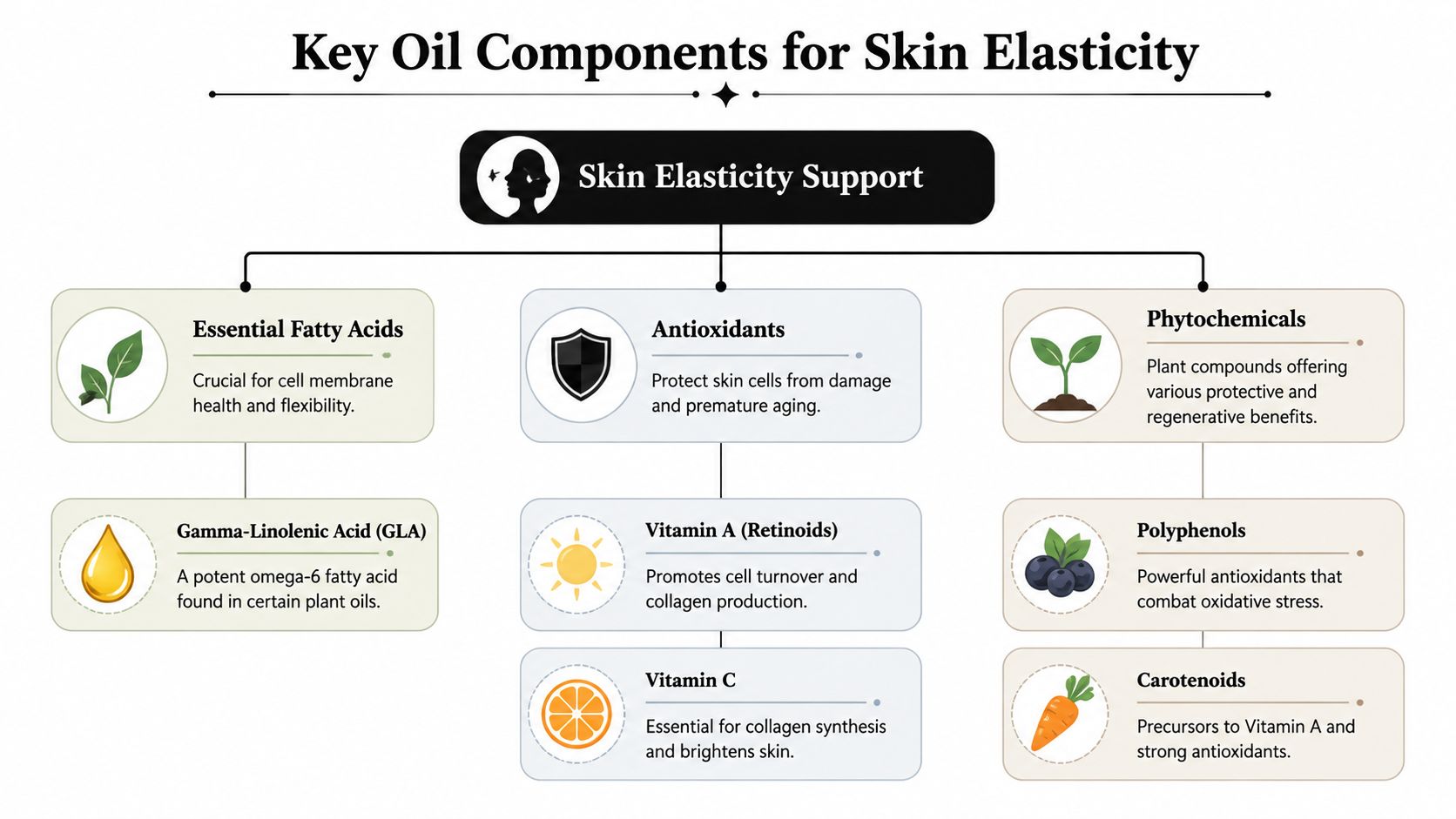
A simple way to sort the ingredients is this:
- Essential fatty acids: support cell membrane flexibility and barrier feel.
- Gamma-linolenic acid: useful in oils where elasticity support is the goal.
- Antioxidants: help protect skin from stress that can make visible aging more pronounced.
- Phytochemicals: add supportive, often soothing or protective effects.
The main takeaway is simple. Oils support elasticity best when they bring the right fats and supportive compounds, not just a pleasant texture.
Review of the Best Oils for Skin Elasticity
A skin oil earns its place by doing more than adding shine. The better choices line up with active compounds, skin type, and human evidence, so the oil supports how skin behaves, not just how it feels for a few minutes. That is why argan and evening primrose stay in the conversation, while some other oils are better understood as supportive options that help the routine rather than directly changing elasticity on their own.
Comparing the top contenders
| Oil | Key Actives | Evidence Summary | Best For |
|---|---|---|---|
| Evening Primrose Oil | GLA | Human study showed improvements in elasticity, firmness, moisture, TEWL, fatigue resistance, and roughness | Dry, rough, barrier-weakened skin |
| Argan Oil | Fatty acids, antioxidant compounds | Trial in postmenopausal women showed significant improvements in gross elasticity, net elasticity, and biological elasticity, with P < 0.001 Argan study | Mature skin, skin that feels less springy |
| Jojoba Oil | Waxy esters that resemble sebum | Often favored for a lighter feel and a more sebum-like texture, especially in minimalist routines | Combination, sensitive, acne-prone skin |
| Rosehip Oil | Fatty acids, carotenoid-rich profile | Commonly used for texture and barrier support, though the strongest elasticity data are less direct than argan or evening primrose | Dull, uneven, photo-aged-looking skin |
| Grapeseed Oil | Linoleic-acid-rich profile | Better suited to lighter routines and less greasy finishes | Oily or acne-prone skin that still wants moisture support |
Argan deserves special attention because the study population matters. In postmenopausal women, skin elasticity often declines alongside dryness, so an improvement in elasticity parameters is a relevant signal, not just a generic beauty result Argan study. That makes argan one of the more convincing options if the concern is visible loss of bounce rather than only surface dryness.
Evening primrose has a different strength. Its story centers on GLA, which links the oil to measurable changes in skin properties in healthy adults. That matters because it suggests the effect is not only about comfort or glide. It is about the skin performing better under testing, the way a well-tuned hinge opens more smoothly than a dry one.
For readers who want a lighter-feel oil often used in simple routines, jojoba oil for skin is a practical reference point because jojoba tends to suit people who dislike a heavy finish. It also shows why “best” is not a single answer. The right oil depends on the skin you are putting it on.
How to Apply Oils for Maximum Elasticity
Application matters almost as much as ingredient choice. A strong oil can still underperform if it is placed on completely dry skin, used in too large an amount, or layered in the wrong order. A smaller amount, applied with the skin's own moisture still present, usually gives a better result in daily use.
Build the routine in the right order
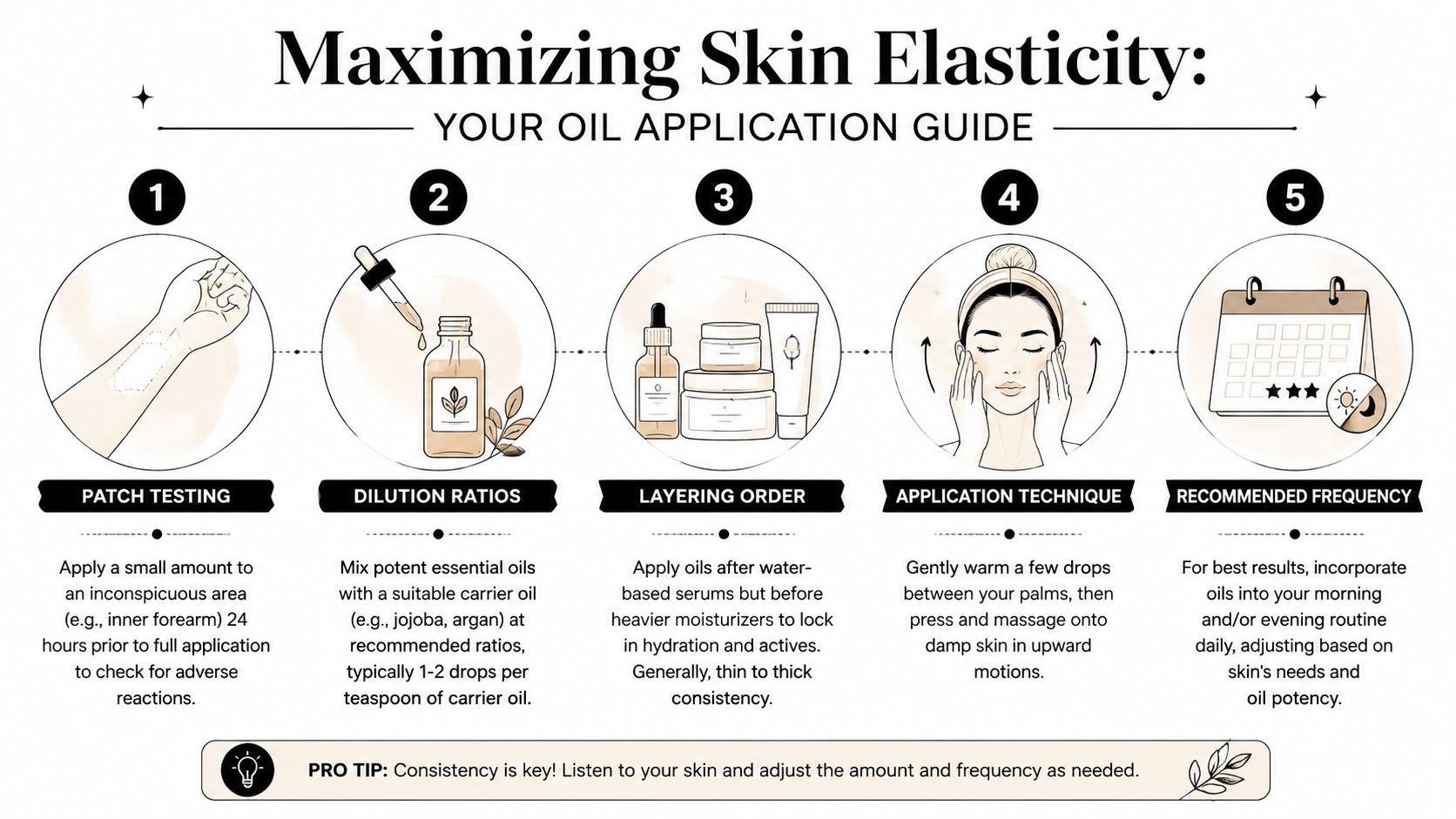
Start with clean skin, then apply any water-based serum before oil. Oils work best as a sealing layer, not as the first product on fully dry skin. The oil traps the water that is already there, much like a lid helps keep steam inside a pot. A 2025 routine-design guide also supports applying oil right after showering on damp skin, ideally with humectants such as hyaluronic acid, because that pairing supports barrier function and visible elasticity.
Keep the amount small
You do not need much. A few drops warmed between the palms usually spread farther than expected. Pressing the oil into skin often feels better than rubbing hard, especially if the skin is sensitive or already reactive. That lighter touch helps the oil sit evenly instead of gathering in one greasy patch.
Use dilution when the oil is potent
If you are using a stronger essential oil, dilute it into a carrier oil instead of applying it directly. Jojoba or argan can serve as the base. That lowers irritation risk and makes the routine easier to keep up day after day.
Best practical habit: apply oil after a shower, while skin is still slightly damp, then finish with moisturizer if your skin needs extra seal-in support.
Patch testing still matters even with “natural” products. An inner forearm test can reveal irritation before you use the oil on your face or neck. That matters more if you deal with redness, eczema-prone skin, or a history of reacting to fragrance or botanicals.
A simple routine is often the easiest one to sustain. Use the oil daily on areas that feel dry, crepey, or less springy, then adjust based on how your skin responds. Elasticity support usually comes from steady use, not from a dramatic one-night change.
Matching Oils to Skin Types and Concerns
The same oil can feel comfortable on one face and too heavy on another. Skin type changes the choice because texture, oxidation stability, and how an oil sits on the skin matter just as much as the headline ingredients.
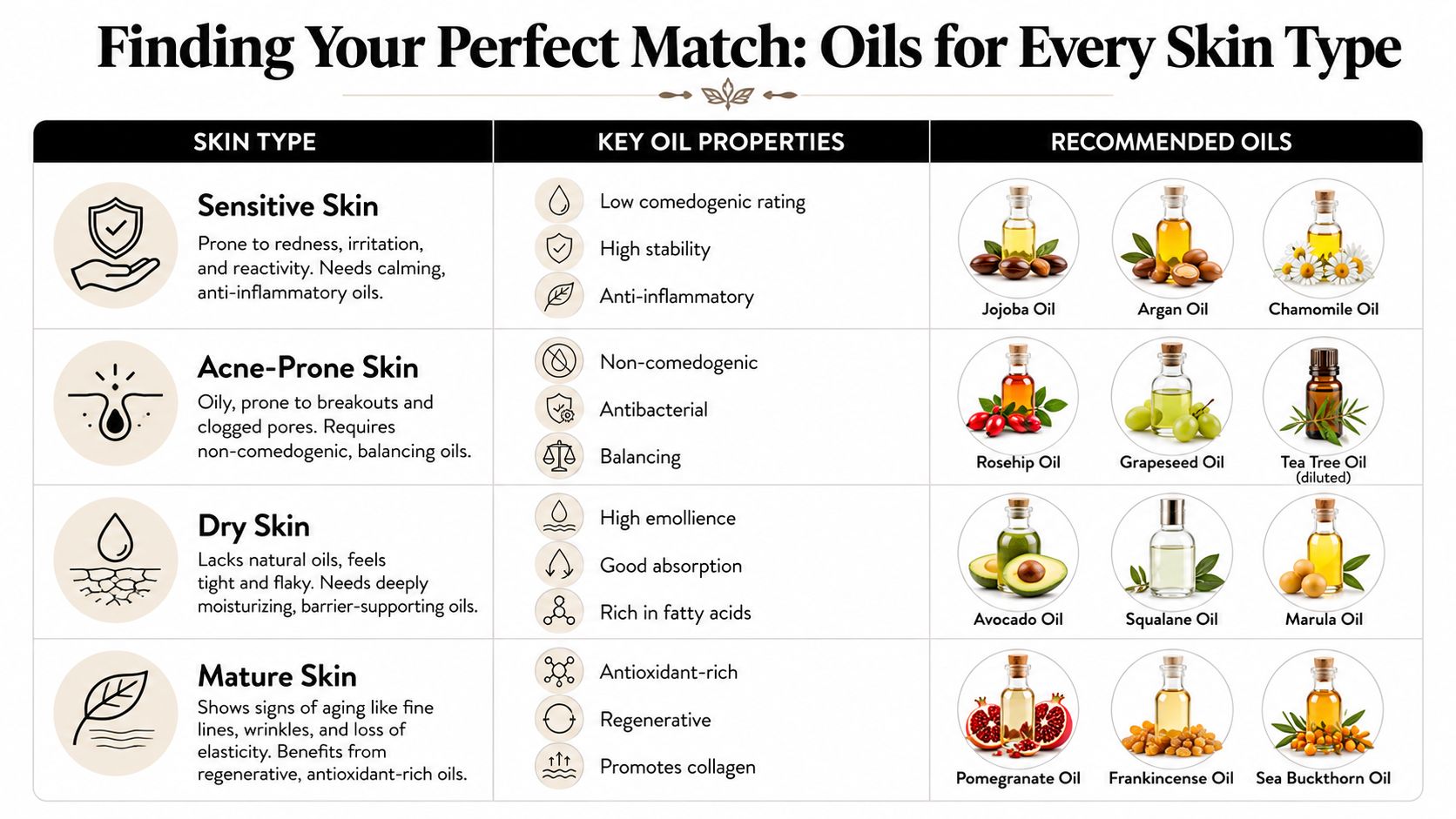
A simple fit guide
- Sensitive skin: Choose low-irritation oils with a calm texture, such as jojoba or argan. Jojoba's sebum-like feel is one reason it is often chosen in gentle routines, and its lighter finish can be easier to tolerate.
- Acne-prone skin: Choose linoleic-acid-rich oils that feel lighter and are less likely to leave a heavy film. As noted earlier, jojoba mimics sebum, and linoleic-acid-rich oils may suit acne-prone skin better than heavier monounsaturated oils.
- Dry skin: Pick oils with a richer emollient feel and stronger barrier support. Evening primrose and argan are often easier fits when skin feels tight, flaky, or rough.
- Mature skin: Focus on antioxidant-rich options with stronger elasticity evidence, especially argan. That profile fits skin that has started to look less springy and more creased.
A useful way to sort oils is to match the oil's chemistry to the skin's main complaint. If skin feels reactive, a lighter, simpler oil usually lowers the chance of discomfort. If skin feels rough and depleted, a more cushioning oil can help reduce the friction that makes lines look sharper. If the goal is true elasticity support, the oil with the strongest human data should stay near the top of the list, then texture can be adjusted around it.
One routine can still stay simple
You do not need four separate products to cover four concerns. A minimalist routine often works better with one base oil and one backup option, then placing them where the skin needs them most. Face, neck, chest, and body do not always need the same formula.
Cold-pressed oils also make the formula easier to read and compare. For a clear reference point on what that means, what cold-pressed oil means is a useful starting point. When a bottle is simple, it is easier to tell whether your skin is getting along with the oil or reacting to extra ingredients.
A practical shortcut helps here. If your skin breaks out easily, start lighter. If your skin feels thin or dry, start richer. If elasticity is the main goal, begin with the oil that has the clearest support for that concern, then adjust the feel of the routine around it.
Safety Tips and Choosing Cold-Pressed Oils
The safest routine is usually the simplest one. A cold-pressed, unrefined, single-ingredient oil gives you a clearer formula, fewer filler concerns, and better control over how your skin reacts. That matters more than pretty packaging or trendy blends.
Cold-pressed oils also make it easier to judge whether the product is helping or irritating your skin. If a formula includes fragrance, multiple extracts, or vague “proprietary” blends, it becomes harder to know what your skin likes. For a clean, no-fuss example of this category, what cold-pressed oil means is a good reference point.
What to check before you buy
- Ingredient list: Choose one oil when possible, especially if your skin is sensitive.
- Storage and packaging: Dark bottles and tight caps help preserve quality better than clear, loosely sealed containers.
- Smell and texture: Rancid or unusually sharp odors can signal poor freshness.
- Patch testing: Always test first on a small area before moving to the face or neck.
Photosensitivity is another reason to be careful with certain essential oils. If an oil is highly aromatic or intended as an active essential oil rather than a gentle carrier oil, dilution and nighttime use are usually safer. That's especially relevant if you're building a daytime routine and spending time outdoors.
Safety first: the more reactive your skin is, the more valuable a plain, fragrance-free oil becomes.
There's also a practical timing issue. If you're trying a new oil for elasticity, don't stack it with several other new products at the same time. Keep the routine narrow so you can see whether the oil is helping or whether your skin is benefiting from the added seal.
The best oils for skin elasticity are the ones you can tolerate long enough to use consistently. A well-chosen bottle, stored properly and applied carefully, usually beats a complicated shelf of half-used products.
If you want a cleaner skincare routine built around simple, fragrance-free oils, visit Ella & Eden to explore options like jojoba and argan that fit a minimalist elasticity-support plan. Their approach matches this topic well, because it focuses on single-ingredient, cold-pressed oils you can use every day without extra clutter.