What Is Mango Butter and Why Your Skin Loves It
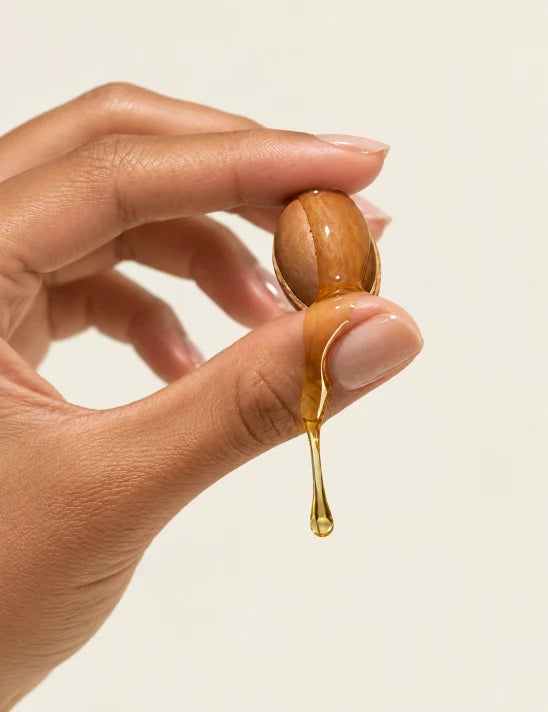
You're standing in front of a clean-beauty shelf, comparing a pale, soft butter with familiar jars of shea and cocoa. The label says mango butter, but that name can be misleading. It doesn't come from the juicy mango flesh you eat. It comes from the hard kernel inside the fruit's seed, and its distinctive balance of fatty acids determines whether it feels firm, creamy, protective, or too rich for your skin.
So, what is mango butter in practical terms? It's a semi-solid plant fat used as an emollient and structuring ingredient in skincare and haircare. Its stearic acid helps create body and staying power, while oleic acid contributes glide and softness. That combination explains why a jar can feel solid on a shelf, then melt into a smooth layer as you warm it between your fingers.
Meet Mango Butter Before You Reach for It
Open a jar of mango butter and warm a small amount between your fingertips. It begins with more structure than a liquid oil, then softens against your skin. This behavior comes from a seed-kernel fat made from Mangifera indica, the botanical name for the mango tree, rather than from mango pulp or juice. Technical ingredient information on mango butter describes it as a semi-solid plant fat produced from the fruit's kernel for cosmetic use.
The kernel creates a material very different from the fragrant, watery fruit. Mango butter generally has a quiet, butter-like texture and mild scent, so it can support a formula without making fragrance the main experience. In a routine, it sits between a harder butter and a liquid oil, adding cushion while remaining softer and more spreadable than a wax.
The simplest definition
Mango butter functions as a softening and sealing ingredient. It does not supply water to skin, so it is not a humectant like a water-based product. Its oily components form a surface layer that smooths the feel of roughness and helps slow moisture loss, especially when applied over damp skin or another moisturizing layer.
Its texture reflects the balance between saturated and unsaturated fatty acids. Stearic acid contributes firmness and body. Oleic acid supports glide and easier melting as the butter is worked across skin. Together, they help explain why mango butter can feel structured in a jar but turn into a comfortable film during application.
That balance also gives it a practical role in formulation. It can add body to body butters, balms, lip products, hair products, and solid treatments without automatically creating the dense drag associated with a very hard butter.
Practical rule: If you want a butter that gives a product body but still melts into a comfortable film, mango butter is a sensible ingredient to investigate.
Mango butter is available beyond a single orchard or beauty tradition. The mango tree originated in South Asia and is now cultivated across tropical regions, with commercial production and processing documented in India, Thailand, Pakistan, Brazil, tropical Africa, Mauritius, and the Seychelles. That broad availability places it alongside shea, cocoa, and plant oils in minimalist routines. The useful question is not whether it moisturizes, but whether its stearic-oleic balance suits the texture and skin feel you want.
Where Mango Butter Comes From and How It's Made
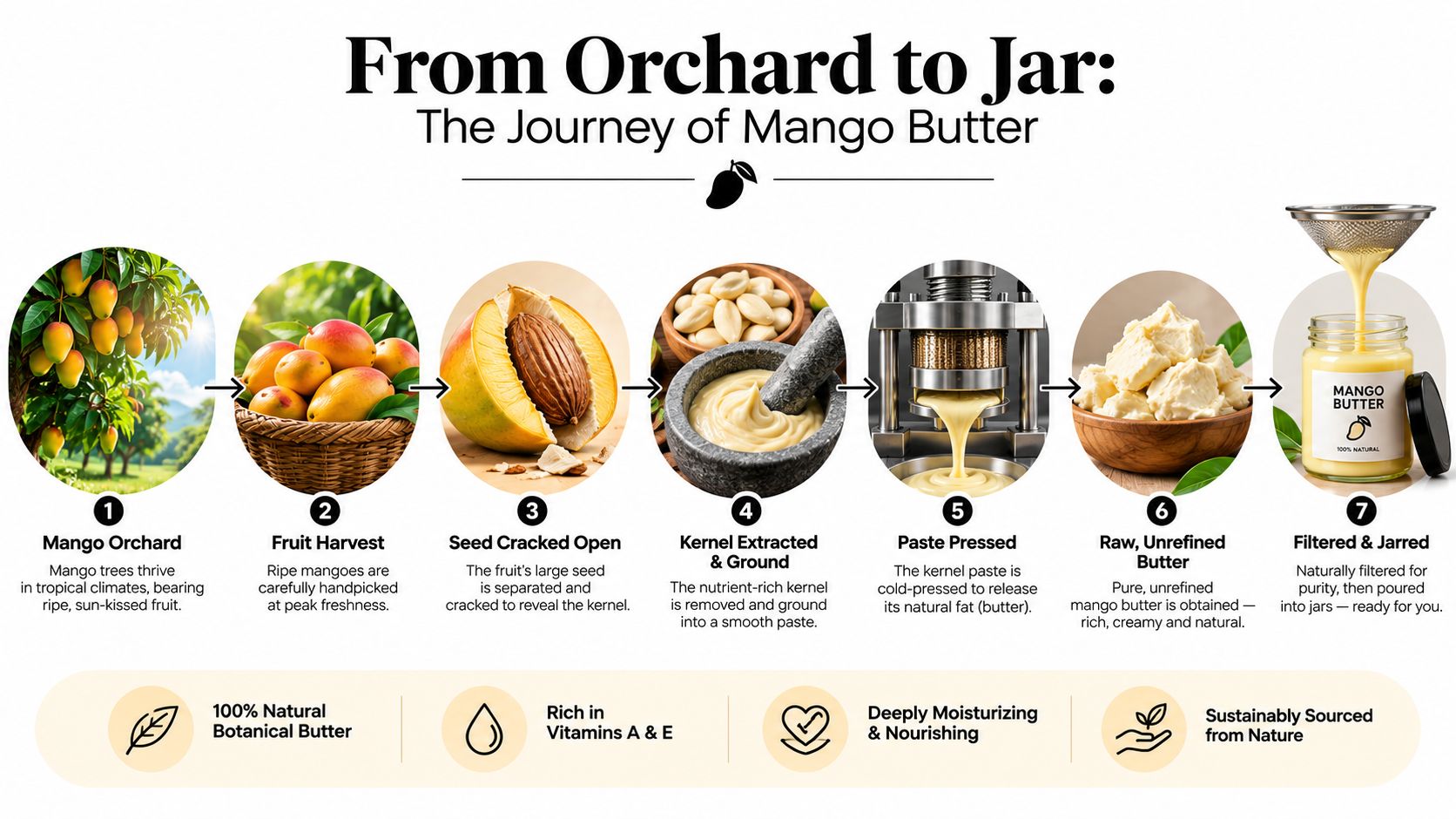
Mango butter begins with a mango seed, not the edible flesh. After the fruit is processed, the large inner seed is separated, dried, and opened so the kernel can be recovered. That kernel contains the fat used to make cosmetic mango butter.
India and Burma are identified as part of the mango tree's original native range, while the tree is now cultivated throughout tropical countries. In the natural cosmetic ingredient trade, the European CBI's market information on mango butter identifies India, China, and the United States as major sources. Other documented producing regions include Thailand, Pakistan, Brazil, tropical Africa, Mauritius, and the Seychelles.
From kernel to cosmetic ingredient
The basic process is easier to understand as a sequence:
- Harvest and separate: Mangoes are harvested, and the inner seeds are removed from the fruit.
- Dry the seed material: Drying prepares the seed for opening and helps reduce excess moisture before extraction.
- Recover the kernel: The hard outer shell is cracked so the oil-rich kernel can be collected.
- Press the kernel: The kernel may be mechanically pressed, often after grinding, to release its fat. For a clearer explanation of how mechanical extraction works, see this guide to what cold-pressed oil means.
- Refine or filter: The resulting material can be filtered and further refined for a smoother, more consistent cosmetic ingredient.
Processing changes the final experience. Unrefined mango butter may retain more of the kernel's natural color and aroma, while refined butter is generally selected when a formulator wants a cleaner appearance, milder scent, or more predictable texture. Neither label automatically tells you which product is better. The right choice depends on whether you value a more minimally processed material or a neutral ingredient that behaves consistently in a finished formula.
Mango kernels can also be viewed as a useful co-product of the fruit industry. Using the kernel for cosmetic fat gives manufacturers another way to use material that might otherwise receive less value, although sustainability still depends on responsible agricultural, processing, and packaging practices.
The Fatty Acid Profile Behind the Feel
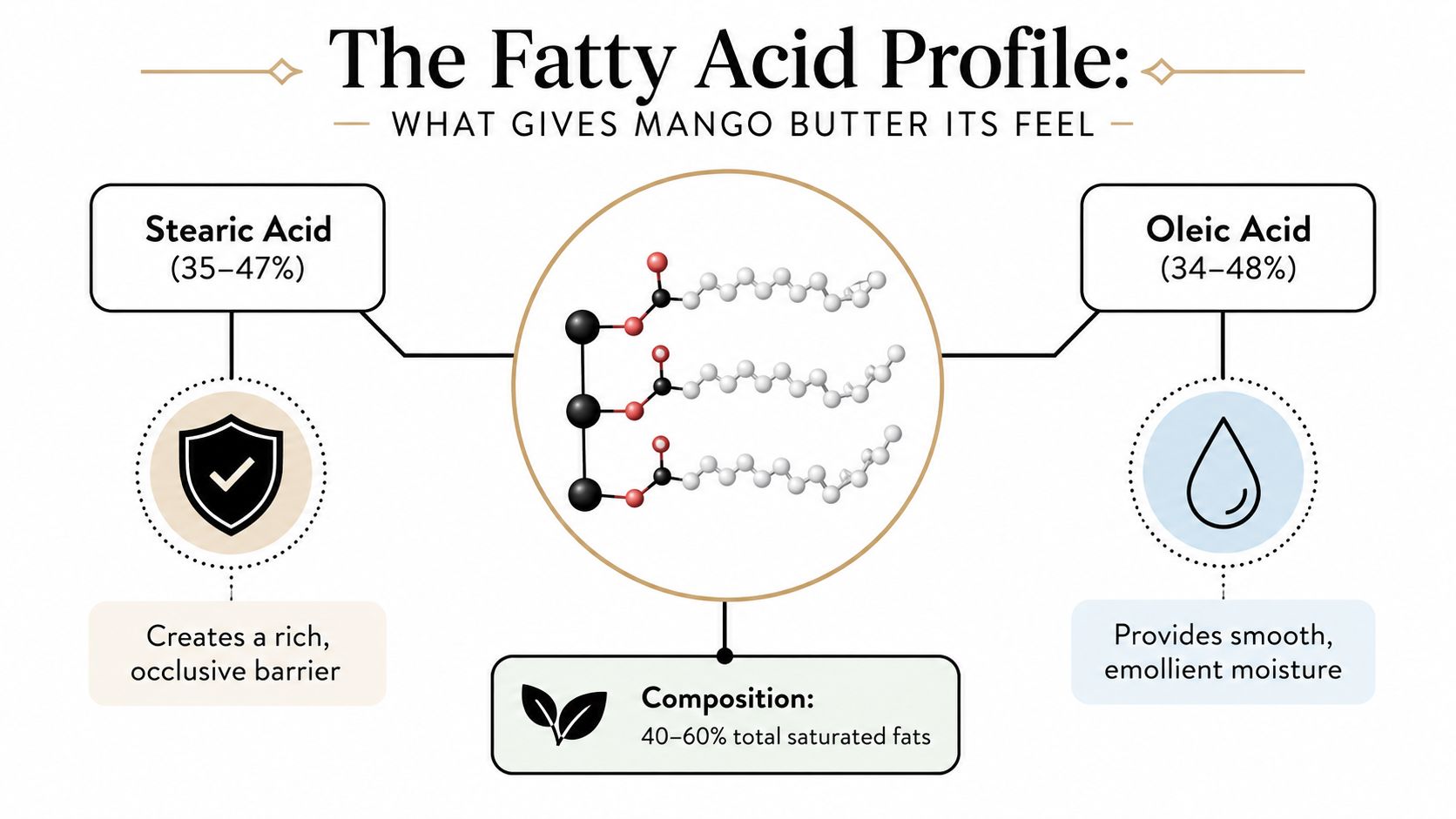
Mango butter's feel becomes easier to predict through its two dominant fatty acids. A technical reference reports stearic acid at 35–47% and oleic acid at 34–48%. These are ranges rather than a guarantee for every jar, since cultivar, origin, and refinement can change the final lipid profile.
Stearic acid is a saturated fatty acid with a firm, structured character. Within the butter, it helps form the solid framework that gives mango butter body at room temperature. That structure supports balms and body butters that need to hold their shape instead of flowing like liquid oils.
Oleic acid is unsaturated and generally contributes softness and spreadability. It offsets some of stearic acid's firmness, allowing the butter to glide as it warms against skin. The result is a substantial, cushiony feel rather than the brittle drag associated with some harder solid fats.
Why the melting point matters
Mango butter's melting point is commonly reported around 30–37°C. In practical terms, it can stay structured on a shelf while beginning to soften near skin temperature.
That thermal range explains the change from solid to spreadable:
- In the jar: It feels firm enough to scoop or scrape.
- Between your fingers: Friction and body heat soften the surface.
- On skin: The softened butter spreads into a thin, protective film.
- In a formula: It adds body to a balm or body butter without the same hard drag as some waxier materials.
A mango butter with more structural character may suit a firmer balm, while one that softens readily may feel easier to spread. Texture therefore depends on the batch, not only on the ingredient name.
A physicochemical study found mango butter samples with melting points around 31.35–31.60°C, with stearic acid ranging from 32.32–39.56% and oleic acid from 27.49–39.93%. For formulators, that variation means testing hardness, glide, and melt behavior when changing suppliers or grades.
What Mango Butter Does for Skin and Hair
Mango butter works mainly as an emollient and occlusive ingredient. An emollient smooths the feel of rough skin by filling in some of the unevenness between surface cells. An occlusive layer sits on top of the skin and helps slow moisture escape. Mango butter doesn't replace a water-based moisturizer, but it can help keep a moisturizing routine from evaporating too quickly.
Apply it to slightly damp skin after cleansing, especially on areas that feel tight or rough. The butter's structure gives it more staying power than a very fluid oil, while its oleic component helps it spread once warmed.
Useful places to apply it
- Elbows and heels: Press a small amount over damp skin, then cover especially dry feet with socks if comfortable.
- Cuticles: Massage a tiny amount around the nail edges when they feel dry or rough.
- Lips: Use a thin layer as a simple protective balm, provided the product is formulated for lip use and contains no irritating fragrance.
- Post-shave areas: Smooth a light amount over clean, damp skin instead of rubbing aggressively. Stop if stinging or redness develops.
- Facial sealing: Apply a very thin layer over a facial oil when your skin needs more protection, rather than spreading a thick coat by default.
The same film-forming behavior can help hair, but quantity matters. Mango butter can seal the lengths and ends of textured, dry, or highly porous hair after a leave-in product. It may also work as a pre-wash treatment for hair in protective styles, where the goal is to soften and reduce the dry feel before shampooing.
For fine or low-porosity hair, a liquid oil may be easier to distribute. Mango butter can weigh down strands when applied heavily, so warm a small amount between your palms and touch only the ends first. A butter is most useful when you need lasting protection and slip, while a plain oil may be better when you want light shine and minimal residue.
How to Layer Mango Butter With Single-Ingredient Oils
Layering works because each material performs a different job. A liquid oil spreads quickly across damp skin, while mango butter remains behind as a more substantial sealing layer. This approach can make a minimalist routine easier to adjust because you can change the amount of butter without reformulating the oil.
A carrier oil is a plant-derived oil used to dilute or carry other oil-soluble ingredients, and this guide to what a carrier oil is explains the category in beginner-friendly terms. For a simple face or body ritual, start with clean, damp skin, smooth on a few drops of a lightweight oil, and finish with a thin layer of mango butter.
Three practical rituals
For dry facial skin: Use a small amount of jojoba oil on damp skin. Wait until it feels spread evenly, then tap a rice-grain-sized amount of mango butter over the driest areas, such as the cheeks. Avoid treating the butter as a mask. The goal is a breathable seal, not a heavy layer.
For body care: After bathing, leave a little water on the skin and apply argan oil to the arms, legs, or shoulders. Follow with mango butter on elbows, knees, and shins if those areas need extra protection. This keeps the richer ingredient targeted instead of covering the entire body automatically.
For hair ends: Smooth a small amount of argan oil through damp lengths, then warm a trace of mango butter between your hands and press it onto the ends. If the hair looks coated or loses movement, reduce the butter before changing the oil.
Start with less than you think you need. You can add another thin layer, but removing excess butter usually requires cleansing.
Single-ingredient routines also make reactions easier to track. Introduce one product at a time, use it consistently for several applications, and pay attention to texture, comfort, and congestion rather than assuming a rich ingredient will suit everyone.
Mango Butter vs Shea and Cocoa Butter
Mango butter, shea butter, and cocoa butter all add richness, but they don't create the same experience. The meaningful differences are firmness, melt, scent, and how much residue your skin or hair can tolerate.
| Property | Mango Butter | Shea Butter | Cocoa Butter |
|---|---|---|---|
| Texture | Firm but often quick to soften, with a smooth, balanced glide | Creamy and rich, especially in unrefined grades | Harder and more wax-like, with strong structure |
| Scent | Usually mild or close to neutral | Unrefined versions can have a noticeable earthy aroma | Often carries a recognizable cocoa-like aroma |
| Skin feel | Cushiony, emollient, and potentially occlusive | Rich, protective, and more substantial | Dense, coating, and highly protective |
| Best fit | Facial balms, body care, and hair-end sealing when a moderate butter is wanted | Very dry body areas and richer protective formulas | Firm balms, body products, and formulas needing extra solidity |
| Comedogenic consideration | Can feel heavy or contribute to congestion for some users | May be too rich for some facial users | May feel especially heavy on oily or congestion-prone skin |
Choosing by the result you want
Pick mango butter if you want a middle-ground butter with a mild scent and a melt that supports easy application. It can be a useful choice for a facial balm or hair seal when you prefer more structure than an oil but less hardness than cocoa butter.
Pick shea butter if your priority is a rich, protective feel on very dry body skin. Unrefined shea can bring more natural aroma and variation, while refined shea may suit formulas that need a more neutral sensory profile.
Pick cocoa butter if you're making or choosing a firm balm and want a pronounced solid structure. It can be valuable on rough body areas, but its dense feel may not appeal to someone seeking a lighter facial product.
These are formulation tendencies, not universal skin rules. Refining, blending, storage temperature, and the rest of a product's ingredients can change the final texture. A butter's reputation matters less than how the finished product behaves on your skin.
Safety, Allergy Risk, and Acne-Prone Skin
“Natural” doesn't mean universally compatible. Mango butter is often well tolerated, but its plant origin creates two questions beginners shouldn't skip: could it trigger an allergy response, and will its occlusive feel suit breakout-prone skin?
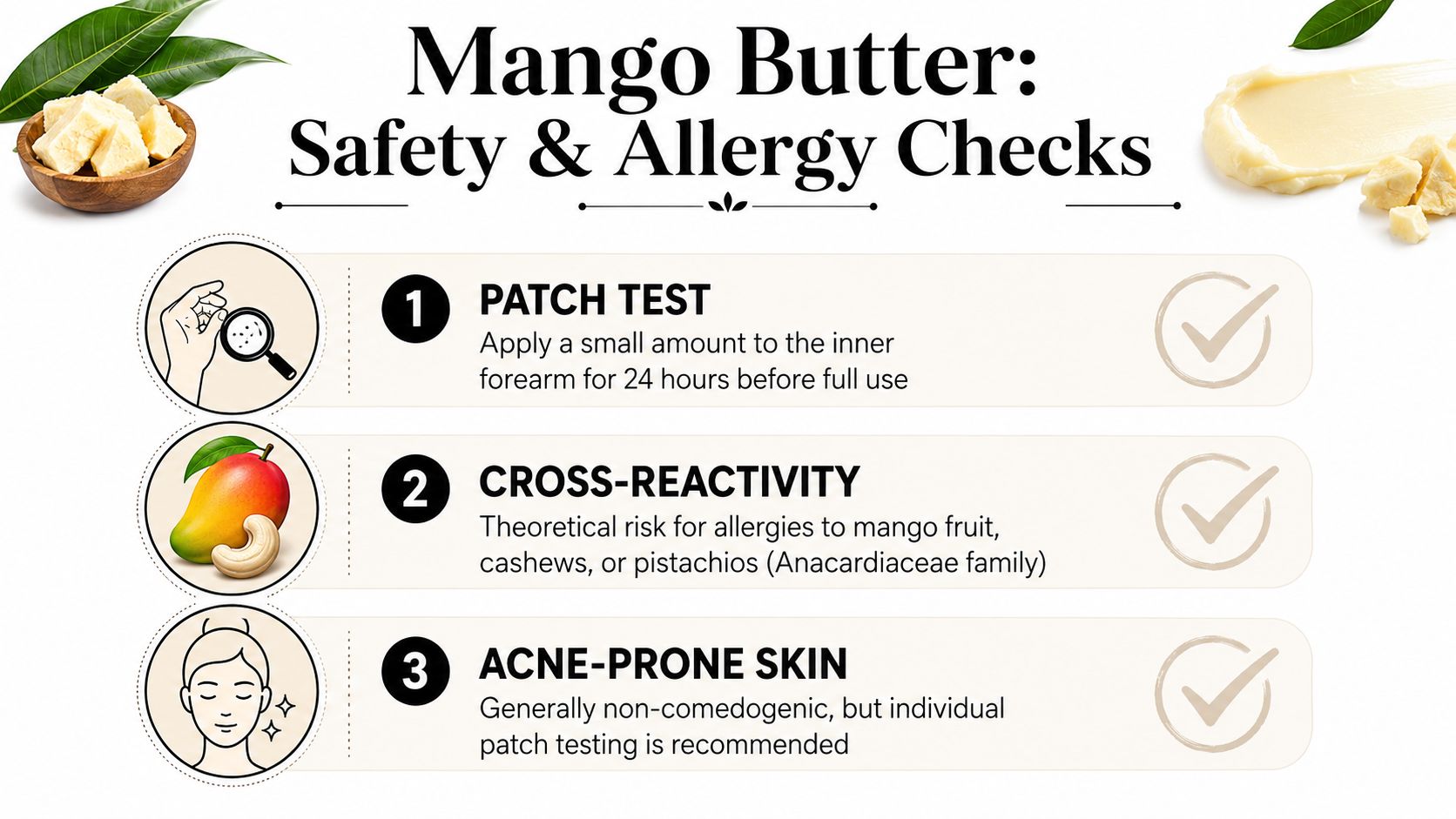
People who react to mango fruit or related members of the Anacardiaceae family, including cashew and pistachio, should be cautious. A public-facing reference on mango butter and potential allergy concerns notes that cross-reactivity has been reported, while also distinguishing the lower risk that may apply to refined cosmetic butter. That doesn't make a refined product automatically safe for someone with a known allergy.
A sensible patch-test routine
Apply a small amount of the finished product to an inconspicuous area, such as the inner forearm, and observe the area for a full day before using it broadly. Don't patch test multiple new products at once, because you won't know which ingredient caused a reaction.
Watch for itching, burning, swelling, hives, or persistent redness. If you have a diagnosed food allergy, a history of serious reactions, or recurring dermatitis, ask a qualified clinician for personalized guidance rather than testing casually.
What about oily or acne-prone skin?
Mango butter can be occlusive, and some independent ingredient references warn that mango seed oil or butter may aggravate congestion in certain users. Another consumer-facing source describes it as having a low comedogenic rating around 2, but that rating shouldn't be treated as a guarantee because individual skin responses vary.
Use a small amount on one area first. Acne-prone readers may prefer applying it to dry cheeks, lips, or body areas instead of the entire face. If you notice new bumps, persistent heaviness, or worsening congestion, stop using it and return to a lighter routine.
Storage, Sourcing, and Sustainability
Mango butter keeps its best texture when protected from heat, light, air, and repeated moisture exposure. Store the jar tightly closed in a cool, dark place, and use clean, dry fingers or a small spatula each time. Warm conditions can soften or melt the butter, and repeated temperature changes may alter its smoothness even when the ingredient remains usable.
What to look for on the label
- Extraction language: “Cold-pressed” tells you the fat was mechanically extracted without relying on solvent extraction. “Unrefined” usually signals less processing after extraction.
- A short ingredient list: A single mango-butter ingredient list makes it easier to evaluate scent, texture, and possible reactions.
- Grade and consistency: If you're formulating, ask about the butter's refinement, origin, and batch specifications. Natural lipid composition can vary, which affects hardness and glide.
- Responsible sourcing: Mango kernels can serve as a co-product of fruit processing, potentially helping manufacturers use more of the harvested material. Look for brands that explain their sourcing and packaging choices rather than relying only on broad sustainability language.
You can also simplify a low-waste routine by choosing products that serve several purposes. For example, a solid cleanser can reduce the number of separate body products in a bathroom.
Mango butter makes the most sense when you match it to the job. Use it as a targeted seal for rough skin, a protective balm base, or a finishing layer on dry hair, then keep liquid oils available when you need faster spread and a lighter finish.
Ella & Eden offers simple, single-ingredient oils for skin, hair, and everyday self-care, including jojoba, argan, castor, rosemary, and rosewater formulas designed for uncomplicated routines. Visit Ella & Eden to pair a lightweight oil with a carefully used mango-butter layer and build a clean ritual around what your skin and hair need.