Argan Oil Moisturizer for Face: Science & How to Use
You've bought a cleanser, serum, cream, facial mist, and perhaps a separate oil, yet your skin still feels tight after washing. The routine looks impressive on the bathroom shelf, but the results feel less convincing. An argan oil moisturizer for face care offers a simpler path: one plant-based ingredient that can soften skin and help reduce moisture loss without turning your routine into a chemistry project.
The important distinction is between a useful facial oil and a product surrounded by exaggerated promises. Argan oil has meaningful evidence for hydration, but that evidence is narrower than many marketing pages suggest. Used thoughtfully, pure argan oil can become a minimalist finishing step, especially for dry or dehydrated skin. Used carelessly, it can feel too rich, irritate reactive skin, or disappoint anyone expecting it to replace sunscreen, acne treatment, or every other moisturizer.
Why Argan Oil Deserves a Place in Your Skincare Routine
Maya had simplified her skincare routine after months of buying products that promised brighter, smoother, calmer skin. Her shelf held a foaming cleanser, exfoliating toner, hydrating serum, night cream, and a facial oil. Some products stung. Others left her skin shiny but still uncomfortable. She wanted fewer steps, not another complicated system.
Argan oil appealed to her because it made one clear promise: help skin feel softer and less dry. A small amount pressed onto clean, slightly damp skin gave her a comfortable finish without the fragrance found in several creams she had tried. That experience doesn't prove argan oil will suit everyone, but it illustrates why single-ingredient skincare can be useful. You can observe one product, one texture, and one response instead of guessing which ingredient caused a reaction.
Argan oil has long been used in beauty and personal care, and modern clean beauty brands continue to value it for its versatility. A bottle can serve as a facial oil, a dry-skin treatment for hands, or a smoothing product for hair ends. That multi-purpose quality matters when you're trying to reduce clutter and choose products you'll finish.
A minimalist rule: Choose one clear purpose first. For facial use, let hydration and comfort be the starting point, not a promise of instant lifting, acne removal, or wrinkle reversal.
The appeal of an argan oil moisturizer for face care is its simplicity. A pure oil won't add water to the skin in the way a water-based cream does, but it can help soften the surface and reduce the escape of moisture. The rest of this guide separates what the research supports from what remains uncertain, then shows how to test the ingredient safely.
The Science Behind Argan Oil for Facial Skin
Argan oil is an emollient, so it smooths the spaces between surface skin cells and makes roughness feel less noticeable. The outer skin barrier works like a brick wall: skin cells form the bricks, and lipids help hold the structure together. Facial oil cannot rebuild every part of that barrier, but it can soften the surface and make dry skin feel more flexible.
Its fatty acids shape both the texture and the way the oil feels during use. Oleic acid contributes richness and softness, while linoleic acid is a lighter fatty acid associated with the skin's lipid environment. Their balance helps explain why argan oil may feel nourishing without the heavier coating some plant oils leave behind.
Argan oil also contains tocopherols, commonly called vitamin E compounds, as well as plant sterols, squalene, and phenolic compounds. These substances help characterize the oil and may support its stability against oxidation. Their presence does not prove every antioxidant, anti-aging, or repair promise found in advertising. A named ingredient is evidence of composition, not proof of a specific facial result.
Why texture and barrier support matter
Pure argan oil works mainly as a sealing and softening layer, rather than as a complete replacement for every moisturizer. If your skin feels dehydrated, a water-based product can provide water, followed by argan oil to improve comfort and slow moisture loss. If your skin already feels comfortable, the oil may work well as the final step in a minimalist routine.
This difference helps explain why applying a large amount to completely dry skin can disappoint. Shine may increase without creating the supple feeling you expected. A small amount pressed onto slightly damp skin, or applied over a simple hydrating product, gives the oil moisture to help retain. The goal is to support the skin's existing routine, not force one ingredient to act like a cream.
Quality and personal response matter as much as the ingredient list. A pure, well-tolerated oil gives you a clearer test: use a small amount consistently, then watch for comfort, tightness, shine, or irritation before adding more products.
The research on topical and oral argan oil measured hydration-related outcomes, not every popular skincare benefit. That makes it relevant to moisturization, while leaving broader claims about facial concerns unconfirmed.
What Clinical Research Actually Shows About Argan Oil Hydration
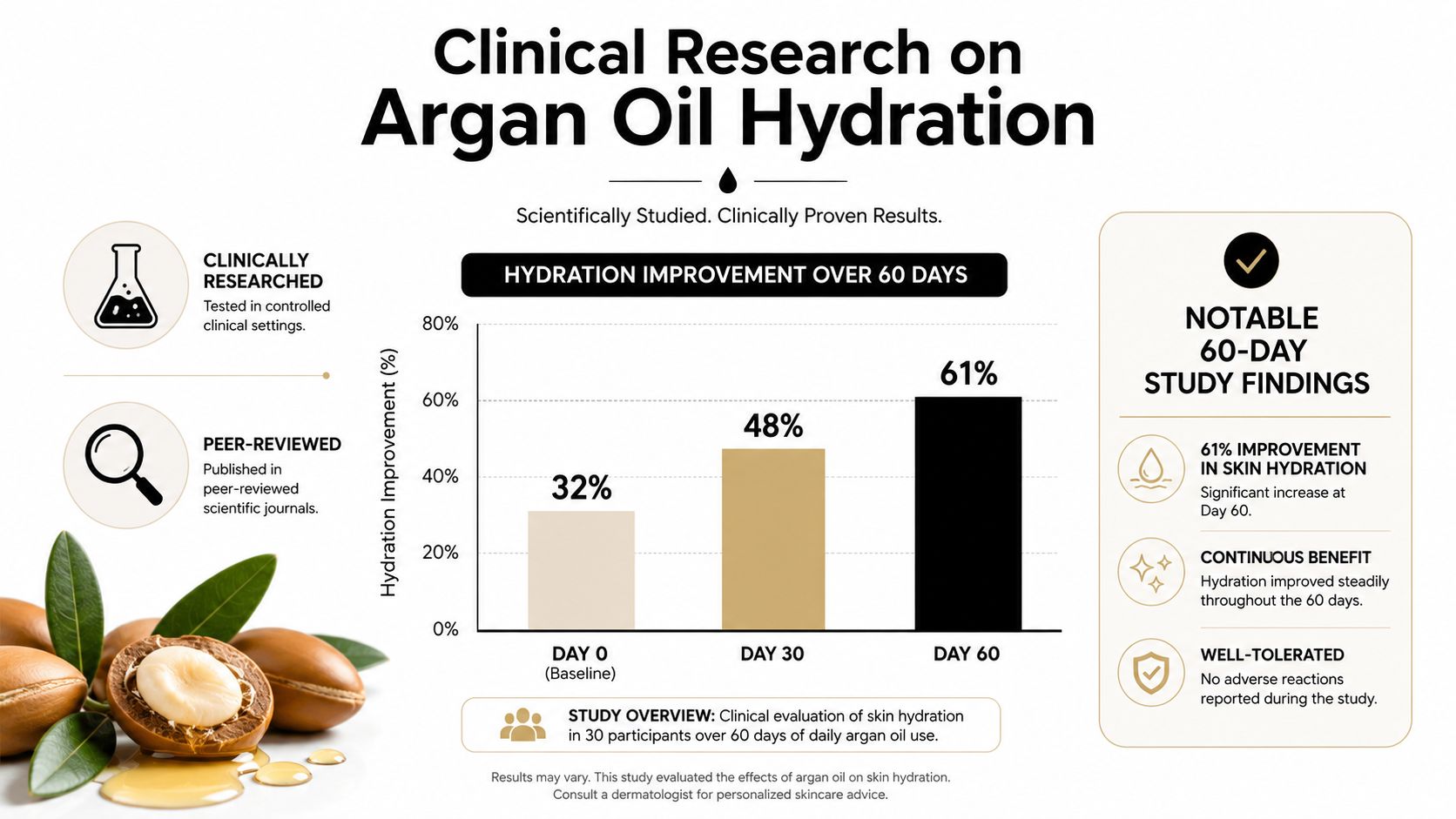
A 60-day study in postmenopausal women provides the clearest clinical evidence for argan oil as a facial moisturizer. Participants who applied it topically at night experienced a significant reduction in transepidermal water loss, or TEWL, with p = 0.01. Their epidermal water content also increased significantly, with p < 0.001. TEWL measures moisture escaping through the skin, while epidermal water content reflects hydration in the outer layer.
The researchers also examined oral argan oil consumption. TEWL decreased with p = 0.023, and epidermal water content increased with p = 0.001. These results suggest that both topical and dietary use may influence hydration markers. They do not turn argan oil into nutrition advice, since dietary choices require separate medical and nutritional context.
The study supports a focused claim: argan oil may improve measurable hydration-related outcomes. It does not prove that every product labeled “argan” will perform the same way, or that the oil addresses every facial concern.
What the evidence doesn't establish
The topical evidence base remains small. An independent dermatology review describes the literature as sparse and discusses a study involving 30 healthy postmenopausal women, who showed statistically significant improvements in TEWL and epidermal water content after 2 months of nightly use.
That limitation makes the findings narrower, not useless. The results fit argan oil's role as a softening, moisture-supporting ingredient, while falling short of confirming benefits for acne, pigmentation, elasticity, or visible aging.
A realistic expectation is gradual improvement in skin comfort, softness, and surface hydration. Marketing can stretch a modest hydration finding into a universal treatment claim. A pure, well-tolerated oil gives you a cleaner way to evaluate your own response, especially if your skin is sensitive, reactive, or acne-prone.
How to Use Argan Oil as a Daily Face Moisturizer
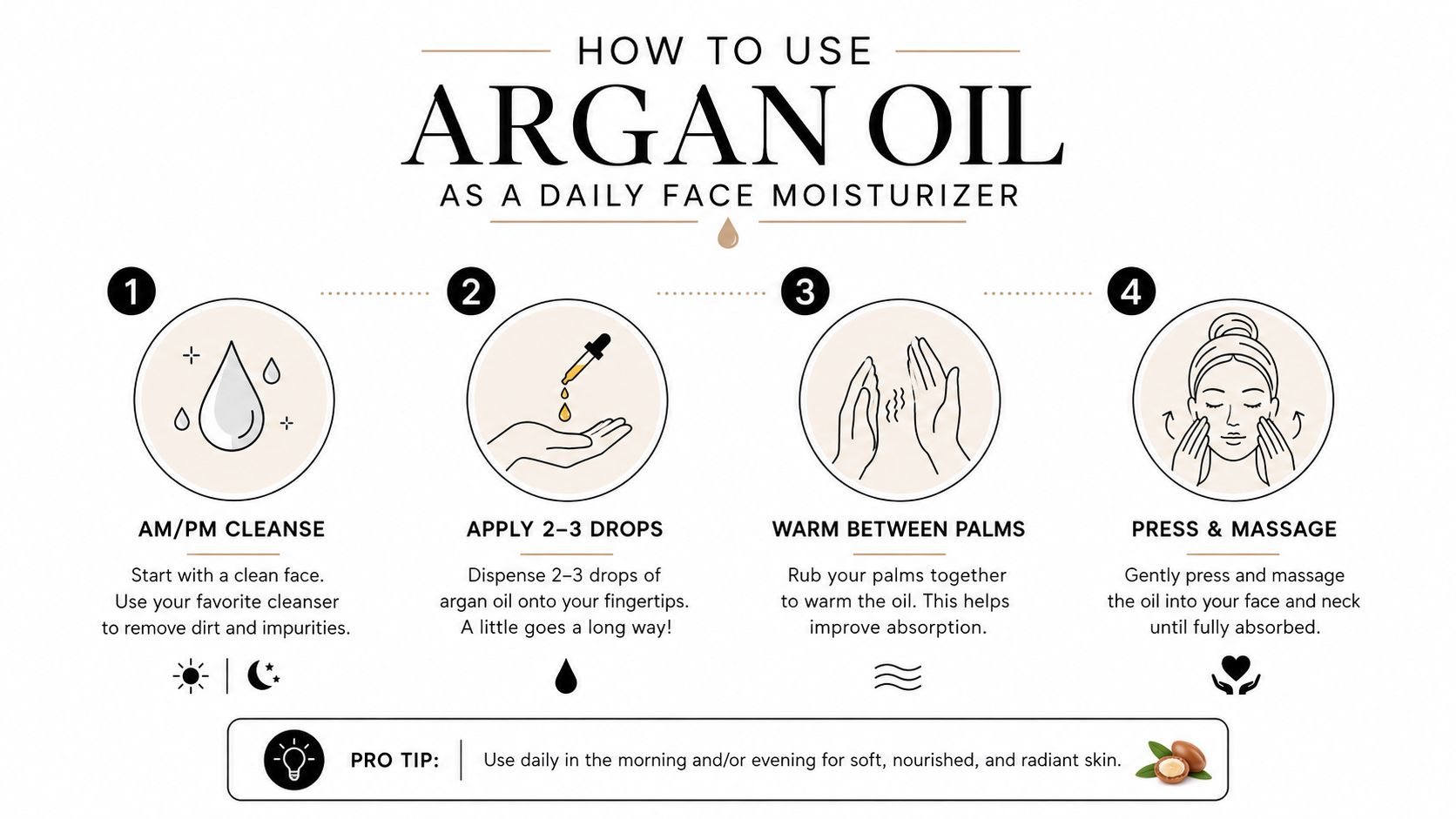
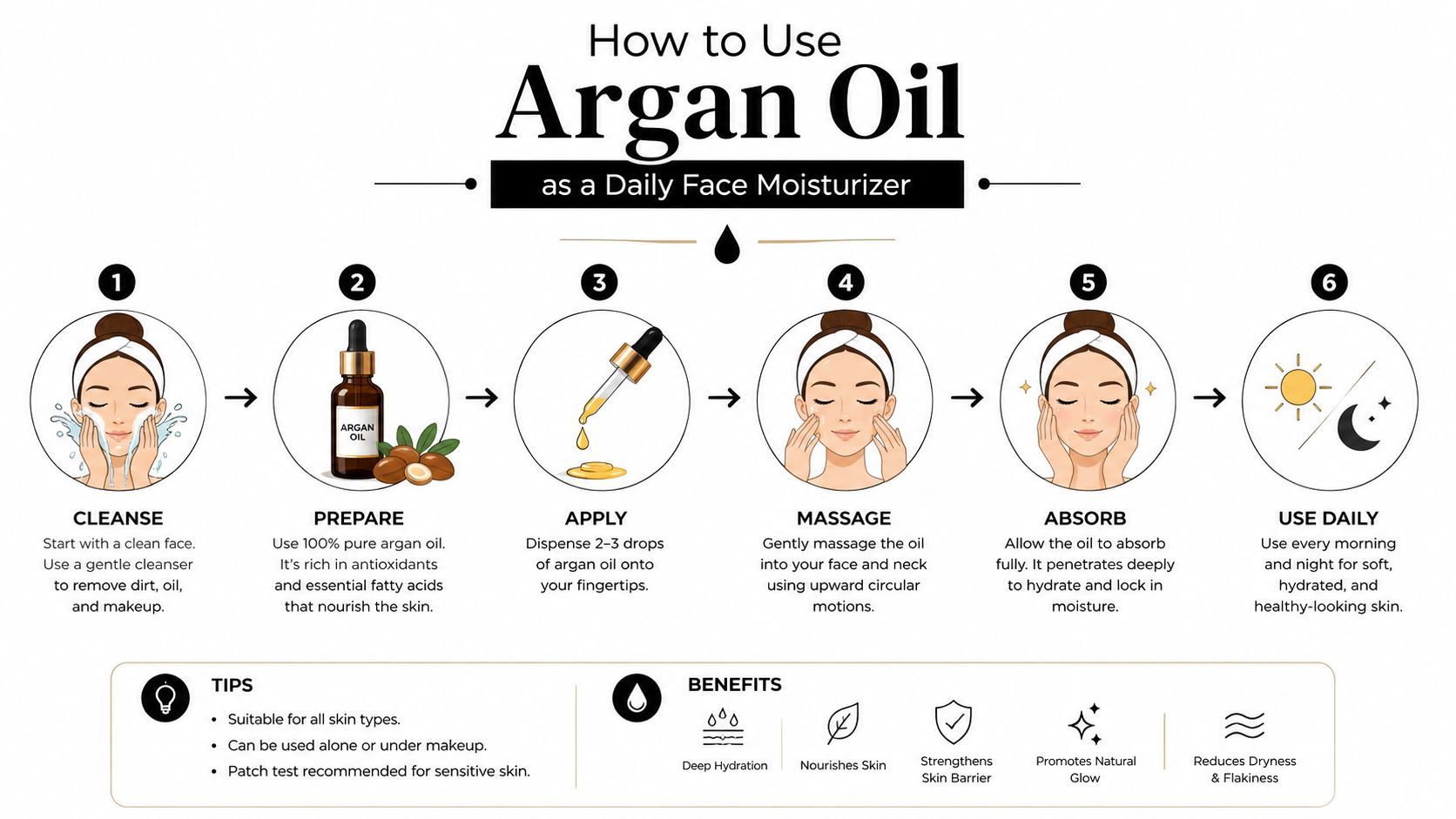
Start with a clean face and a small amount of product. Pure argan oil is concentrated in the sense that it contains no water or filler ingredients, so more isn't automatically better. Ella & Eden's product guidance recommends 2 to 3 drops for the face and neck, a practical starting point for a minimalist routine.
A simple evening method
- Cleanse gently. Remove sunscreen, makeup, and daily residue without leaving your skin squeaky or tight.
- Leave a trace of dampness. You don't need dripping-wet skin. A slightly damp surface can make the oil spread more evenly.
- Warm the oil. Place the drops in your palms and rub them together briefly.
- Press, then massage. Pat the oil over your cheeks, forehead, chin, and neck. Use light strokes rather than vigorous rubbing.
Adjust the routine to your skin
Dry or mature-feeling skin may prefer argan oil as the last step over a basic hydrating serum or cream. Combination skin can use it only on areas that feel tight, such as the cheeks, while leaving the oil off the oilier parts of the face. Oily skin may prefer a very small amount at night rather than applying it automatically morning and evening.
In the morning, apply argan oil after water-based products and before sunscreen if you use it. Give the oil time to settle so sunscreen can form an even layer. If the combination feels slippery, move argan oil to your evening routine instead. Sunscreen remains its own essential product and shouldn't be replaced by a facial oil.
Practical rule: Begin with the smallest amount that makes your skin comfortable. If your face still feels dry, add a little more on a later evening rather than starting with a heavy layer.
Use the same formula consistently while you evaluate it. Introducing argan oil alongside a new exfoliant, cleanser, and serum makes it difficult to identify the cause of improvement or irritation. A minimalist routine gives your skin, and your judgment, a clearer test.
Argan Oil vs Other Popular Facial Oils and Creams
Argan oil isn't automatically the right choice because it's plant-based. Compare it with alternatives according to the experience you want, the products already in your routine, and how your skin reacts. A facial oil generally softens and helps limit moisture loss, while a cream can combine water, humectants, emollients, and occlusive ingredients in one formula.
| Product | Best For | Absorption | Comedogenic Rating | Multi-Purpose Use |
|---|---|---|---|---|
| Argan oil | Dry, normal, or combination skin seeking softness | Light to moderate, depending on amount | Ratings vary by source and formulation, so don't treat a label as a guarantee | Face, hair ends, hands |
| Jojoba oil | People wanting a lighter-feeling facial oil | Often light | Individual responses vary | Face, scalp, hair, cuticles |
| Rosehip oil | Users interested in a distinct botanical oil with a more noticeable scent | Light to moderate | Individual responses vary | Face and targeted dry areas |
| Squalane | Those who prefer a smooth, lightweight finish | Usually fast-feeling | Individual responses vary | Face and body |
| Cream moisturizer | Skin needing water-based hydration plus barrier-supporting ingredients | Depends on the formula | Depends on the full ingredient list | Usually designed mainly for face or body |
Comedogenic ratings can help you form a starting hypothesis, but they don't predict every person's experience. Formulation, amount, cleansing habits, climate, and personal sensitivity all matter. A pure oil also behaves differently from an argan-containing cream because the cream may include emulsifiers, fragrance, preservatives, or other active ingredients.
If you're comparing minimalist facial oils more broadly, the guide to natural oils for glowing skin can help you think through texture and routine fit without assuming that one oil suits every face. Argan oil makes sense when you want a versatile, relatively simple finishing step. A cream may be a better choice when your skin needs more complete hydration in one application.
Who Should Be Cautious With Argan Oil on the Face
“Natural” doesn't mean universally risk-free. People with tree nut allergies should approach argan oil carefully, and anyone with reactive skin should patch test before applying it broadly. Independent guidance notes that argan oil can irritate some users and may contribute to rashes or acne, even though many product pages describe it as non-comedogenic or suitable for all skin types.
Patch testing is a decision tool
Apply a small amount to a limited area, such as the inner arm or a discreet area near the jaw, and watch for discomfort or visible irritation before using it across your face. The guide to patch testing skincare offers a practical method for introducing a new product more cautiously.
Stop if you notice burning, persistent itching, swelling, or a spreading rash. If you have a known allergy, a history of severe reactions, or a diagnosed skin condition, ask a qualified healthcare professional before experimenting with a new facial oil.
Acne-prone users deserve a particularly honest answer. Argan oil may feel light and may not clog pores for many people, but that doesn't guarantee clear skin for every individual. Breakouts can reflect the oil itself, the amount used, another ingredient in a blended formula, or an unrelated change in the routine.
Clinical support for anti-acne and anti-aging claims remains limited. Argan oil has stronger support for hydration than for treating active acne or reversing visible aging, so use a proven acne treatment or seek dermatology guidance when those concerns are your priority. Pure argan oil and an argan-containing cream also aren't interchangeable. Check the entire ingredient list, especially if fragrance or essential oils tend to bother your skin.
How to Choose a High-Quality Cold-Pressed Argan Oil
A clear label is the starting point. If your goal is a single-ingredient facial oil, look for argan oil listed by itself, plus understandable information about sourcing and packaging. Cold-pressed and unrefined describes an extraction approach that aims to retain more of the oil's original character, which is why many clean beauty shoppers prefer those terms.
Read the bottle before the claims
A dark glass bottle can help limit light exposure, which may affect botanical oils over time. Check whether the bottle is well sealed, whether the argan fruit's origin is explained, and where the oil is bottled. Organic certification may matter to you, but “natural” alone provides less useful information than a complete ingredient list and transparent production details.
Look beyond the word “argan” on the front label. A formula may also contain fragrance, essential oils, fillers, or preservatives. Those additions are not automatically unsuitable, yet they change the product and can make an irritation easier to trace. Shoppers seeking a straightforward cold-pressed oil may also check whether hexane extraction was used.
For argan-specific sourcing and application ideas, explore this guide to argan oil's benefits, rituals, and selection.
Use this checklist before buying:
- Single ingredient: Confirm that the label lists only argan oil if purity is your goal.
- Extraction method: Look for cold-pressed and unrefined wording.
- Packaging: Prefer a sealed dark glass bottle.
- Sourcing: Seek clear information about origin and production.
- Skin tolerance: Patch test, particularly if your skin is reactive or allergy-prone.
Treat label details as clues, not proof that an oil will suit your face. Start with a small amount and let your skin's response guide the rest of the routine.