Face and Body Oils Guide for Radiant Skin and Hair
You finish your morning routine with a few drops of facial oil, then notice your elbows still feel rough by midday. That evening, the same oil makes your forehead look shiny, while your legs seem to absorb it without a trace. The problem usually isn't that the oil failed. Face and body skin have different structures, oil production, and water-loss patterns, so one texture can't serve every area equally well.
A useful oil ritual starts with a change in perspective. An oil isn't a universal moisturizer. It's a site-specific tool that can soften rough skin, reduce water evaporation, balance a lightweight routine, condition hair, or protect a dry patch. The right choice depends on where you're applying it, what sits underneath, and whether your skin needs simple occlusion or deeper barrier support.
Ella & Eden's single-ingredient approach fits that way of thinking. Jojoba, argan, castor, rosemary, rosewater, and magnesium each have a distinct role, without requiring a crowded shelf of fragranced formulas and unnecessary fillers. You'll also find that personal care decisions often sit alongside broader body-confidence questions.
Introduction to Face and Body Oil Rituals That Actually Work
Think of your skin as a series of neighborhoods rather than one continuous surface. Your cheeks may need a featherlight layer after cleansing, your hands may need a richer seal before bed, and your scalp may benefit from a targeted oil treatment that never touches your face. Treating all three areas identically can create either congestion or under-conditioning.
The simplest way to avoid that mismatch is to ask three questions before reaching for a bottle:
- Where are you applying it? Facial skin often needs a thinner layer, while elbows, knees, and heels can tolerate more cushioning.
- What is underneath? Oils help slow water loss, but they don't supply water in the same way a toner, essence, or moisturizer does.
- What is the oil's job? Jojoba can provide a light balancing step, castor can act as a dense spot treatment, and diluted rosemary can support a scalp-focused ritual.
A useful rule: Choose the oil by the area and purpose first, then adjust the amount.
Clean beauty works best when simplicity is paired with observation. A single-ingredient oil makes it easier to notice what your skin likes, what feels too heavy, and whether irritation comes from the oil itself or from layering too many products. That clarity matters especially for sensitive skin, reactive skin, and anyone moving away from aggressive exfoliation.
The broader category is large enough to support this kind of focused routine. One market estimate valued global skin care at USD 163.9 billion in 2024 and projected USD 191.5 billion by 2029, with facial care representing 74.8% of value and body care 12.5% in 2024, as reported by Fortune Business Insights' skin care market overview. Facial products dominate spending, but body care remains a substantial opportunity for practical, multi-purpose formulas.
How Your Skin Barrier Works Differently on Face and Body
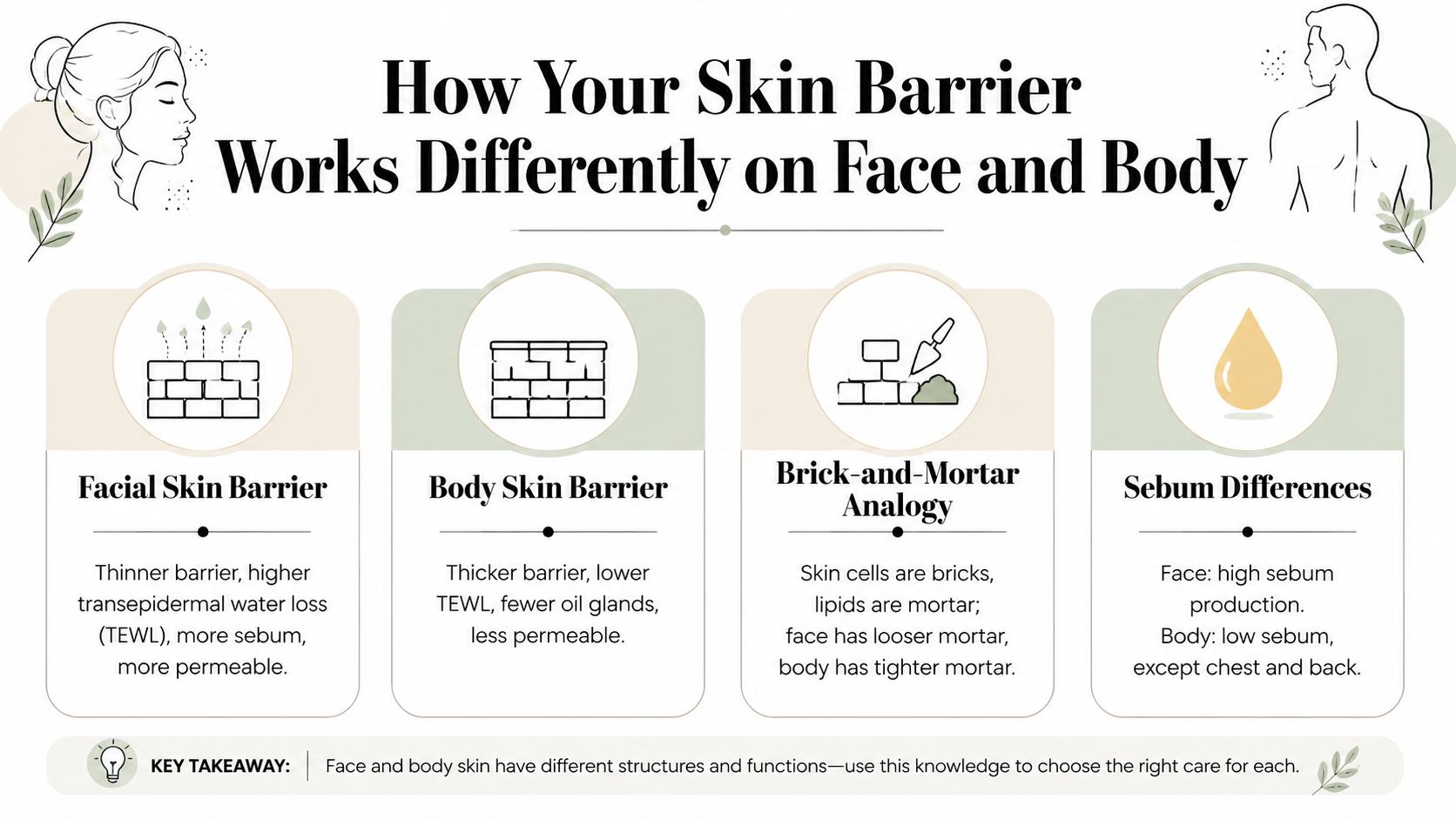
Your skin barrier resembles a brick wall. The cells of the outermost layer act like bricks, while lipids between those cells work like mortar. When the mortar is well organized, water stays inside more effectively and irritants have a harder time moving through. When cleansing, inflammation, friction, or over-exfoliation disrupts that structure, the wall becomes less dependable.
Transepidermal water loss, or TEWL, describes water moving from inside the skin into the surrounding air. A systematic review found substantial variation between body sites, with TEWL ranging from 2.3 g m^-2 h^-1 on breast skin to 44.0 g m^-2 h^-1 in the axilla, according to the systematic review indexed by PubMed. That variation shows why location matters. Sweat-gland density, anatomy, thickness, and local oil production all influence how skin holds water and responds to products.
Why oils help, but don't do everything
An oil primarily works as an occlusive or semi-occlusive layer. It can reduce evaporation by forming a flexible film over the skin, especially when applied after water-based hydration. It doesn't replace the water supplied by a toner or moisturizer, and it may not provide the lipids needed to rebuild a significantly damaged barrier.
The difference becomes clearer when you compare the face with the body. Facial skin usually has more active sebaceous glands, particularly around the forehead, nose, and chin. Body skin often has fewer oil glands and may feel tight or rough on the shins, elbows, and hands, although the chest and back can behave more like the face.
Barrier disruption also changes the equation. Independent dermatology data summarized in the PubMed review found that removing the stratum corneum can increase water loss about 50-fold, while sodium lauryl sulfate can immediately increase outward diffusion. Those findings support a practical conclusion: dryness often reflects barrier disturbance, not just a lack of surface oil.
Match the weight to the site
Use a light texture on oilier, more permeable facial areas, particularly if you're prone to congestion. Use a richer layer on body areas that feel rough, cracked, or exposed to frequent washing. If skin feels tight after cleansing, place a hydrating step underneath the oil rather than adding more oil alone.
Mental model: Thin and measured for the face, richer and more targeted for the body, and always lighter than the layer your skin doesn't need.
Safety First and How to Use Oils Without Irritation
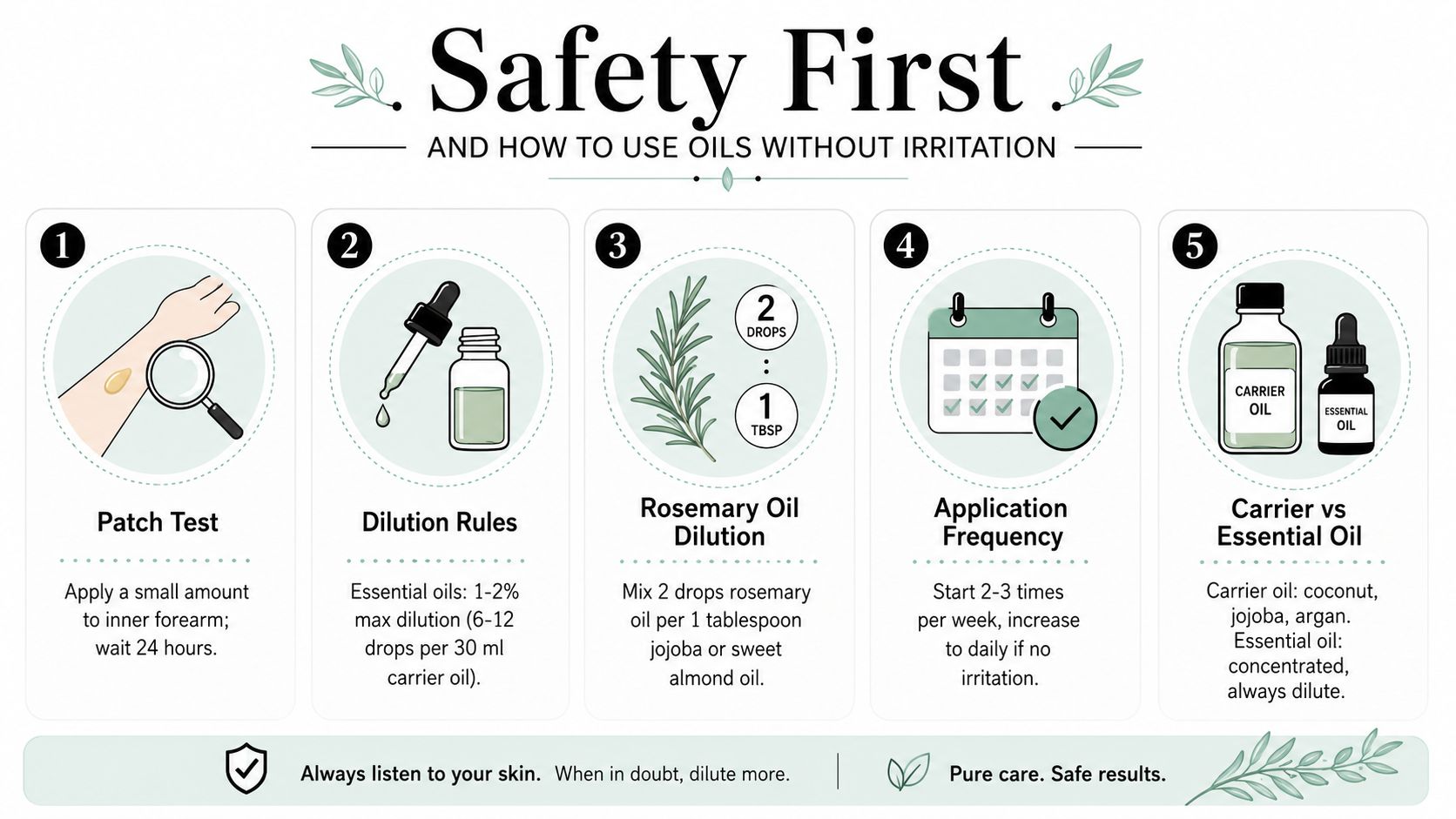
Natural ingredients still need careful handling. Carrier oils such as jojoba, argan, and sweet almond oil are designed to be used more generously than essential oils, which are highly concentrated aromatic compounds. Rosemary oil belongs in the second category, so it shouldn't be applied directly to the face, scalp, or body.
Start with a patch test. Apply a small amount of the finished product to the inner forearm, leave the area undisturbed, and observe it for 24 hours. For a more detailed guide, follow Ella & Eden's instructions for patch testing skincare.
Dilute before application
For essential oils, keep the finished blend within a 1% to 2% dilution, which the supplied safety guidance expresses as 6 to 12 drops per 30 ml of carrier oil. Rosemary oil can also be diluted by mixing 2 drops with 1 tablespoon of jojoba or sweet almond oil. That mixture is for a targeted scalp or hair ritual, not for drinking or use on broken skin.
If you're pregnant, nursing, managing a skin condition, or taking medication, ask a qualified healthcare professional about essential-oil use before adding it to your routine. Stop immediately if you experience burning, swelling, hives, persistent redness, or worsening itching.
Use a deliberate layering order
A simple order keeps application comfortable:
- Cleanse gently and pat the skin until it's damp rather than dripping.
- Apply rosewater toner if it suits your skin and you want a light water-based preparation.
- Use moisturizer when needed, especially if your barrier feels compromised.
- Press in a small amount of carrier oil to reduce evaporation and soften the finish.
- Apply sunscreen in the morning as the final dedicated protection step.
Start body oils a few times per week, particularly if your skin is sensitive. Magnesium spray should also begin at a modest frequency, such as 2 to 3 applications per week, with an increase only if your skin remains comfortable. Avoid applying oils or sprays to cuts, freshly exfoliated skin, active rashes, or areas that are already stinging.
Choose bottles labeled with clear sourcing and processing details. Cold-pressed, unrefined, hexane-free oils can help you avoid unnecessary processing aids and make the formula easier to understand. Store oils away from heat and direct light, keep the cap closed, and check for changes in smell, color, or texture.
Meet Your Single Ingredient Essentials and What Each One Does Best
A minimalist shelf still needs a system. The point isn't to use every oil everywhere. It's to assign each ingredient a job, then keep the application narrow enough that you can tell whether it's helping.
Ella & Eden's collection includes Organic Castor Oil, Jojoba Oil, Argan Oil, Rosemary Oil, Rosewater Toner, and Magnesium Oil Spray. Their formulas are presented as single-ingredient or focused essentials, with organic, vegan, cruelty-free, and sustainability-oriented sourcing details. The table below separates texture from purpose so you can make a more precise choice.
| Product | Texture and Key Compounds | Best For | Use on Face or Body |
|---|---|---|---|
| Jojoba Oil | Light, smooth, wax-ester texture that resembles some components of natural sebum | Balanced-feeling facial skin, dry areas, and simple hair conditioning | Face, body, scalp, and hair ends |
| Argan Oil | Lightweight, silky oil with naturally occurring fatty acids and antioxidant compounds | Facial nourishment, dry hair lengths, and a softer body finish | Face, body, and hair |
| Castor Oil | Thick, dense, highly cushioning oil with strong occlusive character | Brows, lashes, cuticles, heels, elbows, and isolated dry patches | Targeted face or body use |
| Rosemary Oil | Concentrated essential oil with a strong aromatic profile | Diluted scalp and hair rituals | Scalp and hair only when properly diluted |
| Rosewater Toner | Water-based, refreshing preparation step | Dampening skin before an oil or moisturizer | Face and selected body areas |
| Magnesium Oil Spray | Water-based mineral spray with a brisk, sometimes tingly feel | Body-focused evening or post-shower rituals | Body, not the eyes or broken skin |
Let the trade-off guide you
Jojoba is often the easiest starting point when you want a light oil that doesn't make the face feel coated. Argan suits someone who wants a silky finish on dry cheeks, hair lengths, or the arms and legs. Castor is more specialized. Its density makes it useful for small areas, but a full-face application may feel heavy, especially for oily or congestion-prone skin.
Rosemary is not a carrier oil. It's the ingredient that requires the most restraint because concentration changes its safety profile.
Rosewater belongs underneath an oil rather than in the same category. It adds a water-based preparation step, while the oil helps slow the loss of that moisture. Magnesium spray is also different from a cosmetic oil. Use it as a body ritual, and expect a different feel from a carrier oil.
Before mixing anything, learn what a carrier oil is. That distinction prevents the most common rosemary mistake, applying a concentrated essential oil as though it were jojoba or argan.
Simple Face and Body Routines You Can Follow Daily
A good routine should be short enough to repeat and specific enough to prevent guesswork. Use fewer drops than you think you need, press rather than rub, and give each layer a little time to settle before adding the next.
A calm morning face routine
Begin with a gentle cleanse, then pat your face so it stays slightly damp. Mist or apply rosewater toner with clean hands, and follow with 2 to 4 drops of jojoba or argan oil pressed across the cheeks, forehead, and jaw. If your skin is oily, start at the lower end and keep the oil away from areas that already feel slick.
Apply moisturizer before the oil if your skin needs more cushioning. Finish with sunscreen, allowing the previous layers to settle so the sunscreen forms an even film. Oil shouldn't be treated as a replacement for sun protection.
For evening care, cleanse away sunscreen and makeup first. Apply rosewater if you enjoy the step, use moisturizer where your skin feels dry, and press in 1 to 3 drops of jojoba or argan. Reserve castor oil for a pinpoint application on a dry patch, brow area, or cuticle rather than spreading its dense texture across the entire face.
A practical body routine
Apply body oil after bathing while skin is still slightly damp. Use argan on the legs and arms when you want a lighter finish, then place castor oil only on elbows, knees, heels, or unusually rough patches. Covering those areas with soft clothing overnight can help reduce friction and keep the product in place.
Magnesium spray belongs in a separate body ritual. Apply it to clean, intact skin, avoid the face and sensitive areas, and reduce frequency if the sensation becomes uncomfortable. Don't apply it immediately after shaving or exfoliating, when the skin may be more reactive.
Ella & Eden's natural oils for the body can provide additional ideas for assigning oils to dry areas instead of using one heavy layer everywhere.
A focused scalp and hair ritual
Mix rosemary oil into jojoba or sweet almond oil before application. Part the hair, place a small amount on the scalp, massage gently with your fingertips, and leave it on only as long as your scalp tolerates it before cleansing. Use argan on the mid-lengths and ends when hair needs softness without a dense coating.
Avoid soaking the scalp. More product doesn't automatically mean better conditioning, and excess oil can make cleansing harder. Keep the mixture away from your eyes and stop if your scalp becomes itchy, hot, or persistently red.
Troubleshooting Common Mistakes and When to Choose Barrier Repair
Oil can lock in moisture, but oil isn't water. If your skin is dehydrated, applying more oil to completely dry skin may leave it shiny without making it feel comfortable. Add a water-based step underneath, then use a small amount of oil to reduce evaporation.
Greasy skin often signals excess product, a texture mismatch, or layering that hasn't had time to settle. If oil pills, reduce the amount, wait between layers, and press instead of rubbing. If congestion appears, stop the new product, return to a simpler routine, and reintroduce only after the skin calms.
Remember: “Natural” describes an origin, not a guarantee of tolerability.
When minimalist oils aren't enough
A compromised barrier may need more than an oil seal. Signs can include persistent stinging, repeated flaking, visible redness, sudden sensitivity to products that were previously comfortable, or dryness that continues despite regular moisturization. In that situation, pause scrubs, strong acids, retinoids, and fragranced products until the skin is calmer.
Ceramide-rich formulas have a stronger evidence base for barrier-focused care than a simple oil alone. In a double-blind acne-treatment study, a ceramide cleanser and moisturizer kept TEWL significantly lower than control at all measured time points while improving dryness, erythema, and scaling, according to the clinical study indexed by PubMed. A separate four-week study in 60 volunteers reported a 22.96% reduction in TEWL and a 21.96% increase in stratum corneum moisture with a ceramide-containing sunscreen, with no adverse events reported in that study.
Those findings don't make oils useless. They clarify the division of labor. Use a lightweight oil for comfort and water-loss control when skin is balanced, but consider a ceramide- or lipid-rich moisturizer when irritation and barrier weakness are the central problem.
Recent beauty coverage also describes a shift toward barrier- and microbiome-first care, particularly for sensitive or compromised skin. If symptoms persist, worsen, or look like a medical condition, consult a dermatologist instead of continuing to experiment.
Building a Minimalist Face and Body Ritual You Will Love
A face and body oil routine becomes easier when every product has a defined role. Jojoba can serve as a light balancing layer, argan can soften skin and hair, castor can cushion small dry areas, rosemary can support a diluted scalp ritual, rosewater can prepare damp skin, and magnesium spray can remain a separate body step.
Three decisions matter most:
- Choose the texture for the site. Keep facial layers light and reserve dense oils for targeted body areas.
- Dilute concentrated ingredients. Rosemary essential oil should never be treated like a carrier oil.
- Layer in a sensible order. Water-based products come before moisturizer and oil, with sunscreen completing the morning routine.
Start with one carrier oil and one application area. Watch how your skin feels over several uses, adjust the quantity before changing the ingredient, and let the ritual stay uncomplicated. Ella & Eden's clean, vegan, sustainably bottled essentials offer a focused way to explore single-ingredient care for skin, hair, and everyday self-care.
Explore Ella & Eden to find single-ingredient oils, rosewater toner, and magnesium spray for face, body, hair, and scalp rituals. Choose one product for one clear purpose, then build a gentle routine around your skin's response.