Best Oils for Under Eyes: A Clean Beauty Guide
You're standing at the mirror, holding a bottle of facial oil and wondering whether one tiny drop could soften dryness under your eyes, or whether it might leave you with stinging, puffiness, or little white bumps. The search for the best oils for under eyes often sounds like a hunt for one miracle ingredient, but the better question is more practical: what does this delicate area need, and which formula can stay where you put it?
Under-eye oils can support comfort, softness, and the skin barrier. They won't correct every cause of dark circles, bags, or wrinkles, and the safest choice usually has less to do with a dramatic promise than with low irritation, light application, and minimal migration toward the eye.
Why the Under-Eye Area Needs a Different Approach
You apply the same facial oil to your cheeks and under your eyes, then notice that it spreads into the crease or leaves the area feeling heavy. The under-eye zone is not just a smaller cheek. A quantitative facial-skin mapping study measured the upper eyelid at a median thickness of 573.5 μm and the lower eyelid at 807.5 μm, so both areas are considerably thinner than much of the face. Separate clinical research has also connected thinner under-eye skin with more visible vessels and hyperpigmentation.
That anatomy changes product behavior. The area has less natural oil support, lies over loose connective tissue, and sits close to the orbital bone. An oil that feels comfortable on your forehead may spread more readily here, settle into fine creases, or move toward the lash line as you blink.
The geography matters more than the trend
Near the eye, a drop of oil may stay over the orbital bone, collect below the lashes, or reach the tear film. A “natural” label describes an ingredient's origin, not how safely or predictably it behaves around the eyes.
The practical target is surface hydration and barrier support without a thick, mobile film. Vegetable oils generally remain in the upper stratum corneum rather than penetrating far into the skin. That can improve softness, while also making placement and quantity important.
Practical rule: Choose an oil for predictable under-eye behavior, not an impressive ingredient story.
For reactive skin, this clean beauty guide to oils for sensitive skin provides a useful comparison point. Favor a short ingredient list and no added fragrance. Treat the under-eye area as its own zone, then apply less product than you would across the rest of your face.
What Under-Eye Skin Is Actually Asking For
If an oil feels comfortable on your cheeks but slides toward your lashes when you blink, the under-eye area is asking for a different formula and a smaller amount. Its practical needs are moisture retention, reduced friction, and a calm barrier, with limited migration.
Oil can slow transepidermal water loss, or TEWL, by forming a light occlusive layer over hydrated skin. It works best as the final layer of a routine, not as a substitute for the water-based product beneath it. The eyelid's thin structure also helps explain why vessels and discoloration may look more visible here. An oil can smooth dry texture, but it cannot remove the underlying cause of a shadow or visible vessel.
Match the texture to the job
A lightweight oil softens roughness while leaving less mobile residue. A richer oil may feel comfortable on very dry skin, yet its heavier film can travel more easily or feel warm on a puffy eye area.
Build the routine in layers:
- Water-based hydration, such as a gentle serum or eye cream, adds surface moisture.
- Supportive ingredients, including peptides or hyaluronic acid, can target hydration and texture within a formulated product.
- A small amount of oil slows evaporation and adds slip.
Jojoba fits this role because research found that it reduced TEWL within 24 hours and continued supporting the hydro-lipid barrier after 14 and 28 days of use (jojoba safety and efficacy review_2012_75-79.pdf)). A separate clinical study reported lower TEWL after barrier disruption and about a 30% hydration increase within 30 minutes in one test.
Weigh the trade-offs
A thicker film does not automatically provide better hydration. It may feel excessive on puffy skin, while fragrance, essential oils, or an oxidized formula can irritate this reactive area. The more predictable choice is usually a plain, non-fragranced oil used sparingly on the orbital bone, kept away from the lash line and tear film.
The Best Oils for Under Eyes at a Glance
If your under-eyes feel tight after cleansing, a few drops of oil may improve comfort. If the concern is puffiness, dark circles, or pronounced wrinkles, oil alone will not address every cause. Use this comparison to match the texture to the job, rather than searching for one miracle ingredient.
Best Oils for Under Eyes Quick Comparison
| Oil | Comedogenic Rating | Finish | Best For | Watch-Outs |
|---|---|---|---|---|
| Jojoba | Often considered low | Smooth, light | Dryness and barrier support | Use sparingly to limit migration |
| Argan | Often considered low to moderate | Silky, nourishing | Dry or tight skin | Richer feel may not suit puffiness |
| Rosehip | Often considered low to moderate | Lightweight, dry-touch | Texture and fine-line routines | Patch test, and protect the oil from oxidation |
| Squalane | Generally low | Very light, silky | Sensitive or easily congested skin | Offers less of a rich cushion |
| Marula | Often considered moderate | Rich and glossy | Very dry under-eyes | Can feel too occlusive near the lash line |
Comedogenic ratings are broad guidance, not a promise that every oil will suit every person. A low rating also does not remove the need for careful placement around the eyes, where product can migrate. Jojoba has the clearest support in this group for cosmetic safety and barrier-focused use.
Jojoba is a practical first choice when dryness is the main concern. It works as a skin-conditioning occlusive with a smooth, neutral feel, so a small amount can soften the area without a heavy finish. For more context, see this guide to jojoba oil for skin.
Argan oil feels more nourishing and may suit under-eyes that feel tight after cleansing. Apply less than you would on the cheeks, particularly if you wake with puffiness or notice residue collecting in creases.
Rosehip oil has a lightweight, dry-touch finish that may fit a texture-focused routine. Its natural composition varies, and it is more vulnerable to oxidation than some stable options. Store it carefully, patch test first, and do not treat it as a substitute for a properly formulated retinoid eye product.
Squalane provides the lightest, silkier feel among these choices. It may suit sensitive or easily congested skin, or anyone who dislikes richer plant oils. Its lighter cushion can also work during the day under sunscreen when minimal slip matters.
Marula oil is the richest option listed. It can make very dry skin feel cushioned, while its glossy film may feel excessive near the lash line. Start with a tiny amount and keep it on the orbital bone rather than directly beside the lashes.
The useful question is simple: does the oil support comfort without adding warmth, heaviness, or migration? That answer depends on your skin and the specific under-eye concern.
How to Choose a Clean, Under-Eye-Safe Oil
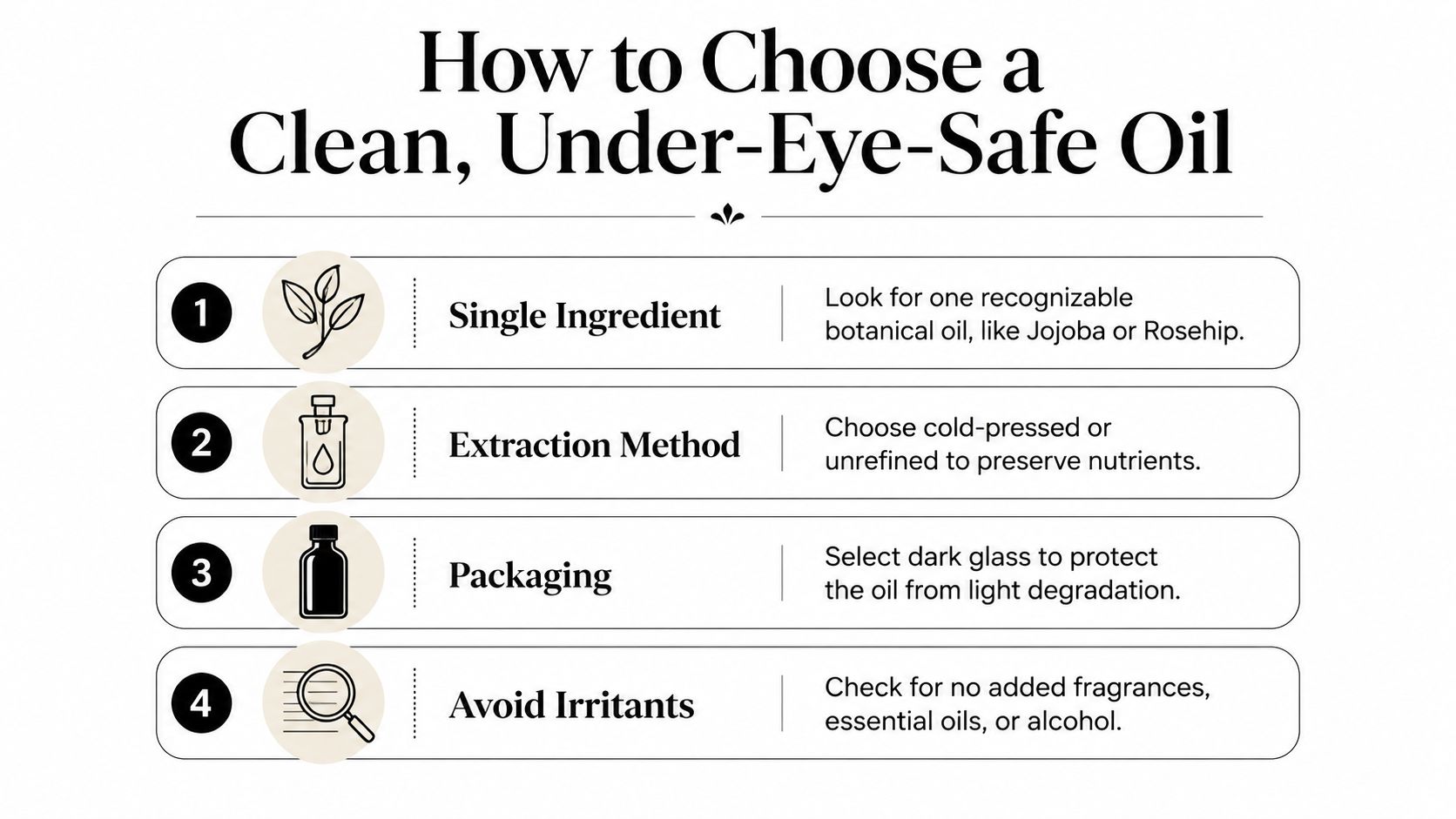
Read an under-eye oil label as if you're choosing a product for contact with a sensitive neighborhood, because migration is possible even when you apply it correctly. A shorter formula gives you fewer potential irritants to evaluate and makes it easier to identify the ingredient responsible if your skin reacts.
Start with one recognizable carrier oil. Botanical names such as Simmondsia chinensis for jojoba or Argania spinosa for argan can help you identify the actual oil rather than a vague blend. Cold-pressed or unrefined extraction may preserve more of the oil's natural character, while dark glass packaging helps limit exposure to light.
What to leave on the shelf
Avoid formulas containing synthetic fragrance, high concentrations of essential oils, added colorants, or an undisclosed “fragrance” or “parfum” blend. Essential oils are especially difficult to justify near the eye because the benefit is uncertain while the potential for stinging and sensitization is more relevant in this location.
Third-party certifications such as USP, COSMOS, or ECOCERT can provide useful context, but they aren't mandatory for a safe choice. The more important questions are whether the formula is transparent, fresh, appropriately packaged, and intended for cosmetic use.
A clean formula isn't defined by the word “natural.” It's defined by transparent ingredients and predictable use.
Keep the bottle away from direct sunlight and heat. Replace an opened oil when its smell, color, or texture changes, because oxidation can make an otherwise familiar ingredient irritating. If you want broader professional context before considering cosmetic procedures for an eye-area concern.
How to Apply Facial Oils Around the Eyes Safely
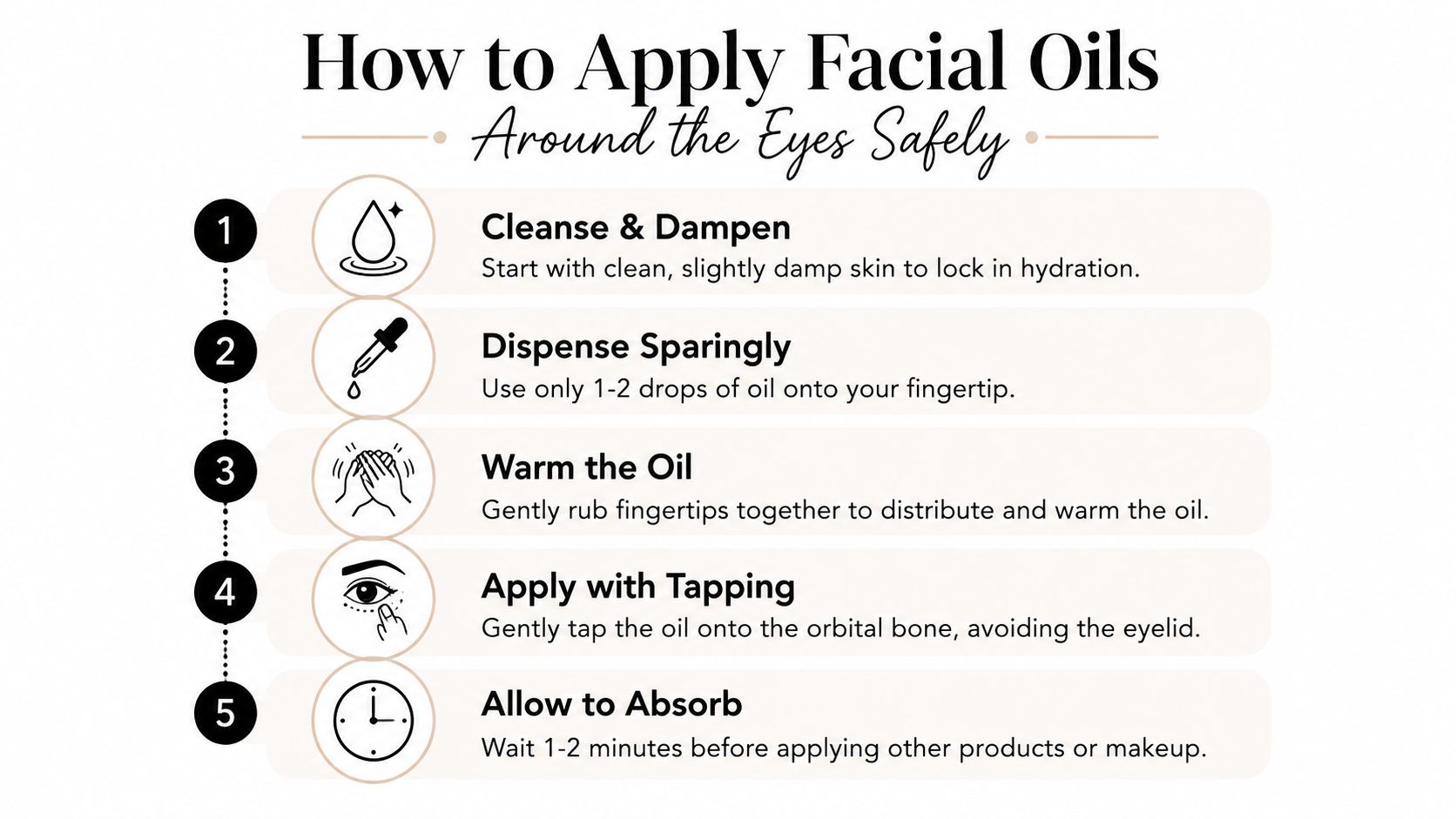
Application technique matters as much as the oil itself. Start with a clean face and slightly damp skin, so the oil can help seal in existing hydration instead of sitting heavily on a dry surface.
Use a rice-grain amount per eye, not a full dropper. Place the oil on your fingertip, warm it lightly between clean fingers, then tap along the orbital bone. Begin near the outer corner and move inward beneath the brow and along the lower orbital rim, stopping before the lash line and inner lid.
A low-migration routine
- Cleanse gently and leave the skin slightly damp.
- Dispense a very small amount of oil.
- Press and tap rather than rubbing or dragging.
- Keep the product on the orbital bone, away from the inner lid margin.
- Give it time to settle before applying makeup or another product.
Patch test the oil on your inner wrist or behind your ear and wait 24 hours before putting it under your eyes. This won't predict every eye-area reaction, but it can reveal obvious sensitivity before you introduce the product to a more delicate location.
Begin with two or three evening applications per week. If the area stays comfortable, you can increase use gradually. Nighttime application reduces the chance that the oil will interfere with makeup, although a very light layer can work under daytime sunscreen if your skin tolerates it.
Placement is protection: The lower orbital bone is the target. The lash line and inner lid margin aren't.
If oil gets into your eye and discomfort persists, rinse the eye and seek medical advice rather than applying more products to “calm” it. Contact-lens wearers and people with eczema-prone or highly reactive skin should be especially conservative and may prefer a fragrance-free eye cream over a free-form oil.
What Oils Can and Cannot Do for Under-Eye Concerns
Facial oils are excellent at supporting the surface. They can reduce the uncomfortable feeling of dryness, improve softness, add emollience, and make dehydration lines look less noticeable when rough texture is the main issue. They're not universal treatments for every change beneath the eyes.
A review of eye-cream ingredients discusses caffeine, niacinamide, vitamin C, retinol, peptides, and hyaluronic acid for concerns such as puffiness, hyperpigmentation, and wrinkles, rather than treating generic oils as the primary solution. That distinction helps you choose an oil for what it can realistically contribute.
Separate the concern before choosing the product
| Concern | Primary Cause | What Oils Can Do | What Oils Cannot Do |
|---|---|---|---|
| Dark circles | Visible vessels, pigmentation, shadows, or thin skin | Improve softness and reduce dry, crepey texture | Reliably correct vascular or pigment-driven discoloration |
| Under-eye bags | Fluid-related puffiness, tissue changes, or structural volume | Support comfort and surface smoothness | Drain fluid or reverse structural changes |
| Wrinkles | Dehydration plus changes in collagen and skin structure | Cushion the surface and soften the look of fine dehydration lines | Rebuild lost structure or replace targeted wrinkle actives |
Dark circles are often not an oil-deficiency problem. Thinner skin can make vessels and pigment more apparent, so adding oil may improve the surrounding texture without removing the source of the shadow.
Puffiness creates a different challenge. A rich film can make the area look and feel heavier, particularly when the primary issue is fluid-related. Wrinkles also need realistic expectations. Lubrication can make fine lines appear softer, but it can't reverse deeper structural changes.
Oils can remain part of supportive skincare, but they shouldn't delay medical evaluation when swelling is persistent, painful, or accompanied by significant redness.
Troubleshooting Irritation, Milia, and Clogged Pores
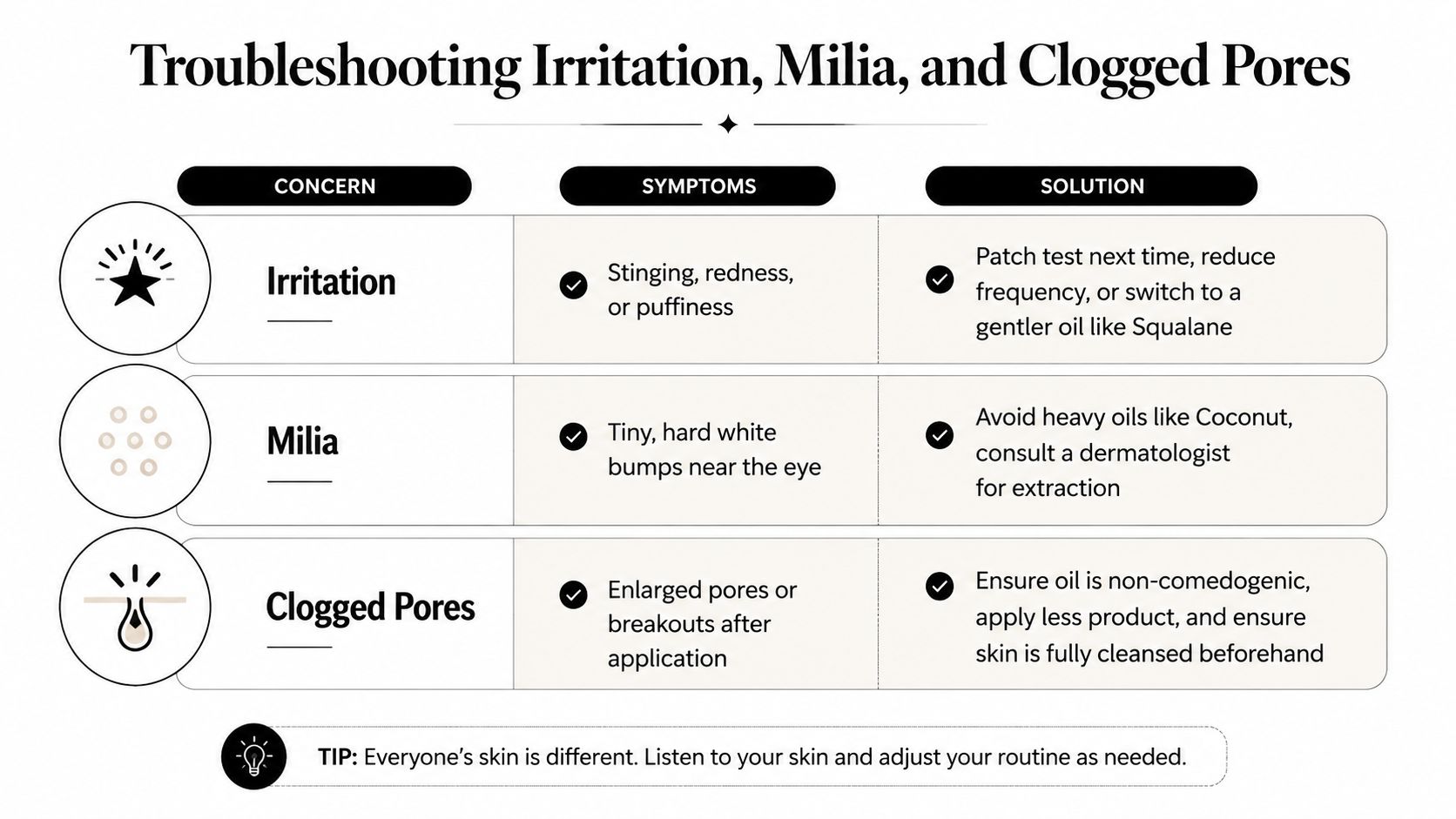
If tiny white bumps form along the orbital bone after you switch oils, congestion is more likely than immediate irritation. Stinging, redness, or sudden puffiness within minutes points more strongly to an incompatible formula, fragrance component, or placement too close to the eye. An oil that has oxidized may also irritate skin that previously tolerated it.
Milia are small, firm white bumps caused by trapped keratin. A thick layer can make them more noticeable or add to congestion in people prone to milia, particularly when product collects along the orbital rim. Under-eye skin behaves like a delicate fabric: excess oil can sit on its surface instead of absorbing comfortably.
Match the symptom to the response
- Irritation: Stop the oil, rinse gently, and wait until the skin feels normal. Review your patch test and choose a simpler, fragrance-free formula.
- Milia: Use less or keep the product away from the affected spot. Persistent milia may require professional assessment or extraction.
- Clogged pores: Reduce the amount, avoid the lash line, and cleanse thoroughly without scrubbing.
Do not massage bumps aggressively or apply facial exfoliating acids close to the eye to remove them. If a rash, swelling, or bump persists, worsens, or affects the eye itself, consult a dermatologist or eye-care professional. This skincare patch-testing guide can support a more cautious testing habit with future products.
A Simple Under-Eye Ritual With Ella & Eden
A good routine should be easy to repeat and easy to stop if your skin objects. In the evening, cleanse your face, mist or lightly hydrate the under-eye area, and wait until the skin is damp rather than wet.
Use one drop of Ella & Eden Jojoba Oil, divide it between your ring fingers, and press it along the orbital bone from the outer corner inward. Don't drag the skin, and don't place oil directly on the eyelid, lash roots, or inner corner.
If your under-eyes feel particularly tight, you can add a small amount of Ella & Eden Argan Oil as a richer finishing layer, but introduce that change separately so you can tell how your skin responds. The oils can also be combined with an eye cream when you prefer a more cushioned texture.
In the morning, skip the oil if it makes sunscreen or makeup slide. If your skin tolerates it, a minimal amount of squalane beneath sunscreen can provide a lighter finish than a richer botanical oil. Start with a few evenings per week, then build toward a consistent routine based on comfort, not quantity.
Ella & Eden offers simple, single-ingredient oils, including jojoba and argan, for minimalist routines focused on barrier support and everyday skin comfort. Visit Ella & Eden to explore its clean beauty collection and choose a straightforward formula for your under-eye ritual.