Best Oil for Black Hair: Your Ultimate Guide 2026
Your bathroom shelf might already have coconut oil, castor oil, rosemary oil, maybe argan oil, maybe a blend you bought because the label promised growth and shine. Yet your hair still feels dry by the next day, your ends still feel rough, and sometimes your strands feel oily on top but thirsty underneath.
This is a common sticking point. The issue isn't choosing bad oils. It's choosing without a system.
The best oil for Black hair usually isn't one magic bottle. It's the oil that matches how your hair takes in moisture, what problem you're trying to solve, and how you apply it. Once you understand those three things, oils stop feeling random and start feeling useful.
Beyond the Hype Finding What Your Hair Truly Needs
A lot of oil advice for natural hair sounds contradictory. One person says coconut oil is too heavy. Another says castor oil fixes everything. A third says use only lightweight oils. If you've tried all three approaches, you already know the problem isn't just the oil itself.
Your hair has its own behavior pattern. Some strands resist water. Some soak it up fast and lose it just as fast. Some need protection more than stimulation. Some need scalp support more than shine. That's why a list of “top oils” often leaves people frustrated.
A better question is this: What is my hair asking for?
For many, the answer comes down to two things:
- Porosity tells you how your hair absorbs and holds moisture.
- Primary concern tells you what result matters most right now, such as breakage, dryness, or scalp-focused growth support.
If your curls are dry all the time, you may not need more oil. You may need the right kind of oil used in the right order. If your strands snap during detangling, your routine may need more internal support before styling. If your scalp feels neglected, your oil choice may need to shift from cosmetic shine to targeted care.
Start here: Oil works best when it supports moisture, not when it replaces it.
That's also why it helps to pair oil choices with a broader moisture routine. For a simple moisture foundation, Ella & Eden's guide on how to moisturize natural hair is a practical companion.
The goal isn't to memorize every oil on the market. It's to learn a simple decision process you can repeat every wash day.
The Science of Oils Penetrating vs Sealing
The biggest source of confusion in Black hair care is that people use the word “moisturizing” for oils that do two very different jobs.
Some oils help move into the hair shaft. Others mostly sit closer to the surface and help slow moisture loss. Both matter. They just aren't interchangeable.
The plant and lid analogy
Think of your hair like a potted plant.
Water nourishes the soil. That's your actual moisture. A penetrating oil is more like something that helps support what gets inside the strand. A sealing oil is like putting a lid over the pot so moisture escapes more slowly.
If you only use a sealing oil on dry hair, you can end up sealing in dryness. That's where the “greasy but dry” feeling comes from. A source discussing Afro-textured hair notes that many people need a two-step approach and that generic oil lists often miss this nuance, especially for preventing that greasy-but-dry result in textured hair routines.

What counts as penetrating and what counts as sealing
The available guidance for textured hair generally places these oils into two useful groups:
- Penetrating oils like coconut, olive, and avocado are discussed as oils that enter the hair shaft more readily.
- Sealing oils like castor and jojoba are usually treated as oils that help coat the strand and reduce moisture loss.
That distinction matters more than hype. If your hair feels stiff, rough, or weak after washing, a penetrating oil may be the missing step. If your hair feels soft right after moisturizing but dries out quickly, a sealing oil may help hold onto that moisture longer.
Why Afro-textured hair often needs both
Coils and tight curls make it harder for natural scalp oils to travel down the strand. That means the ends often need extra support. But “support” can't be one-dimensional.
Many people with textured hair do better when they use a penetrate first, then seal approach based on porosity. If you want a helpful overview of common oil categories, Ella & Eden's article on best carrier oils for hair offers a clean starting point.
Hair oil doesn't replace water. It changes what happens after water touches your hair.
Once you understand this, oil labels become easier to decode. You stop asking, “Is this oil good?” and start asking, “Is this oil supposed to go inside, stay outside, or do a little of both?”
Decoding Your Hair Porosity The Simple Spray Test
Porosity is your hair's ability to absorb moisture and hold onto it. It's one of the fastest ways to narrow down the best oil for Black hair because it tells you whether your strands struggle more with getting moisture in or keeping moisture from leaving.
You don't need a lab test. You just need clean hair, water, and a minute of observation.

How to do the spray test
Use a spray bottle on clean, product-free hair. Lightly mist one section and watch what the water does.
- If water beads on top, your hair may be low porosity.
- If water slowly sinks in, your hair may be normal porosity.
- If water disappears almost right away, your hair may be high porosity.
This test is simple, but it's useful because it mirrors what many people notice during wash day. Some hair seems to “fight” water. Some welcomes it but loses softness quickly.
What each result usually means
- Low porosity hair often has tightly packed cuticles. Moisture has a harder time getting in, but once it's in, the hair can hold it fairly well.
- Normal porosity hair tends to take in moisture and retain it with less drama.
- High porosity hair usually absorbs moisture quickly, then loses it quickly too. This hair often benefits from stronger sealing support.
If your hair is color-treated, heat-styled often, or fragile at the ends, you may notice higher porosity in some areas than others. That's normal. Hair can behave differently from roots to ends.
What to do with the answer
Porosity doesn't lock you into one oil forever. It gives you a starting point.
Low porosity hair usually prefers lighter application and often needs patience with penetration. High porosity hair usually needs more help with retention and protection. If your hair falls into that second group, Ella & Eden's resource on best oils for high porosity hair can help you think through your options.
Don't worry about getting the test perfect. You're looking for a pattern, not a grade.
Matching the Right Oil to Your Hair Concern
Once you know your porosity, the next question is simpler: what are you trying to fix first?
For many, it's one of three things. Strands that break easily. Hair that feels dry no matter what. Or a scalp and hairline routine that supports stronger-looking density over time.
If breakage is your main problem
For brittle hair, coconut oil deserves special attention. A review focused on hair oils in patients with skin of color found that coconut oil is the only hair oil with strong clinical evidence for reducing protein loss and breakage, including a 41.8% reduction in hair breakage across 17 studies involving 370 patients.
That matters because breakage often gets mistaken for “slow growth.” In reality, the hair may be growing, but the ends keep snapping before you can retain length.
For breakage-prone hair, think in layers:
- Low porosity hair: Use a small amount of coconut oil as a pre-wash step so the strand gets support without feeling overloaded.
- High porosity hair: Use coconut oil first, then follow with a heavier sealing oil to help protect weak spots along the cuticle.
Practical rule: If your comb is full of short snapped pieces instead of long shed hairs, focus on strand protection before chasing growth products.
If your goal is scalp support and fuller-looking density
Rosemary oil stands out. Clinical data discussed in the same body of evidence found that rosemary oil produced hair density results comparable to 2% minoxidil over a six-month period. That doesn't make it a cure-all, but it does make it a serious option for people building a plant-based scalp routine.
Another source notes that rosemary functions as a 5-alpha-reductase inhibitor, which means it may help reduce the conversion of testosterone to DHT, and also describes peppermint oil as a vasodilator linked to increased scalp blood flow and IGF-1 activity in a study where peppermint oil induced more hair growth than minoxidil, saline, and jojoba oil after four weeks.
For practical use:
- Low porosity scalp routines often do better with diluted, lighter-feeling applications.
- High porosity hairlines and coarse roots may tolerate richer blends, especially if the scalp isn't sensitive.
A simple option in this category is a rosemary-based blend such as Ella & Eden Hair Growth Oil, which includes rosemary alongside castor and peppermint. It fits best as a scalp treatment, not as a substitute for full-hair moisture.
If your issue is chronic dryness
Dryness needs honesty. Oil alone doesn't hydrate hair. Water hydrates hair. Leave-ins help. Oils support the result.
For low porosity hair, too much heavy oil can sit on top and create buildup. For high porosity hair, very light oils may disappear without giving enough protection. This is why matching weight to porosity matters more than trend lists.
Here's a quick reference:
| Hair Concern | Best For Low Porosity (Lightweight Oils) | Best For High Porosity (Heavier Oils) | Ella & Eden Example |
|---|---|---|---|
| Breakage and weak ends | Coconut oil in a light pre-poo layer | Coconut oil followed by castor or jojoba to seal | Organic Castor Oil |
| Scalp-focused growth support | Diluted rosemary with a lighter carrier | Rosemary with a richer carrier for retention | Hair Growth Oil |
| Dryness and moisture retention | Jojoba used sparingly after water-based moisture | Castor or jojoba layered after penetrating moisture support | Jojoba Oil |
One more point deserves caution. Some oils are popular because they feel luxurious, but popularity isn't the same as evidence. The review above specifically noted that castor oil and argan oil did not show strong evidence for actual hair growth or quality improvement in that context, even though many people still enjoy them for sealing, softness, and finish.
That's the difference between a cosmetic benefit and a clinically supported one. Both can belong in a routine. They just shouldn't be confused.
How to Choose a High-Quality Pure Oil
Two bottles can both say “castor oil” or “jojoba oil” and still behave very differently in your routine. Processing matters. Purity matters. Storage matters too.
A high-quality oil usually gives you a shorter ingredient list, a clearer origin story, and fewer surprises on your scalp.
What the label should tell you
Look for labels that are easy to read and specific.
- Single-ingredient formula: The ingredient list should name the oil itself, not a long blend padded with fragrance, silicones, or fillers.
- Cold-pressed or unrefined: These terms suggest gentler processing, which many people prefer when they want the oil in a more intact state.
- Traceable sourcing: A brand should be able to tell you what the oil is, where it comes from, and how it was processed.
The big caution here is that people often assume “natural” automatically means better. But the question of whether cold-pressed virgin oil performs better than refined oil for Black hair growth is rarely answered with direct data. One source highlights that consumers often assume natural is superior, yet there's a real evidence gap around how processing affects retention of growth-related compounds in oils used for textured hair.

What to avoid
Refining doesn't always make an oil useless, but it can make shopping murkier. Be careful when the front label sounds pure and the back label tells another story.
Watch for these red flags:
- Added perfume: Fragrance can be irritating, especially on a sensitive scalp.
- Mystery blends: If the oil is mixed with several unnamed additives, it's harder to know what your hair is responding to.
- No processing details: If a brand says nothing about how the oil was extracted, that's missing context.
Cleaner labels make troubleshooting easier. If your scalp gets itchy or your strands feel coated, you can identify the likely cause faster.
A better way to shop
Think like a detective, not a trend follower. Start with the simplest version of the oil you want to test. Use it consistently. Watch how your hair responds over several wash days.
The best oil for Black hair isn't just about the plant. It's also about the bottle, the processing, and the honesty of the label.
Your Step-by-Step Oil Application Routine
Knowing which oil to choose helps. Applying it correctly is what turns theory into results.
A good routine doesn't need to be long. It needs to be intentional. Oil is typically used for one of three purposes: pre-wash protection, moisture sealing, or scalp massage.

Routine one for pre-wash protection
Use this when your hair feels stripped after shampooing or your ends snap during wash day.
Apply a small amount of a penetrating oil to dry or slightly damp hair before shampoo. Focus on mid-lengths and ends. Smooth it through sections, then let it sit before cleansing.
This works especially well for people whose hair feels weaker after washing. Coconut oil is the classic choice here because this step is about reducing wash-related stress on the strand.
A simple pattern:
- Section hair into four to six parts.
- Apply penetrating oil lightly from mid-length to ends.
- Detangle gently with fingers or a wide-tooth comb.
- Wait a bit, then shampoo as usual.
Routine two for sealing in moisture
This is the routine that fixes the common mistake of putting oil on dry hair and hoping for hydration.
Start with water or a water-based leave-in. Then apply your oil based on porosity. Low porosity hair usually likes a lighter hand. High porosity hair often needs a stronger seal, especially on the ends.
Try this order:
- First: Water or leave-in on damp hair
- Second: If needed, a small amount of penetrating support
- Third: A sealing oil on the driest areas
If your hair looks shiny but still feels rough, use less oil and more moisture underneath. If your hair feels soft at first and then dries out fast, increase the sealing step slightly.
Apply oil to damp hair, not thirsty hair. Oil is better at keeping moisture in than creating it from nothing.
Routine three for scalp massage
Use this when your main focus is scalp comfort, hairline attention, or a fuller-looking routine.
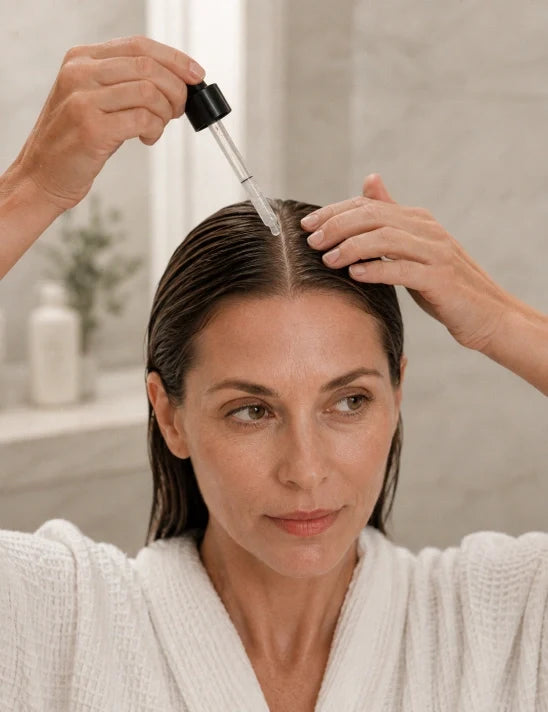
Take a few drops of a diluted scalp-friendly oil blend and apply it directly to the scalp in parts. Massage gently with fingertips, not nails. Keep the pressure light and consistent.
A beginner-friendly blend can be made by combining a carrier oil with a small amount of rosemary oil. If your scalp is sensitive, patch test first and keep the blend simple. Peppermint can feel stimulating, but it can also be too intense for some people, so dilution matters.
A few practical reminders:
- Use less than you think: A greasy scalp doesn't help if buildup starts blocking your routine.
- Be consistent: A simple routine repeated regularly beats a complicated one you stop using.
- Watch your response: If your scalp tingles too much, flakes more, or feels irritated, reduce frequency or simplify the formula.
How often should you oil
There isn't one perfect schedule. Your hair will tell you.
Some people prefer oil mainly on wash day. Others add a light sealing step during the week. Scalp treatments are often best when they're regular but not excessive. The key is to look for comfort, softness, and manageability, not a heavy coated feeling.
If your strands start to feel limp, sticky, or harder to absorb moisture, pull back. That's often a sign your hair needs clarification or less product, not more.
The Simple Secret to Healthy Hair
The best oil for Black hair is rarely a single universal answer. It's a system.
Porosity tells you how your hair handles moisture. Your main concern tells you what kind of support to prioritize. Your method determines whether the oil can do its job. Put those three together, and the guessing starts to fade.
That matters because healthy hair care doesn't have to be loud or complicated. It can be precise. A penetrating oil for support. A sealing oil for retention. A scalp oil when your focus is density and comfort. That's a calmer, smarter way to build a routine.
You don't need to buy every oil. You need to know why you're using the one in your hand.
If you want to build a simpler routine with clean, single-ingredient options, explore Ella & Eden. Their collection centers on cold-pressed, unrefined oils with straightforward labels, which makes it easier to match the right oil to your porosity, your scalp, and your styling habits.