Cold Pressed Oil for Skin: A Complete Guide 2026
Is cold pressed oil for skin automatically better because the label says “natural”? Not necessarily. The useful question is more specific: what does the oil contain, how stable is it, and does its lipid profile suit your skin's barrier and concerns?
Cold pressing can preserve delicate plant compounds, but it can also leave an oil more vulnerable to oxidation or more likely to contain protein residues that matter to allergy-prone users. The best choice depends less on a universal “good oil” list and more on whether your skin is dry, acne-prone, reactive, or comfortable with richer textures.
What Cold Pressed Oil Really Means for Your Skin
Cold pressing is a mechanical extraction method. A plant seed, fruit, or nut is crushed and pressed to release its oil, rather than being processed mainly through high heat or chemical solvents. The simplest analogy is fresh juice. Gentle squeezing can preserve more of the original character of the fruit, while intense processing changes the result.
That original character includes fatty acids, antioxidants, pigments, and other naturally occurring compounds. These components influence how an oil feels, how quickly it oxidizes, and how it interacts with the outer layer of the skin. The extraction method matters, but it isn't a guarantee that every cold pressed oil will suit every complexion.
You can find a more detailed explanation of the extraction process in this guide to what cold pressed oil means.

Chemistry matters more than the label
Plant oils are mixtures of fatty acids. Oils richer in polyunsaturated fatty acids, especially alpha-linolenic acid, generally oxidize more quickly. Oils with more saturated or monounsaturated fats, along with antioxidant content, tend to be more stable. A systematic review of cold-pressed oils found that relatively stable oils, including coconut and olive, commonly showed peroxide values of about 1 to 8 meq O₂/kg, while several PUFA-rich oils, including flaxseed, chia, hempseed, walnut, grapeseed, and pomegranate seed, showed values of about 6 to 15 meq O₂/kg in the reviewed research.
Those values aren't a simple ranking of which oil is “best.” They describe susceptibility to oxidation. A delicate oil may offer useful barrier-supportive lipids, but it needs fresher stock, protective packaging, and careful storage.
Cold pressed doesn't mean universally safer
Less processing can preserve desirable compounds, but it may also preserve more protein residues. That distinction matters if you have a known plant allergy or a history of allergic contact reactions. The extraction method is one part of product quality, not a substitute for patch testing, a clear ingredient list, or attention to freshness.
Practical rule: Choose cold pressed oil for its fatty-acid profile and intended use, not for the label alone.
How Cold Pressed Oils Support the Skin Barrier
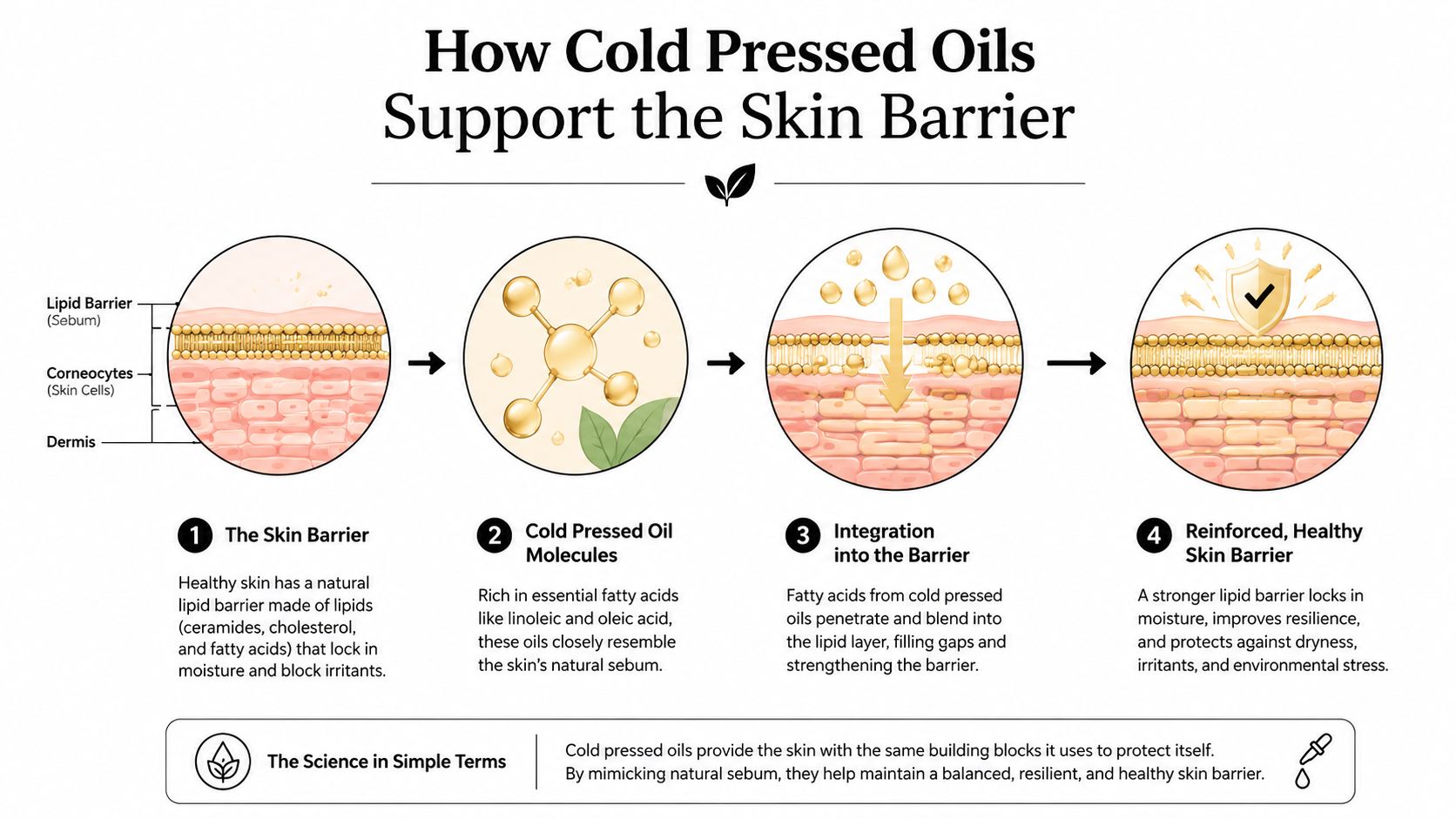
Your skin barrier is the outer defense system that helps keep water inside and unwanted irritants outside. Its surface contains cells surrounded by lipids, often compared to bricks held together by mortar. When that structure becomes disrupted, skin can feel tight, rough, flaky, stingy, or unusually reactive.
An oil doesn't add water to the skin. Instead, it can form a semi-occlusive film that slows water escape from the outermost layer, the stratum corneum. This process is measured through transepidermal water loss, or TEWL. In vivo investigations found that applying various plant oils lowered TEWL, while a related review connected plant oils with barrier repair through anti-inflammatory and antioxidant mechanisms.
The right lipid profile makes the difference
Linoleic-acid-rich oils can be useful when skin needs support for its surface lipids. This doesn't mean an oil must imitate sebum perfectly or penetrate far to work. Its film-forming behavior, fatty-acid composition, concentration, and the products used underneath all affect the result.
A few drops over damp skin can help hold onto water already present after cleansing. Applied over a compatible moisturizer, an oil can function as the final softening layer. Applied to very dry skin without any water-based product beneath it, it may make the surface feel smoother while leaving underlying dehydration unaddressed.
More oil isn't always more repair
Dose matters. A mechanistic study found that some oil mixtures disrupted barrier function in a dose-dependent way, increasing both outside-in penetration and TEWL when their composition didn't match the barrier well. In everyday terms, an unsuitable blend or heavy application can work against the result you're trying to achieve.
Keep the routine simple while you evaluate tolerance:
- Start with a thin layer: Use enough to reduce drag and leave the skin comfortable, not glossy or coated.
- Apply over moisture: Place the oil after cleansing while skin is still slightly damp, or layer it over a moisturizer.
- Change one variable: Don't introduce several unfamiliar oils at once, because you won't know which ingredient caused congestion or irritation.
- Stop at the first clear reaction: Burning, swelling, hives, or persistent itching calls for discontinuation and, when needed, professional medical advice.
For a broader routine focused on recovery, see this practical guide to repairing the skin barrier.
Best Cold Pressed Oils for Every Skin Type
A fixed comedogenic rating can sound reassuring, but it often suggests more certainty than the evidence supports. Recent review literature notes that common comedogenicity tests don't represent human skin well, and rabbit-ear models have limited clinical relevance. Your response depends on the oil, the formulation, extraction and refinement, application amount, and your own skin biology as discussed in this review of topical oil tolerance.
Use the table as a starting point, not a promise. Introduce one oil at a time and judge it by comfort, congestion, redness, and freshness.
Cold Pressed Oils by Skin Concern
| Skin Type | Recommended Oils | Key Benefits |
|---|---|---|
| Acne-prone or oily | Rosehip, hempseed, grapeseed, or other lighter PUFA-rich options | A lighter feel and linoleic-acid-rich support may suit skin that dislikes dense textures, but oxidation and individual tolerance still matter |
| Sensitive or reactive | A simple, fragrance-free formula with a short ingredient list, such as jojoba or a carefully selected olive-based product | Fewer ingredients make reactions easier to identify, while a semi-occlusive layer can reduce surface water loss |
| Dry or flaky | Jojoba, olive, coconut, argan, pumpkin seed, or castor in a suitable blend | Richer textures can soften roughness and help reduce water escape, especially over damp skin |
| Mature or comfort-seeking | Argan, jojoba, rosehip, olive, or pumpkin seed | Emollience and antioxidant-containing compounds can support a smoother, more supple feel |
Choose by the problem you want to solve
For acne-prone skin, texture and freshness deserve priority over a simplistic “non-comedogenic” promise. A light oil may feel more comfortable than a dense one, but even a light oil can disappoint if it has oxidized or if your skin reacts to a botanical component. This guide to oils for acne-prone skin can help you compare options by concern.
For sensitive skin, simplicity is often more valuable than a long list of active botanicals. Cold pressed oils can retain more natural compounds, and those compounds may be welcome for some people but problematic for someone already sensitized. One clinical-style assessment found that one tested oil caused an allergic contact reaction in 4.3% of participants, while most of the other tested oils caused none in the reported assessment.
Dry skin usually benefits from an oil used as a seal, not as a replacement for a water-based moisturizer.
Simple Ways to Use Cold Pressed Oils Daily
An oil works best when you give it a clear job. It can soften, reduce friction, and slow moisture loss, but it doesn't replace cleansing, sunscreen, or a water-based hydrating step.
Build a low-effort face routine
Cleanse gently, apply any water-based serum or moisturizer, then press a small amount of oil over the surface. Damp skin gives the oil moisture to help seal in, while pressing rather than rubbing can reduce unnecessary friction.
For a morning routine, keep the oil light if you plan to apply sunscreen or makeup. For an evening routine, a richer oil can feel more comfortable if your skin is dry and your pillowcase won't be affected by the texture.
Four practical uses
- Facial sealing step: Apply a few drops to damp skin after cleansing, or use it over moisturizer when you need extra softness.
- Makeup adjustment: Mix a tiny amount into foundation only if the formula remains even and your skin tolerates the oil. Test the combination on your hand first.
- Overnight comfort: Use the oil as the final step on nights when your skin feels dry, keeping the layer light enough to avoid heat and heaviness.
- Body care: Massage it into cuticles, elbows, knees, or other rough areas after bathing while the skin still holds moisture.
You can also use a suitable plant oil as the first step of a double cleanse to loosen makeup and sunscreen, then follow with a gentle water-based cleanser. Don't scrub to remove the oil. Let the cleanser do the work, and stop if the process leaves your skin tight.
Simple ritual: One oil, one compatible moisturizer, and a consistent application method will tell you more than a crowded shelf of competing formulas.
Red Flags to Avoid When Buying Cold Pressed Oils
“Cold pressed” describes extraction, not the entire product. A bottle can carry that phrase while still offering little clarity about the specific oil, freshness, formulation, or intended skin use. Read the complete ingredient list instead of treating front-label language as proof of quality.
Read the bottle like a formulator
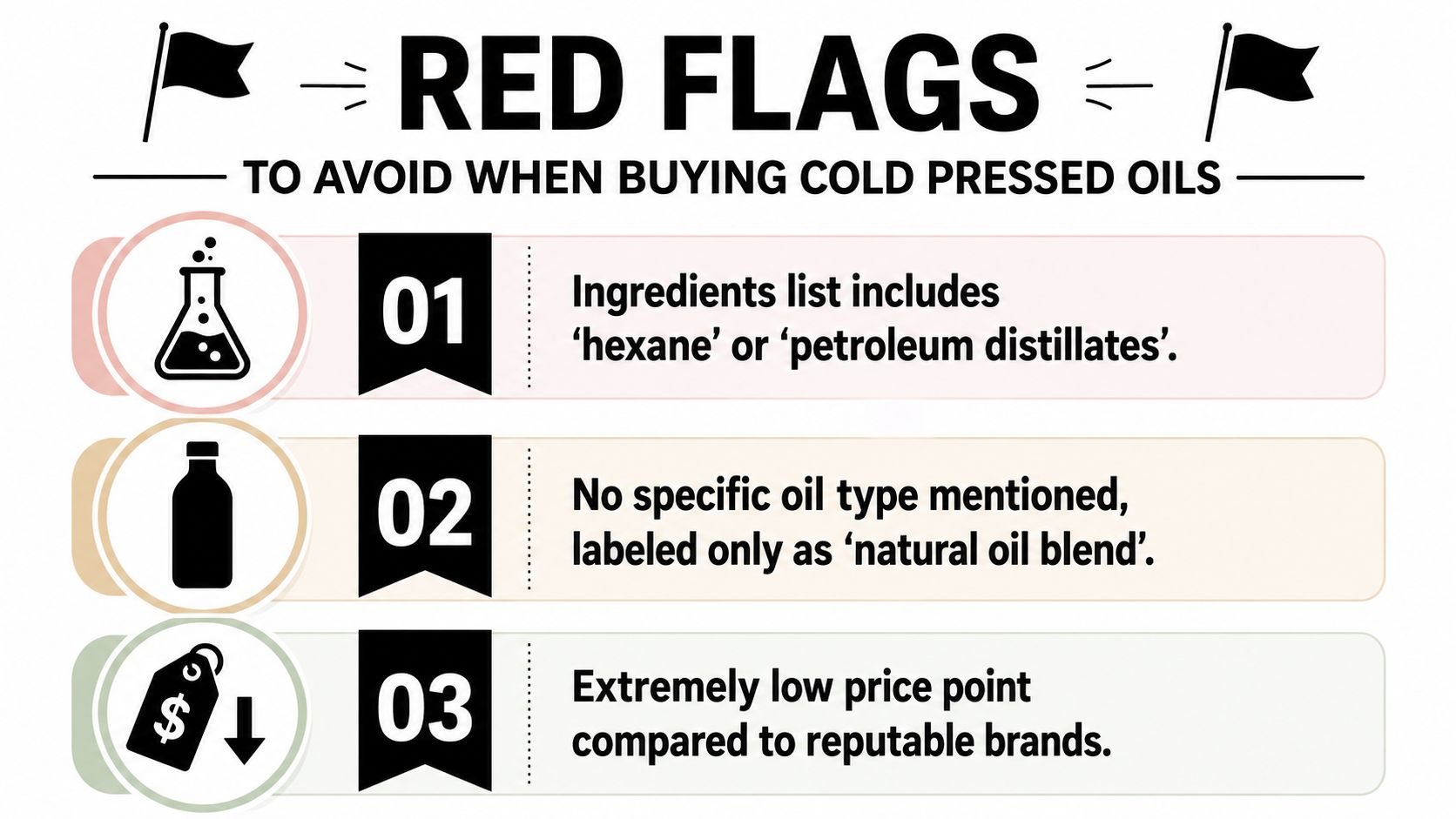
Look for the exact botanical oil, not only a broad phrase such as “natural blend.” A transparent label helps you identify potential allergens, compare formulas, and understand whether fragrance oils or additional ingredients are present.
Be cautious with products that list hexane or petroleum distillates if your goal is a mechanically pressed, minimal formula. Solvent extraction and cold pressing are different processes, and a product shouldn't imply one while using the other.
Watch for quality gaps
- No named oil: “Natural oil blend” doesn't tell you which plant oils are present or how much of each one is included.
- No freshness information: Oxidation-sensitive oils need sensible handling and a clear use window.
- Overloaded fragrance: Fragrance can make a product feel luxurious, but it adds another possible source of irritation for reactive skin.
- Unclear packaging: Transparent bottles, loose caps, and excessive exposure to heat or light can work against freshness.
- Unrealistic promises: An oil can soften and support the barrier, but it shouldn't be presented as a universal treatment for acne, eczema, or allergy.
Cold pressed isn't the same as risk-free
The assumption that less processing always means safer misses the allergy question. Cold pressed oils may retain more bioactive material, but they may also retain more protein residues, which can matter to sensitized users.
Choose certified organic products if that standard matters to you, but don't use certification as a substitute for patch testing. A clear ingredient list, appropriate packaging, traceable sourcing, and a fresh scent are more useful signs of a thoughtfully made product than a vague “clean” claim.
How to Store Cold Pressed Oils for Maximum Freshness
Oxidation changes an oil over time. Oils richer in polyunsaturated fats are generally more vulnerable, which is why flaxseed, chia, hempseed, walnut, grapeseed, and pomegranate seed oils need more attention than relatively stable oils such as coconut or olive according to the systematic review of cold-pressed oils.
Store the bottle in a cool, dark place away from windows, radiators, and steamy bathrooms. Close the cap immediately after use, and avoid touching the dropper or applicator to your face so you don't introduce moisture or microbes into the bottle.
Freshness checks that actually help
A fresh oil usually smells clean and characteristic of its plant source. If the scent becomes sharp, stale, bitter, crayon-like, or otherwise unpleasant, stop using it on your skin. A change in smell is more useful than judging an oil by color alone, because natural color varies between batches.
Buy a container size you can use comfortably while the oil still smells fresh. Keep especially oxidation-prone oils in packaging that limits light and air, and follow the manufacturer's best-by or period-after-opening guidance rather than keeping an opened bottle indefinitely.
If an oil starts causing unexpected stinging after previously feeling comfortable, discontinue it. Oxidized oils can lose desirable sensory qualities and may increase irritation risk over time, so freshness is part of skin compatibility, not just a matter of preserving luxury.
Common Questions About Cold Pressed Oils Answered
Can cold pressed oil clog pores? It can be unsuitable for some people, but simple comedogenic ratings aren't reliable predictors of human results. Skin type, formula, amount, freshness, and extraction method all matter.
How should I patch test? Apply a small amount of the finished product to a limited area and observe it over time. Stop if you develop burning, swelling, itching, hives, or persistent redness, especially if you have known allergies.
Can I combine oils? You can, but introduce them separately first. A blend makes it harder to identify which ingredient caused congestion or irritation.
Is oil enough for dry skin? Oil helps soften and reduce water escape, but it doesn't provide water. Apply it over damp skin or a moisturizer for a more complete routine.
Ella & Eden offers simple, multi-purpose options such as cold pressed jojoba and castor oils for minimalist skin rituals, with ingredient information designed to help you choose thoughtfully. Visit Ella & Eden to explore fragrance-free, filler-free oil care and build a routine around your skin's actual needs.