Raw Mango Butter: Benefits, Uses, and How to Choose the Best
Is raw mango butter really a moisturizer, or is that label hiding a more useful role? The answer matters because a product can soften skin while doing something more technical in a formula: adding structure, improving glide, and helping a balm hold its shape.
Raw mango butter is best understood as a plant-derived kernel fat with clear formulation behavior. It can be valuable for dry skin, textured hair, balms, and body butters, but the evidence doesn't justify treating it as an anti-aging treatment, brightening active, or acne cure. The most useful way to choose it is to match its texture and composition to your routine.
What Raw Mango Butter Actually Is
Raw mango butter, also called mango seed kernel butter, comes from the kernel inside the stone of Mangifera indica, the mango tree. It isn't pressed from the juicy pulp you eat. Processors recover the hard seed, open it, dry the inner kernel, and extract its fat.
That distinction explains why mango butter often appears in discussions about byproduct use. Mango processing leaves behind peel and seed material, and the kernel can become a cosmetic raw material instead of remaining processing residue. Industry data reports that mango fruit contains 11 to 18% peel and 14 to 22% seed, making kernel recovery a meaningful part of the ingredient's supply story.
At room temperature, unrefined mango butter is generally a pale ivory to soft yellow semi-solid. Its scent may be faintly fatty, nutty, or leafy, although processing affects both aroma and color. It softens with body heat and melts in the range of 30 to 37°C, or 86 to 98°F.
Why formulators use it
Think of mango butter as a structuring fat, not a liquid carrier oil. It gives body to a balm, cushion to a body butter, and a smoother spread to a hair conditioner. Once warmed, it distributes across skin and hair without the immediate drag of a hard wax.
The butter is oil-soluble and water-insoluble, so it belongs in the oil phase of an emulsion or an anhydrous product. It won't hydrate skin by supplying water. Instead, it helps reduce the feel of dryness by softening the surface and slowing moisture loss when applied over damp skin.
If you want a broader primer on plant oils and extraction methods, this guide to what cold-pressed oil means can help. The key mental model is simple: raw mango butter is a defined lipid ingredient with a useful texture, not a miracle cure.
The Composition Behind the Texture
Mango butter feels the way it does because its fatty acids balance firmness with spreadability. Independent ingredient specifications report approximately 35 to 47% stearic acid and 34 to 48% oleic acid, with palmitic acid at 2 to 18% and linoleic acid at 2 to 9%. A separate technical dossier reports stearic acid at 35.0 to 45.0%, oleic acid at 35.0 to 50.0%, linoleic acid below 5.0%, and free fatty acids below 0.25% as oleic acid. These ranges vary with cultivar, growing conditions, kernel source, and processing.
| Fatty Acid | Typical Range (%) | Functional Role |
|---|---|---|
| Stearic acid | 35 to 47 | Adds firmness, body, cushion, and a stable semi-solid structure |
| Oleic acid | 34 to 50 | Improves slip, spreadability, and conditioning feel |
| Palmitic acid | 2 to 18 | Reinforces the solid character and contributes to texture |
| Linoleic acid | 2 to 9 | Adds another unsaturated fatty-acid component to the lipid profile |
Stearic acid is the main reason mango butter doesn't behave like a liquid oil. This saturated fatty acid helps create a smooth, substantial body that supports sticks, balms, whipped butters, and conditioning bars. In practical terms, it makes a formula feel more finished and less runny.
Oleic acid pulls the texture in the other direction. It contributes slip and makes the butter easier to spread after warming. That balance gives mango butter a comfortable middle position. It's more structured than most liquid oils, but it doesn't necessarily leave the hard, brittle impression associated with very firm butters.
Texture is also a processing issue
The fatty-acid profile provides a useful baseline, but it doesn't determine every sensory detail. Refining, deodorizing, cooling speed, storage temperature, and batch variation can affect scent, color, graininess, and final hardness. A product marketed as raw or unrefined may preserve more of its characteristic aroma and color, while a refined product may be paler and more neutral.
Mango butter also shows cocoa-butter-like triglyceride behavior in some mango species and kernel sources. Published analysis identifies triglycerides such as POP, SOS, and POS alongside dominant palmitic, stearic, and oleic acids in research on mango kernel fat composition. That pattern helps explain why formulators value it in systems where firmness, crystallization behavior, and shelf stability matter.
For shoppers, the takeaway is practical. Mango butter isn't a watery hydrator or a lightweight serum oil. It's a semi-solid oil-phase ingredient that combines body with a relatively smooth melt.
If you're comparing processing labels, this explanation of unrefined oil versus refined oil is useful. Neither label tells you everything about performance, but it helps you understand why two mango butters can look and smell different.
Skin and Hair Benefits, Honest Version
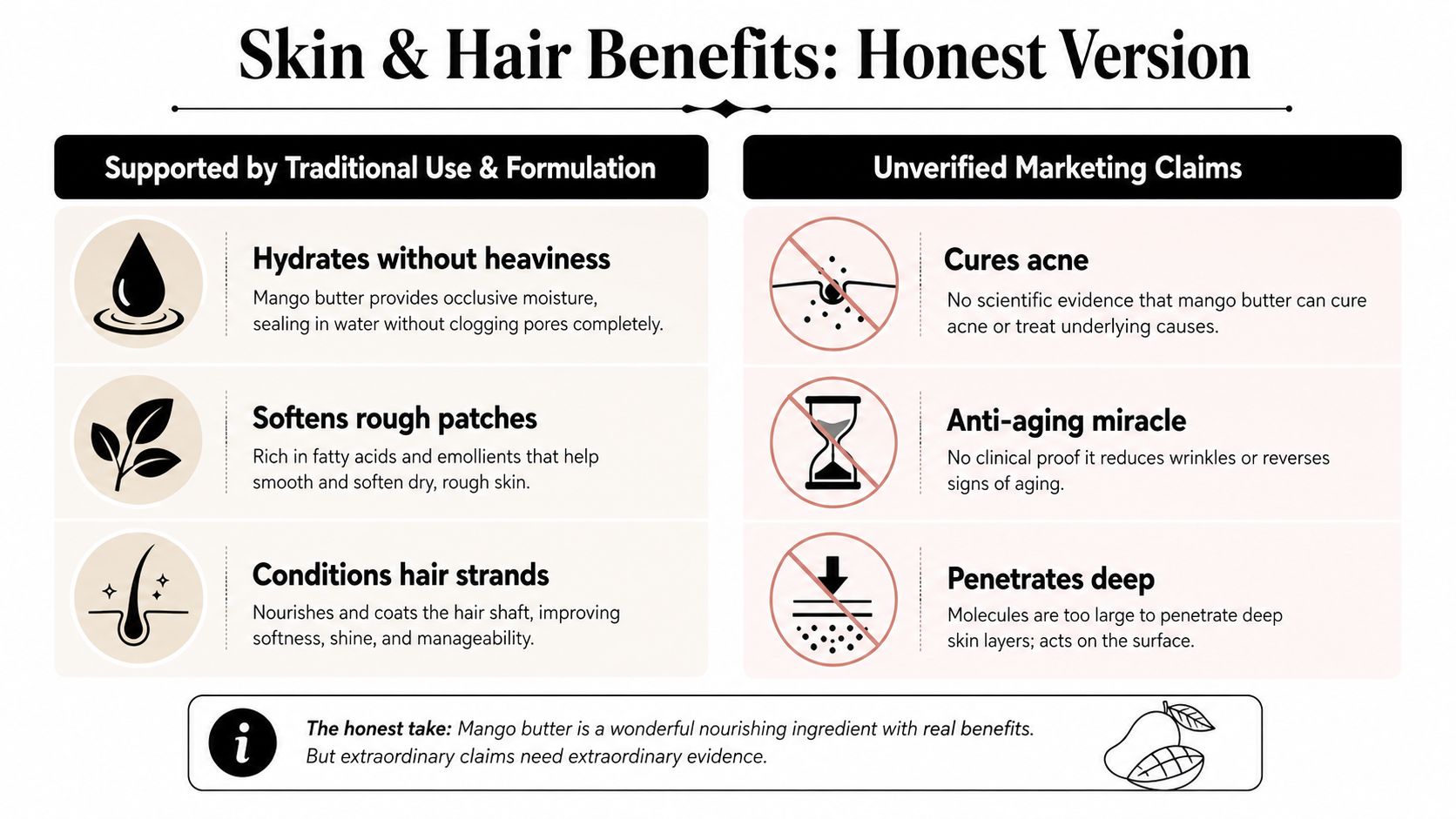
Raw mango butter earns its place in a routine through emollience, not through dramatic treatment claims. Emollients fill in some of the uneven feel between dry skin cells, leaving rough areas softer and more flexible. On elbows, heels, hands, and other dry patches, the butter can provide a comfortable protective layer, especially when pressed into slightly damp skin.
Its structure also improves the sensory quality of a formula. A balm containing mango butter can feel less runny than an oil-only blend, while a body butter can gain cushion without relying entirely on waxes. The oil-soluble fat spreads across the surface and helps reduce the tight, rough sensation associated with dryness.
Practical distinction: Raw mango butter can improve how skin and hair feel. That doesn't make it a clinically proven treatment for every condition mentioned on a product label.
Hair benefits follow the same logic. A small amount can smooth the feel of coarse or textured strands, reduce the appearance of flyaways, and add lubrication to dry ends. Used as a pre-shampoo treatment, it may make hair feel less rough during washing. In a leave-in product, it works best as a conditioning and frizz-managing component rather than as a growth active.
The composition also makes it useful in blends where a formulator wants a stable, semi-solid fat. The stearic- and oleic-acid balance supports body, slip, and a pleasant melt, while the material's resistance to oxidation can be useful in an oil-based formula. That doesn't mean every finished product will last longer. Packaging, freshness, heat, light, and the other ingredients still matter.
What the evidence doesn't establish
Claims about anti-aging, dark-spot correction, collagen support, or acne clearing go beyond what raw mango butter itself has demonstrated. A neutral review describes the research base as mainly traditional use, in-vitro work, or small studies, with no large randomized human trial isolating mango butter itself.
That doesn't make the ingredient ineffective. It means the strongest claims are softening, conditioning, slip, and formula structure, while treatment claims need separate active ingredients and clinical support.
Oily and acne-prone users should also avoid blanket reassurance. A dermatology-focused summary gives mango butter a comedogenic rating around 2, suggesting low-to-moderate pore-clogging potential rather than a universal fit.
For a wider look at gentle plant oils, this guide to natural oils for glowing skin can help you compare textures without turning any single oil into a cure-all.
How to Use Raw Mango Butter Safely
Start with less than you think you need. Raw mango butter softens quickly, and applying too much can leave a greasy film, especially on the face or on fine hair.
For skin, warm a pea-sized amount between clean fingertips until it becomes glossy. Press it into slightly damp skin after bathing, or smooth a thin layer over particularly dry areas such as heels, knuckles, and elbows.
A simple personal-use method
- Clean your hands first. This limits the transfer of dirt and microbes into the jar.
- Warm a small amount. Body heat changes the semi-solid butter into a spreadable oil.
- Apply it over damp skin. The butter helps reduce surface moisture loss, but it doesn't replace water.
- Wait before adding more. Give the first layer time to spread before deciding that your skin needs another one.
For hair, melt a small amount between your palms and smooth it over the ends. Keep it away from the scalp if your hair is fine or becomes greasy easily. Coarse, curly, and textured hair may tolerate more, but the right amount depends on strand thickness and porosity.
You can also blend mango butter with a liquid oil such as jojoba or sweet almond oil. A starting point of 25 to 40% mango butter in an anhydrous balm, body butter, or leave-in treatment can provide structure without making the product completely hard. Those percentages are practical formulation starting points, not universal safety limits, so adjust the texture in small test batches.
A basic body butter formula uses 30 g mango butter, 15 g jojoba or sweet-almond oil, and 5 g arrowroot powder. Melt the butter and oil together, allow them to cool, add the powder, then whip only after the mixture has begun to thicken.
Clean formulation rule: Keep water out of an unpreserved butter blend. Water introduces preservation requirements that an oil-only product doesn't have.
Use a sanitized jar, a clean spatula, and small batches. Store the finished butter in a cool, dry place away from light and heat. Essential oils require separate dermal-limit checks, and fragrance doesn't make a product safer or more effective.
Mango Butter vs Shea vs Cocoa vs Kokum
No butter is automatically the best choice. Choose based on the finish you want, the climate where you live, the product you're making, and how your skin or hair responds.
| Butter | Texture and spreadability | Scent | Best-fit uses |
|---|---|---|---|
| Mango | Semi-solid, smooth, and readily spreadable after warming | Faint fatty or nutty scent when unrefined | Body butters, balms, hair conditioners, softer bars |
| Shea | Softer and creamier, with a more yielding feel | Often mild, though unrefined batches vary | Facial moisturizers, body care, gentle hair conditioning |
| Cocoa | Firm and more brittle, with a substantial occlusive feel | Recognizable chocolate aroma | Lip products, very dry elbows, heels, and firm bars |
| Kokum | Hard, dry-feeling, and strongly structuring | Usually minimal | Balms, sticks, and formulas that need extra firmness |
Mango butter sits between softer shea and harder cocoa or kokum in many practical formulas. Its oleic acid contributes glide, while its stearic-rich structure gives the product body. That combination can make it useful when a liquid oil feels too loose but cocoa butter feels too heavy or rigid.
Shea butter usually feels creamier and more forgiving on broad areas of skin. Cocoa butter creates a more noticeable protective film, which can be useful for lips and very rough patches but less appealing when you want a quick-spreading finish. Kokum is often chosen as a support ingredient because its harder texture helps a balm keep its shape.
Choose by the finished product
For a soft body butter, mango or shea may be easier to spread. For a firm stick, cocoa or kokum can contribute more rigidity. For hair, mango may offer a middle-ground conditioning effect, but fine hair often needs less butter than dry, coarse hair.
Scent also matters. Unrefined mango butter can add a subtle seed-fat aroma, while refined varieties may be more neutral. Oxidative stability depends on the specific batch, processing, and storage, so fresh material in a well-sealed container matters more than a simplistic ranking based on butter type.
Purity and Quality Cues to Look For
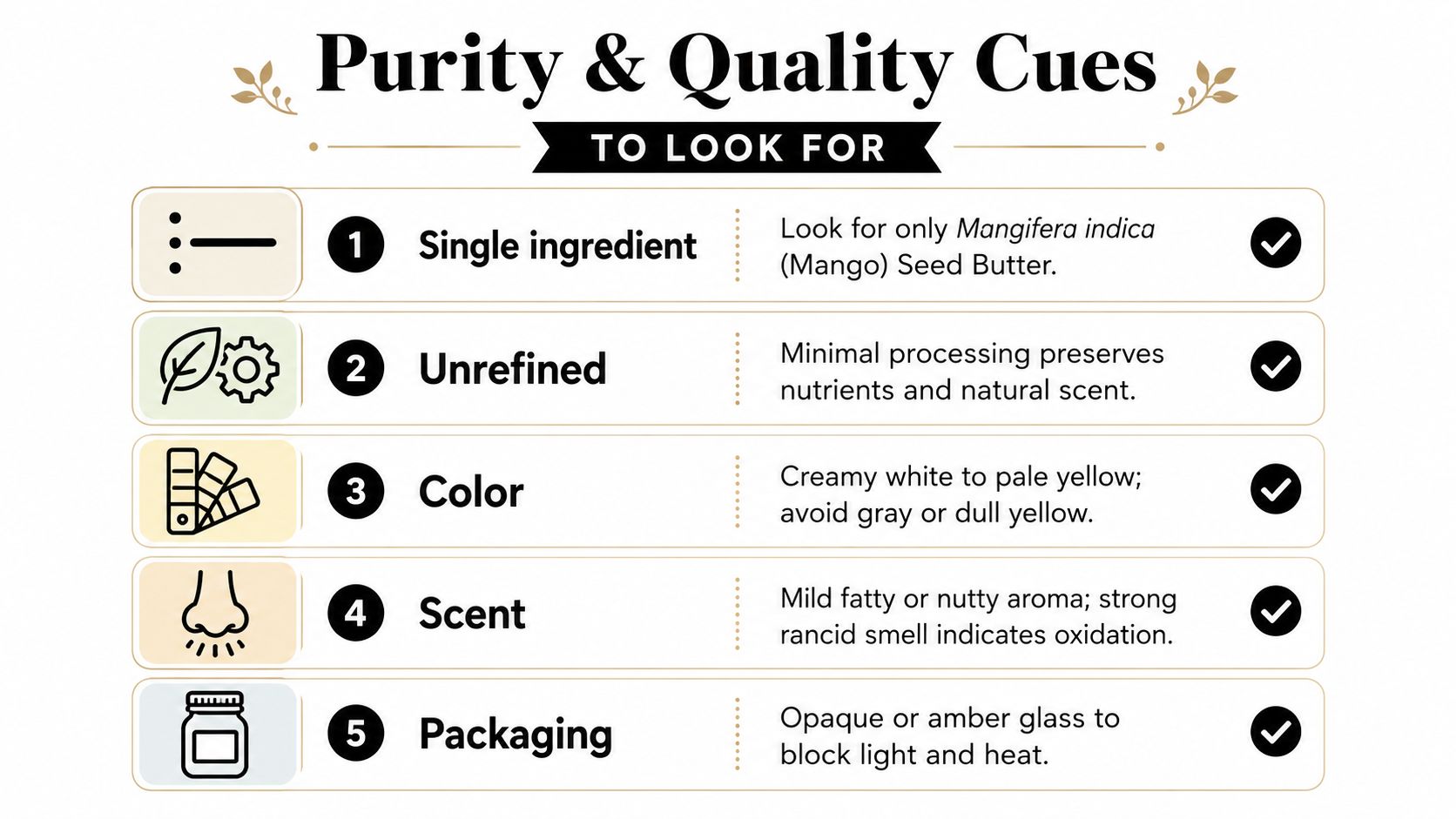
Start with the ingredient panel, not the front label. The simplest product should identify Mangifera indica seed butter as the sole ingredient. If the product contains fragrance, colorants, or several oils, it may still be useful, but you won't be evaluating raw mango butter alone.
An unrefined butter is commonly ivory to pale yellow rather than stark, bleached white. Color isn't a perfect purity test because processing changes appearance, but an unusually bright color should prompt you to check whether the product has been refined or deodorized.
Sensory checks at home
- Scent: Expect a mild fatty, nutty, or leafy aroma. A sharp, sour, paint-like, or strongly chemical odor can indicate oxidation, contamination, or heavy processing.
- Texture: Fresh butter should soften with body heat. Persistent grit, a plastic-like waxiness, or a stale feel deserves caution.
- Label language: “Raw” isn't a regulated cosmetic-processing term, so check what the seller means by it. Look for details about pressing, refining, deodorizing, and batch handling.
- Traceability: A sealed container, batch or lot number, best-by date, and storage directions show better quality control than a vague “natural” claim.
- Packaging: Opaque or amber packaging can reduce exposure to light, while a tight closure helps limit air and moisture.
Cold pressing can help preserve the material's native fatty-acid profile and characteristic color, but it doesn't automatically establish organic certification. If organic sourcing matters to you, look for a credible certification rather than assuming the extraction method proves it.
Buy a container you can finish while it's still fresh. Repeated exposure to warm air, sunlight, wet fingers, and bathroom humidity can shorten the useful life of an otherwise good butter.
Sustainability and Sourcing Considerations
Mango butter has a different sustainability profile from an oil produced solely for cosmetic extraction. It commonly comes from the seed kernel recovered during mango processing, including juice, pulp, and dried-fruit operations. That recovery can turn a processing residue into a useful fat without requiring a separate mango crop for butter production.
The supply chain still needs scrutiny. Orchards, processors, kernel-drying facilities, and pressing operations all influence environmental and social outcomes. Ask brands where the kernels come from, how they verify traceability, and whether they publish information about farmer relationships or cooperative sourcing.
A byproduct story is valuable, but it isn't a complete sustainability audit.
Look for sourcing details that address more than the word “upcycled.” Questions about land use, labor standards, fair-trade practices, and processing energy can reveal whether a brand understands its supply chain. Packaging matters too. Glass and aluminum can be useful choices when the product needs protection from light, although the best option depends on transport, reuse, and local recycling systems.
The ingredient's market growth also reflects wider commercial interest. Industry reporting places Asia Pacific at 63.3% of global mango seed kernel butter revenue in 2025, valued at about $0.19 billion, with Europe at 18.4% and North America at 10.2%. Those figures describe market concentration, not proof that every supplier follows responsible practices.
A minimalist ritual can keep consumption practical. Use a small amount on damp hands, dry heels, or hair ends once a week, then assess whether you need more. Buying only what you can use helps the byproduct story remain connected to low-waste behavior at home.
Raw Mango Butter Questions Worth Answering
Can oily or acne-prone skin use it?
Possibly, but use a thin layer and test it first. The dermatology summary cited earlier places mango butter around 2 on the comedogenic scale, which suggests low-to-moderate pore-clogging potential, not guaranteed compatibility. Apply it sparingly over damp skin, avoid starting with a heavy facial blend, and stop if congestion or irritation develops.
How can I use it before shampooing?
Melt a small amount between your palms and work it through the mid-lengths and ends. Leave it on as a pre-shampoo treatment, then wash thoroughly. Because mango butter melts near skin temperature, a little can spread across several strands, but using too much may make fine hair look coated.
What dilution works for DIY facial and body products?
For facial blends, a cautious starting range is 5 to 15% mango butter with a suitable liquid oil. Body butters can begin at up to 30%, depending on the firmness and finish you want. These are formulation starting points, not guarantees for every skin type. Don't add water to an oil-only blend unless you're using an appropriate preservative system and have the knowledge to formulate it safely.
How long does raw mango butter last?
A commonly cited working range is 12 to 24 months, but the actual life depends on freshness at purchase, packaging, heat, light, and contamination. Keep it sealed in a cool, dark place, preferably in protective glass or another suitable container. Discard it if the scent becomes sharp or rancid, the texture changes dramatically, or visible contamination appears.
Choose raw mango butter for what it can reliably contribute, softness, glide, structure, and hair conditioning, rather than for unsupported treatment promises. Explore the single-ingredient, traceable oils and practical clean-beauty guidance at Ella & Eden, then build a small routine around the textures your skin and hair enjoy.